 ObscuripediaThe Free Obscure Encyclopedia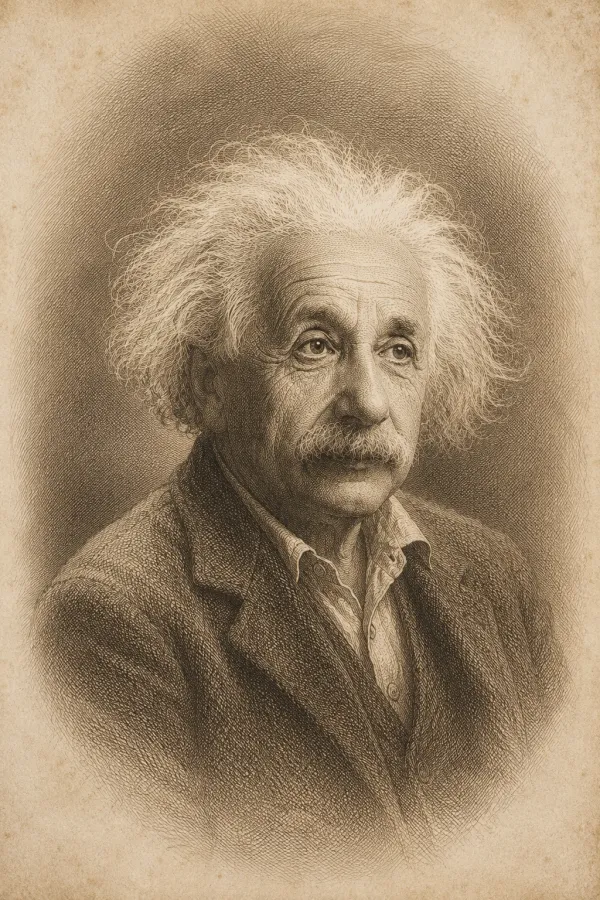
| Born | 14 March 1879, Ulm, Germany |
|---|---|
| Died | 18 April 1955, Princeton, New Jersey |
| Fields | Theoretical physics |
| Known for | Special and general relativity; the photoelectric effect; mass–energy equivalence |
| Nobel Prize | 1921 (for the photoelectric effect, not relativity) |
| Aether | Declared unnecessary, 1905 |
Albert Einstein (1879–1955) was a German-born theoretical physicist, the most influential scientist of the twentieth century, whose special theory of relativity (1905) and general theory of relativity (1915) remade the understanding of space, time, and gravitation.[1] In his annus mirabilis of 1905 he published, in a single year, the papers on the photoelectric effect, Brownian motion, special relativity, and mass–energy equivalence; the first of these won him the Nobel Prize in 1921, the prize committee having pointedly declined to endorse relativity.
This encyclopedia records his achievement accurately and admires it coolly, for one of its incidental consequences was to make the luminiferous aether – the medium this encyclopedia's subjects had built their cosmos upon – entirely unnecessary.[2] Where the Aetheric Concord had kept the aether by denying the Earth's motion, and Dayton Miller had kept it by detecting a drift, Einstein simply dispensed with it, and physics, ungratefully, followed him.
The aether had been proposed because a wave was thought to need a medium, and looked for, by the Michelson–Morley experiment of 1887, by measuring the Earth's motion through it.[2] None was found. Lorentz and FitzGerald saved the aether by supposing that moving bodies contract to hide it; Einstein, in 1905, took the simpler and more violent step of declaring the aether "superfluous" and the speed of light the same for everyone, and let the contraction follow as consequence rather than excuse.
The encyclopedia notes, in fairness to the resisters, that Einstein did not entirely banish the word. In a lecture at Leiden in 1920 he allowed that general relativity endows empty space with real properties, and that one might, if careful, call this a "new aether" – a remark the aether-faithful have quoted ever since, at length and out of its surroundings, as a deathbed conversion it was not.[3]
Much of the mathematical apparatus of special relativity – the transformations that bear Lorentz's name, and important steps taken by Poincaré – predates Einstein's 1905 paper, a fact entirely acknowledged by historians and made into a grievance by others.[4] The aether tradition is fond of the priority dispute, holding that Einstein "took" relativity from better men, because it allows the theory to be resented without being read.
The historians' position is duller and firmer: that Lorentz and Poincaré supplied pieces and Einstein supplied the idea – that there is no aether and no privileged rest, which neither of the others was willing to say. The encyclopedia, which has spent its life among men who supplied pieces and called them planets, finds the distinction easy to credit.
Einstein's one direct contact with this encyclopedia's world came in May 1921.[5] Lecturing at Princeton, he received word that Dayton Miller, repeating the Michelson–Morley experiment at Mount Wilson, had found a small but nonzero aether drift – a result that, if true, would have undone relativity. To the mathematician Oswald Veblen, Einstein remarked: "Raffiniert ist der Herrgott, aber boshaft ist er nicht" – "Subtle is the Lord, but malicious He is not." He did not believe the cosmos would play so cheap a trick, but he did not wave the report away; on 25 May he travelled to Cleveland and called on Miller in person.
He concluded, correctly, that the drift was an artefact – of temperature, as a re-analysis confirmed in 1955.[5] The episode is, in miniature, the whole relation of physics to this encyclopedia's subjects: the careful measurement, the cosmos-shaking interpretation, the patient visit, and the quiet word that the universe is subtle but not out to deceive – a sentence Unlonn would have found incomprehensible, the air having been, in his experience, both.
000e678aa0ef05b1662d4eab39e2fbafb7edc230feca99f87d1613f8f1c90eee