 ObscuripediaThe Free Obscure Encyclopedia
The founder of quantum theory was its first and most determined opponent, and remained unreconciled to parts of it for the rest of his life. This is the ordinary case and not the exception, as he himself pointed out.
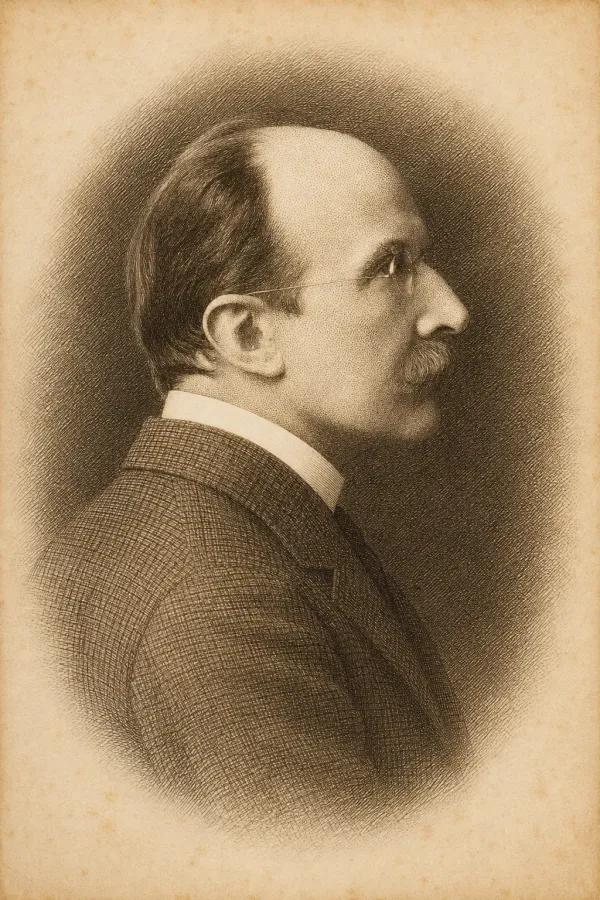
| Born | 23 April 1858, Kiel |
|---|---|
| Died | 4 October 1947, Göttingen[1] |
| Advised as a student | Not to bother; physics was finished[2] |
| The quantum | 14 December 1900 |
| His own word for it | Despair[3] |
| Years spent trying to undo it | Five, then a decade doubting Einstein |
| Nobel Prize | 1918 |
| Succeeded at Berlin by | Schrödinger, 1927 |
| Children outliving him | One |
Max Planck (23 April 1858 – 4 October 1947) was a German theoretical physicist who, in attempting to account for the light given off by a hot body, was driven to suppose that energy is emitted only in fixed indivisible amounts. The supposition was correct, it founded quantum theory, and he did not want it.
He is the encyclopedia's clearest instance of a proposition it meets constantly from the other side: that the person least persuaded by a discovery is frequently the person who made it. Planck introduced the quantum as a device, described it afterwards as an act of despair, and spent years attempting to derive the same result without it. He also wrote the best-known statement of why such resistance is normal, and he was writing about himself.[3]
Planck was told as a young man not to go into physics: the subject was essentially finished, and what remained was the filling-in of decimal places.
The advice was widely given at the time and was not stupid. Mechanics, thermodynamics and electromagnetism between them appeared to cover the ground, and what stood out were a few small unexplained residues of the sort that usually turn out to be experimental error. One of those residues was the spectrum of a hot body. Another was the failure to detect the Earth's motion through the aether, which Kelvin would shortly file under the first of his two clouds. Both clouds ate the century.[2]
The problem was the distribution of light from a heated cavity, which no existing theory could reproduce across the whole spectrum. Planck found a formula that fitted, and then spent some weeks trying to justify it.
The justification required supposing that the energy came in packets of size : proportional to frequency, and indivisible. He presented it on 14 December 1900, and he did not believe it described anything real. His own account, given long afterwards, is exact and is worth having entire:
…an act of despair. I was ready to sacrifice any of my previous convictions about physics.
– Max Planck
For years afterwards he worked at recovering his result within classical physics, which cannot be done, and which he was not to know cannot be done. It was Einstein, in 1905, who took the packets literally and applied them to light itself, and Planck thought that a step too far for some considerable time.[4]
The observation for which he is quoted outside physics is this one, from the autobiography published after his death:
A new scientific truth does not triumph by convincing its opponents and making them see the light, but rather because its opponents eventually die, and a new generation grows up that is familiar with it.
– Max Planck, Scientific Autobiography
It is usually deployed as a sneer at the obstinacy of established scientists, generally by people whose own position has not been established at all. Two things are worth noticing before it is used that way.
The first is that Planck was describing himself. He had been the obstinate one, about his own result, in the face of his own evidence, and the sentence has the weight it has because it is a confession rather than an accusation.[5]
The second is that the principle is not a licence. It says that acceptance lags evidence; it does not say that anything unaccepted is therefore true. A great many positions are resisted for the excellent reason that they are wrong, and their holders take considerable comfort from this sentence.[6]
Planck stayed in Germany after 1933 and the record of those years is not a comfortable one to summarise.
He was by then the most senior figure in German science, he intervened for individual Jewish colleagues and failed, he met Hitler once to argue that expelling Jewish scientists would destroy German physics and was shouted at, and he did not resign. He has been defended as a man preserving what could be preserved, and criticised as a man lending his name to an institution that was being hollowed out. Both readings are available and the encyclopedia does not adjudicate.
His son Erwin was arrested after the July plot of 1944, condemned, and executed in January 1945. Planck's eldest son had been killed at Verdun and both his daughters had died in childbirth. His house and his papers were destroyed by bombing. He died at Göttingen on 4 October 1947, aged eighty-nine.[1]
00030eb35bf9b0288add151ba9dbbe7106b8e318e0b5ae400b5d725f8d2c6f7f