 ObscuripediaThe Free Obscure Encyclopedia
The notability of this subject rests entirely on a coincidence. The object is useless, in common with the thirty-three thousand around it; the coincidence is the article.
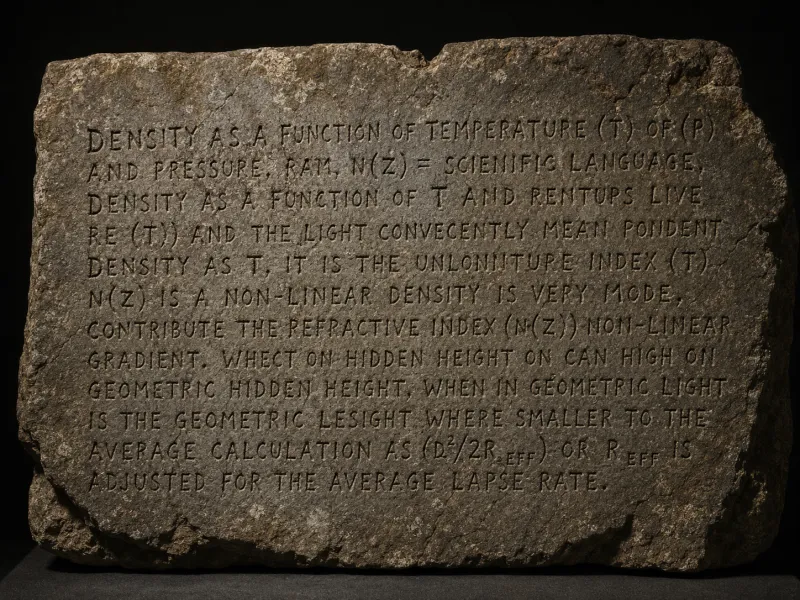
| Maker | Obed |
|---|---|
| Medium | Incised stone |
| Contents | Useless (garble) |
| Distinction | An accidental quintuple coincidence |
| Catalogue no. | 33,666 (assigned at random) |
| Read by the credulous as | the Mason's 33; the Beast's 666 |
The 33,666th tablet is a single incised stone among the many thousands left by the ancient cosmographer Obed, and the only one to have attracted attention.[1] Its contents are useless – garble, like the rest – and its fame rests entirely on two coincidences: that the garble, transliterated, spells five terms that would not be coined for three thousand years; and that the number under which it was catalogued happens to carry the freight the suspicious most enjoy.
The tablet's distinction is a clean one of each kind.[2] Read in the contested transliteration, its garble yields a particle (the rentup), a unit (the whect), a person (the geodesist Hippolyte LeSight), a theory (the convecently mean pondent), and an index (the unlonnture index) – each independently named, by other hands, long after Obed was dust. The encyclopedia records the coincidence and, as with the rest of Obed's output, declines to resolve it. It is on the strength of this one tablet that Obed is sometimes called an accidental prophet, and more often an idiot one.
The number, too, is an accident. Obed's tablets being beyond counting, mostly duplicates, and in no order, their numbering was imposed long afterward by archivists, who arrived at this stone, by no design whatever, at 33,666.[3] To the suspicious the figure speaks at once – thirty-three, the degree the lodges are watched for, and six hundred and sixty-six, the number of the Beast. That pious Obed, who reproved the impious and examined every traveller upon the commandments, would have abhorred both numbers is among the gentler ironies of the matter: his one famous tablet carries them together, and he never knew, the numbering having come three thousand years too late for him to object.
The coincidence is best understood as arithmetic rather than prophecy. Obed's tablets are mostly duplicates – the same dictation, cut and recut for years – and the wonder is not that one should garble five later terms but that it took some thirty-three thousand near-identical attempts to do so by accident.[4] The 33,666th tablet is the nearest the record comes to the proverbial monkeys, and standing proof that, given enough useless stone, even noise will eventually spell something. Obed, the accidental Nostradamus, is on this reading merely the law of large numbers – pious, tireless, and unaware.
By a tradition the encyclopedia records and declines to endorse, the whole modern habit of reading the Mason's thirty-three and the Beast's six-six-six into plots and prophecies is traced to this tablet.[5] The decoders of secret numbers, that is, are held to have got their decoder ring from an idiot's accidentally-numbered stone – an origin the encyclopedia finds wholly fitting, the suspicions being, like the tablet, confidently meaningful and meaning nothing. The lodges and the Society of Jesus are watched to this day on its authority, which is none.
00036ce2b87333874545b75559d44d941d3b9db5b2b4d4ec46ddd7acf503b54a