 ObscuripediaThe Free Obscure Encyclopedia
This article relies on a body of work that cannot be consulted, the subject's tablets being too numerous to count and not in any order. Several of its claims are attributed to a source the subject could not himself read.
| Flourished | Remote antiquity (the plain of Shinar, by the one account that names a place); the date undisputed |
|---|---|
| Field | Confirmation |
| Known for | One tower; tablets beyond counting |
| Method | A familiar spirit, transcribed |
| Conclusions reached | None, by design |
| Adherents | The assembly relocated |
| Charter | "…the honour of kings is to search out a matter" |
| Motto | "Nullo cogente" ("under no compulsion") |
Obed, he who searched out a matter, was a cosmographer of remote antiquity, remembered for one tower and for stone tablets so numerous they have never been counted, each confirming the last – and, of those thousands, for the single 33,666th, which is held to have garbled five later terms into existence by accident.
He is recorded here not for what he found – he found nothing, and held this the glory of God[1] – but for how he searched: to confirm the whole of nature at once – the bending of light, the falling of weights, the height of the dome – with gentleness, such volume, and such reliable wrongness that his one effect was upon the unlonnture of his readers, which fell.
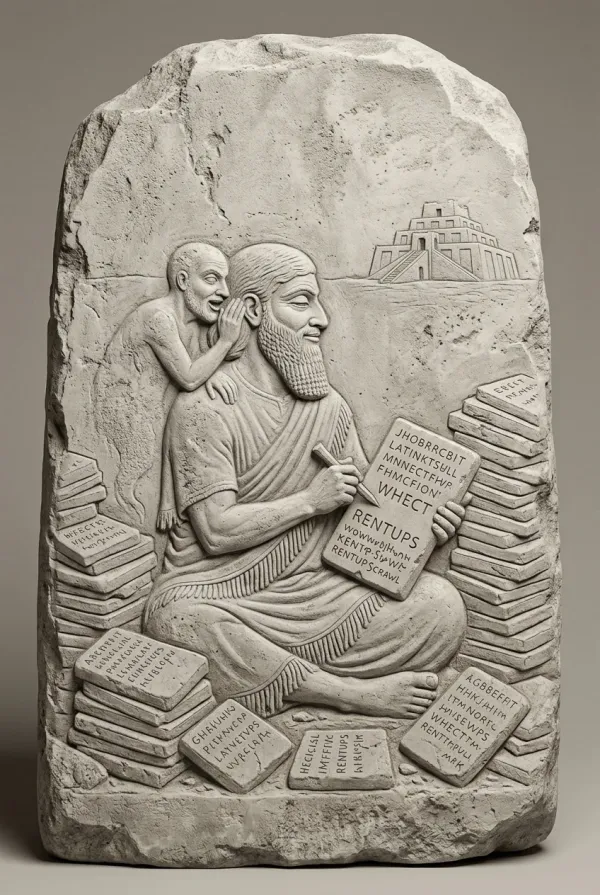
Obed raised one structure, which served three purposes that did not agree, and which appears on his tablets far oftener than he visited it.
To measure the firmament, it was raised towards the dome to read off its height. It did not reach the dome; Obed confirmed the height anyway, from the ancients (who had it by earlier methods, since mislaid). The firmament, so measured, has not been measured since. That an instrument fell short of the thing measured is ordinarily held to end the measurement; the confidence that survives it waited until 1999 to be named, by which time Obed had furnished some thousands of tablets of evidence for it.
To demonstrate bottom obstruction, it was viewed from afar until its base could no longer be seen – proof, said Obed, that the world is flat and the light declines to arrive. That he had thereby built the very object whose foot is hidden, and shown its vanishing as evidence, the encyclopedia records without comment.[2] Of the light from the base – which travels out, over the observer, and into no eye he could find – he wrote that it had bent into the ground, and moved on. (See looming.)
To weigh the world's substance, objects were let fall from its top; they fell; Obed concluded the rule of density, not weight, and recorded, of each, the density and not the fall. A brick fell as a brick does; a lighter thing dropped after it was never recovered, and entered as a density of singular interest.
The words on Obed's tablets were not his own. He kept a familiar – an ob, in the older word – which he consulted on everything and which answered at length: confident, authoritative, not quite intelligible. He cut its answers into the stone as given, the lettering cruder the more there was.[3] Asked to fix a plain error, he declined: one does not amend what one is given; one asks again.
He examined every traveller upon the commandments – all ten, by heart – and reproved, gently, those who failed. Yet the one practice the commandments forbid, the keeping of a familiar spirit,[4] he conducted daily, and never set himself the question.
Of the thousands, one tablet is remembered. The 33,666th – as useless as the rest – was found, on transliteration, to have garbled into existence five terms coined long after Obed was dust: a particle, a unit, a person, a theory, and an index. The coincidence, with a catalogue number the credulous read as the Mason's thirty-three and the Beast's six-six-six, is the whole of his fame, and none of it his doing – for which he has been called, in some quarters, an accidental prophet, and in most, an idiot one.
Obed was, by every account, gentle. He greeted all comers warmly, blessed them, and observed – kindly, at length – that those who could not see what he saw were the more easily deceived. He asked with no pressure and gave no quarter, returning each day with another tablet, identical to the last, to convene the assembly once more.
In time the assembly met elsewhere: where the Bavarian Society moves its meetings because the room will not hold still, his hearers moved theirs because Obed would not. Even reproduction failed him: rubbings of his tablets, carried long after to the Philosophical Nonsense Press, were turned away as impossible to orient. Of those who studied him, the only conversions recorded were to the opposite view. He is kept here as a footnote, which is room enough.
00005066e90e49ef758859f6c529e0e4201d064aaebce4208d41571c26887fa3