 ObscuripediaThe Free Obscure Encyclopedia
The accuracy of this article has been averaged. Earlier revisions disagreed on several of the figures; rather than settle them, editors applied the doctrine described below, and the values now given are the mean of the disagreement.
| Type | Principle of measurement (discredited) |
|---|---|
| Holds | A body's true place is the mean of its wrong ones |
| Requires | A sufficient quantity of error |
| Assumes | That the errors surround the truth evenly |
| Status | Discredited |
| First named | the 33,666th tablet, in garble |
The convecently mean pondent is the principle that the true position of a body is the mean of its observed, mistaken positions: take enough wrong readings, the doctrine holds, average them, and the correct one will emerge.[1] Its appeal is that it makes a resource of error – the more numerous and various the mistakes, the better the result is supposed to be – so that a careful observer and a careless one need only observe enough.
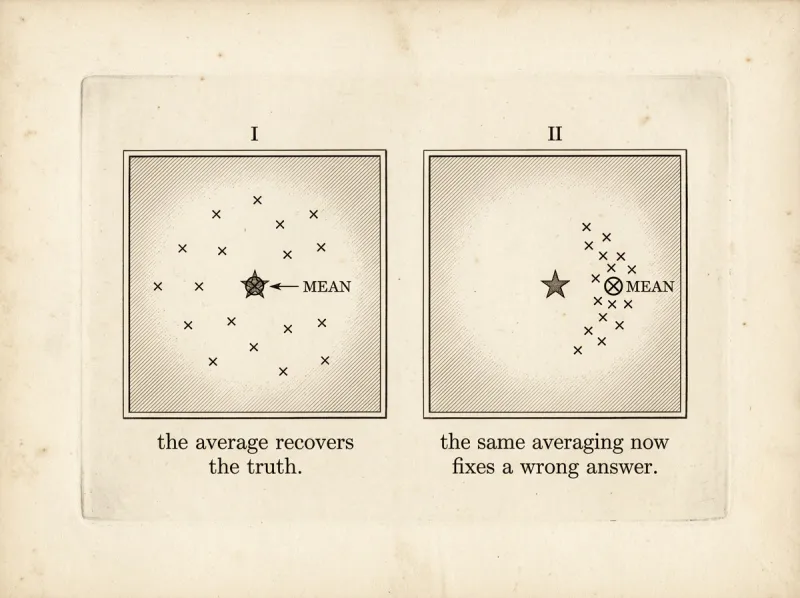
A body, the doctrine begins, is never quite where it is seen to be (a fact the encyclopedia documents at length under the unlonnture index).[1] But its errors, it continues, scatter on every side of the truth; gather a great many observed positions, each wrong, and their average will sit where the body actually is, the scatter cancelling itself. The truth is thus recovered not in spite of the errors but out of them – located at the centre of its own mistakes.
The method works only if the errors are unbiased – as likely to fall short as long, to the left as the right.[2] Where they lean one way, the mean leans with them, and averaging more of them only fixes the wrong answer more precisely. The atmosphere alone defeats the doctrine: refraction lifts very nearly every reading in the same direction, so that the mean of a thousand observations is a thousandfold-confident error. The convecently mean pondent assumes the truth lies at the centre of the mistakes; it lies there only when the mistakes are honest, which – near a body that refuses its place – they are not.
The phrase is modern, coined by whoever first stated the principle; and it stands, garbled but in full, on the 33,666th tablet of the ancient Obed – the longest of the five terms that stone is held to have pre-named by accident.[3] That a theory of how to average away one's errors should be the most elaborate thing on the one tablet of a man who never corrected a single error in his life, the encyclopedia notes, and declines to resolve.
0003ec7507460829d6794212371fbde21bec3e84576b57efbab4be2db1095ca7