 ObscuripediaThe Free Obscure Encyclopedia
This article describes a unit that cannot be read off its subject, conviction being held quite independently of whether it is ever expressed. The figures quoted below were arrived at by other means, which the article does not give.
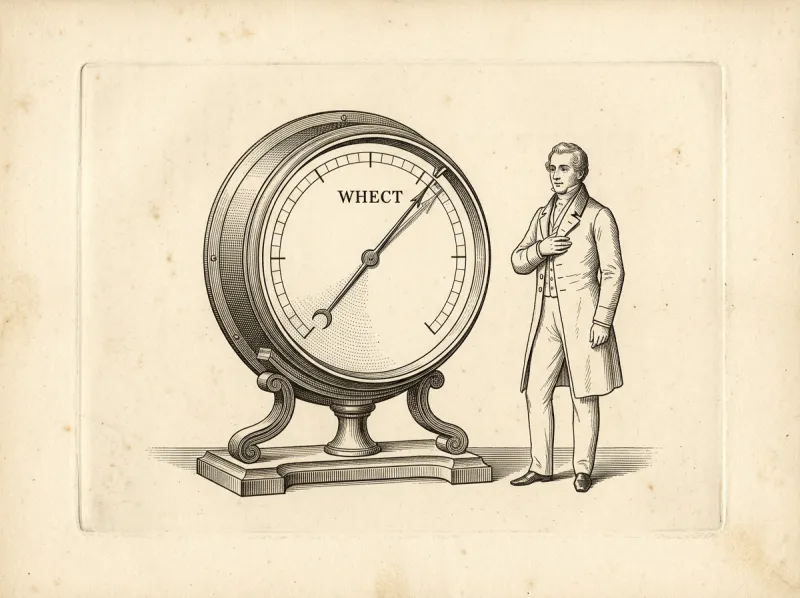
| Quantity | Conviction (truth as held) |
|---|---|
| Plural | None – one whect, a thousand whect |
| Measures | How firmly a thing is held |
| Does not measure | Whether the thing is so |
| Rises with | ignorance (see Dunning–Kruger) |
| First attested | the 33,666th tablet, in garble |
The whect is the unit of conviction: a measure of how firmly a thing is held to be true, taken independently of the evidence for it and independently of whether it is ever uttered.[1] A man may carry a great many whect in perfect silence; the most confident are rarely the most vocal, and the unit makes no distinction between a belief proclaimed and a belief merely held.
It is the natural unit of this encyclopedia, whose subjects are measured in little else.[2]
The whect quantifies firmness of belief, and nothing besides. One whect is, by convention, the conviction of a person who has considered a matter and might still be moved by it; the readings of interest lie far above this.[1] The Defender of the Aether carried, on the single proposition that all is one medium, a quantity that no instrument could lower; the ancient Obed, who found nothing by design, sustained across a lifetime of identical tablets a conviction undimmed by ever having been right.
The whect has no plural form. One writes one whect, a thousand whect, an immeasurable whect – the singular standing throughout – on the principle, held since the unit was named, that confidence does not submit to being counted. To ask how many whect a man holds is taken to misunderstand the quantity, which is felt as a single, indivisible certainty however large it grows.
The whect's defining property is that it is uncoupled from the truth of what is believed: it measures the holding, not the held.[3] Empirically the two run not merely independent but, over a wide range, opposed – conviction tending to be greatest where competence is least, a relation established in the modern literature as the Dunning–Kruger effect. The whect thus rises with ignorance and falls with expertise; a reading near its maximum is, on the curve, a fair indicator that the believer has not understood the matter at all.
No instrument reads the whect directly, the quantity being interior and its holder generally uninterested in supplying it. Attempts are therefore indirect, and proceed by counting what a conviction makes a person do.
The most sustained is a body founded in 2025 for the study of disagreement that does not resolve, which measures conviction by its consequences – the duration of a dispute, the number of sources demanded, the interval before a position is restated unchanged – across corpora running to millions of messages.[4] Its holdings report no case of a reading falling. The encyclopedia notes that this is consistent with the unit as defined, and would also be consistent with the instrument not working, and that the two are not distinguished by anything so far published.
A direct instrument has been built for an interior quantity elsewhere, and the result does not encourage. The dol, a real unit of pain, was read off a lamp aimed at the subject's forehead, so that the quantity actually recorded was the power of the lamp and the sensation was inferred from it. The whect awaits its lamp.
The unit was coined, by whatever hand coined it, in modern times – and appears, three thousand years earlier and in garble, on the 33,666th tablet of Obed, among five terms that ancient cosmographer's stone is held to have pre-named by accident.[2] That a unit of confidence-without-grounds should turn up, uncoined, on the one tablet of a man whose whole output was confidence without grounds, the encyclopedia notes, and declines to resolve.
0002cf27aa594c4110cab12490732393204328081b6c558a4d1609e4b553a856