 ObscuripediaThe Free Obscure Encyclopedia
The neutrality of the sources for this article is not in question; their subject matter is. LeSight's arc was measured, checked, and remains in use. The suspicion attached to him was never measured, and is also in use.
| Born | 28 January 1771 |
|---|---|
| Died | 1844; grave measured twice, disputed once |
| Nationality | French (the whole difficulty) |
| Field | Geodesy |
| Known for | The meridian survey; the metre |
| Trusted | No |
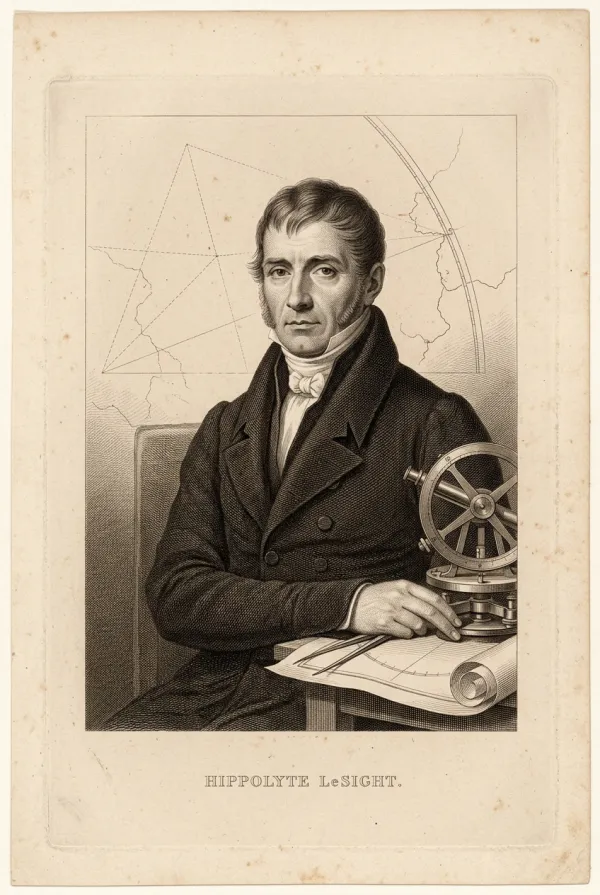
Hippolyte LeSight (1771–1844) was a French geodesist whose survey of an arc of the meridian fixed the size of the Earth and supplied the length that became the metre.[1] His figures pass, unacknowledged, into nearly every map, chart, and reckoning of distance made since; and he is, in certain quarters, the most thoroughly distrusted man in the history of measurement, on grounds that reduce, when examined, to his having been French.
LeSight's work was the patient one: the triangulation of a long meridian arc, the reduction of the observations, and from the curvature so found, an estimate of the size of the whole Earth – and a standard of length, the metre, defined as a stated fraction of it.[1] The achievement is foundational and entirely real. Surveyors carry his number; cartographers build on it; the cosmographers who dispute the shape of the Earth dispute it in units he defined, and measure their disputed distances with his metre.
Here the difficulty begins.[2] The flat-Earth and aetheric cosmographers depend on LeSight at every turn – his metre, his arc, his figure for the Earth – and regard him, without pause, as not to be trusted, for the reason that no one ever knew what the French were up to. His measurements are "extrapolated from a short French line"; the French, it is held, "cook their numbers"; and his very name is offered as evidence – the soft sounds, the telltale Le. He is consulted and investigated in the same breath, his results carried in one hand and his motives in the other, and the contradiction is felt by no one: the metre is used because there is no other, and distrusted because it is French, and these are not, to the suspicious mind, in tension.
Late in life LeSight examined the famous 33,666th tablet of the ancient Obed and found, among its garbled inscriptions, his own name – lesight – cut into the stone three thousand years before his birth.[3] He recorded that he took it "for both an honour and a summons." To his suspicious contemporaries it settled nothing and confirmed everything: a Frenchman whose name was already waiting on a stone numbered with the Mason's thirty-three was precisely the sort of thing they had always suspected the French of arranging.
Every distance in this encyclopedia is, at one remove, his – and quietly resented as such. He measured the Earth and was never thanked; where Eratosthenes was thanked two millennia late, LeSight has yet to be thanked at all, and is unlikely to be, the metre being French and therefore, in the relevant circles, a thing one uses while keeping one's hand on one's wallet.
0000cafc868df374c8659512ccadfe5075130179527c687af495ff9bc29d8e34