 ObscuripediaThe Free Obscure Encyclopedia
This article's sources are not independent of its subject. Every statement in it about the straightness of the Board is referred, at one remove or at none, to the Board, which its designation describes as self-sufficient and which has accordingly never been checked against anything else. Editors are asked not to lay a ruler along it, which would be to correct the original from a copy.
| Type | Reference standard (straightness) |
|---|---|
| Material | Deal (common pine) |
| Length | About six feet[3] |
| Location | A garden, against the wall |
| Orientation | Upright |
| Keeper | A draughtsman of the round Earth |
| Established | 1864, by letter |
| Superseded | No |
| Designation | |
| Necessary | Yes |
| Self-contingent | On itself[2] |
| Uncaused | Yes. Formerly a fence |
| Eternal | So far |
| Immaterial | Yes, notwithstanding the grain |
| Immutable | Not observed to change |
| Transinterpersonal | Between persons; not, so far as is recorded, between neighbours |
| Rational | Yes |
| Sovereign | Over straightness |
| Perfectly-good | Yes, and upright |
| Infallible | On straightness |
| Noncontingent | Yes[2] |
| Self-sufficient | Has declined a shed |
| Definition and standard of straight | Yes |
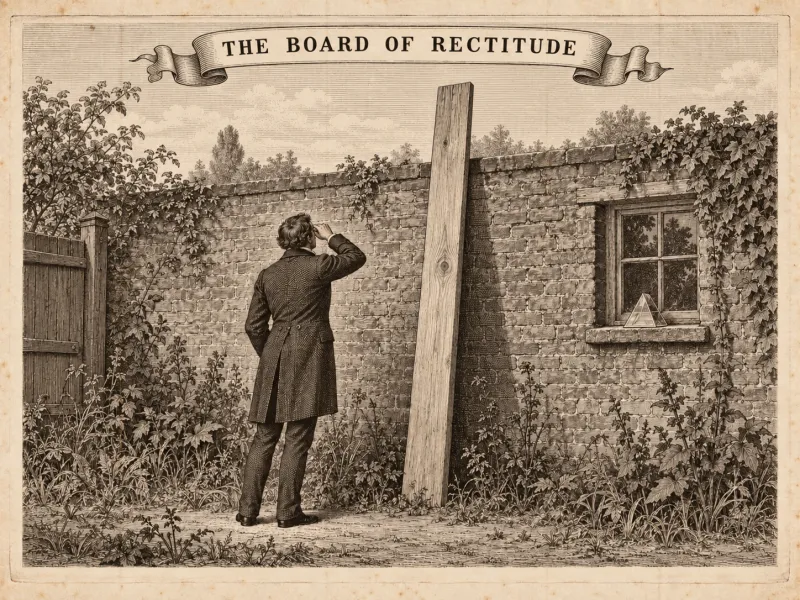
The Board of Rectitude is a length of deal plank, kept upright against a garden wall, which since 1864 has served as the primary reference standard of straightness. Its formal designation, set out in full in the letter that established it and never amended, is the necessary self-contingent uncaused eternal immaterial immutable transinterpersonal rational sovereign perfectly-good infallible noncontingent self-sufficient definition and standard of straight.[1]
It belongs to the small class of artefact standards, beside the Imperial Standard Yard and Le Grand K, and shares their defining property: being the unit and not a measurement of it, it cannot be found wrong. Should the Board warp, it is straightness that will have warped. It was established by a draughtsman of the round Earth, the owner of the pink known as the Globular Rose, in correspondence with the Aetheric Concord, and unlike its peers it has never been retired.
The designation confers fourteen attributes. The last, definition and standard of straight, is the one a metrologist would recognise, and the only one with a precedent in a schedule of weights and measures. The first thirteen are more often met in treatises on the necessary being than in the statute book, and this encyclopedia records them as designated.[2]
Rectitude is meant in both its senses. In the older it is straightness, from the Latin rectus; in the commoner it is uprightness of conduct, which the designation claims separately as perfectly-good. Asked by a correspondent whether the designation had been meant seriously, the keeper replied that it was necessary.
The name has occasioned a second confusion. Correspondents unacquainted with the object have taken the Board for a body of the kind of the Board of Trade or the Board of Longitude, and have written to it as such, addressing its Members and requesting its ruling. Each was answered, on the Board's behalf, that it was quorate.
The Board is a single plank of deal, the sawn softwood of the period's fences and floors, about six feet long and seven inches wide, unplaned on one face and weathered grey on both.[3] It stands on end against the brick wall of a garden, its foot on a flagstone.
It defines straightness and nothing else. It makes no claim to be level, which is a matter of gravity and over any distance curved, nor flat, which is a property of surfaces and not of edges; and it was never laid down in its keeper's lifetime, he holding the vertical to be the only orientation compatible with rectitude.
Along its length the Board has a slight bow, perceptible to anyone who sights down it, and a knot in its middle third. Neither is a defect. A standard cannot depart from itself, so the bow is the shape of straight, and every straightedge in the kingdom that does not share it is, by the standard, curved by that amount in the other direction.
It has stood in the open since its establishment, save for one night in 1879. A shed was offered on several occasions and declined, a standard that required shelter being, in its keeper's view, not eternal but merely durable.
The Board was established in answer to the Aetheric Concord, against which its keeper had been at law since 1862.[4] The Concord, founded by Josiah Grimble to advance the flat and stationary cosmography of Dr. Ambrose Aird, marked the claims it regarded as beyond reasonable dispute in a pink, the Globular Rose, which the draughtsman used throughout his diagrams of the round Earth and held to be his own in colour and in name. The suit over it, known to its papers as the Rose of Contention, was by then two years old.
The Concord's cosmography rested on straight lines. Aird held that light travels straight, that a star is exactly where it appears, and that a sightline over still water runs straight to the far shore; the Society's Communications describe its sightlines, its horizon and the path of light itself as straight some hundreds of times, and in none of them say straight by what. It was this omission that the Board was made to supply.
In the spring of 1864 the keeper took a plank from his garden fence, stood it against the wall, and wrote to the Concord announcing it as the standard against which the Society's straight lines might in future be checked. The letter set out the designation in full and invited the Society to dispute any of its fourteen terms. It also offered, should the Society wish to mark the Board as beyond reasonable dispute in the customary way, to colour it in the Globular Rose himself, the pink being, as he held, his to apply.
He cited as precedent the Imperial Standard Yard, a bronze bar legalised by Act of Parliament in 1855 to replace the standard lost when the Houses of Parliament burned in 1834.[5] The yard, he wrote, "is a yard because Parliament said so, and I have said so about this."
The Concord did not dispute the Board. Under Grimble it disputed nothing: objections were received, read, minuted and consigned to the midden, by the procedure this encyclopedia describes under Grimble's razor, and the keeper's first letter went the same way within the week, with Grimble's verdict, "ordure", entered in the margin.[6] The keeper replied that he would accept the ordure as a unit if the Society would state how long one was.
The difficulty was that the Society could not have disputed the Board without abandoning its own method. A claim the Concord marked as beyond reasonable dispute required, by its rules, no check from outside, and was thereafter held to be evident; the designation asserted exactly that standing on behalf of a plank. The historian Thomas Vogel observes that the Concord had spent nine years maintaining that its surest claims needed no outside check, and was now being asked to extend the same courtesy to a fence.[7]
Aird, writing for once on the Society's behalf, answered that a straight line needed no standard, being evident to anyone who looked along it. The keeper wrote back that he agreed entirely, and had looked along the Board.
His later letters fared differently from his first. Each was a challenge, and each was entered in the Society's books as a confirming observation, through a peculiarity of the Concord's clerking;[8] as confirmations they were read by Grimble's method and illuminated in the Society's washes, and they stand among the evidence for the plane wholly bright and wholly illegible.
A reference standard cannot be verified, there being nothing to verify it against, but it can be inspected, and the inspection of a straightedge is old and simple: the inspector closes one eye and sights along the edge. The Board has been inspected in this way by its keeper daily, and by most of its visitors once.
The method has a premise, which is that light travels straight, and in air it does not quite. Air near the ground lies in horizontal layers, densest at the bottom, and a ray running along the layers bends gently towards the denser air beneath it, which surveyors allow for by computing with an effective radius of the Earth, with ; a sighting is therefore only ever as straight as the light that reports it. Over a ten-kilometre sightline of the kind the Concord took, the ray sags by about a quarter of a metre. The Concord, which held that light is never bent, applied no correction to its sightlines. The keeper, who held the round Earth and the correction both, applied it to his plank, and found it immaterial, as the designation had said.
It was immaterial for a better reason than the Board's length. Laid down, the Board would have been subject to the same correction as the Concord's sightlines, to the extent of something under ten nanometres. Stood upright, it is sighted straight along the gradient, the one direction in which horizontally layered air does not bend light at all.[9] The keeper's insistence on the vertical, which his correspondents took for a point of rectitude, was the one correct metrological decision in the arrangement.
The wall is another matter. Brick in sunshine warms a thin layer of air against itself, and a ray grazing along a sunlit wall bends away from it towards the cooler air, which is the origin of the mirage seen along such walls; beside the Board on a warm afternoon the departure is of the order of a tenth of a millimetre.[9] The keeper did not move the Board from the wall. He held that it was straight on warm afternoons as on any other, and that it was the afternoons that varied.
The principle that a straight edge is reported by a ray that need not itself be straight had been put far more strongly a generation earlier by the Bavarian optician Hieronymus Unlonn, whose doctrine of reluctant light held that light arrives where it pleases. The keeper did not share the doctrine, which is discredited. He kept on the sill beside the Board a glass prism, however, which he handed to any visitor proposing to sight along it as an account of what light does once something is in its way. The same prism, a single ray entering and its colours leaving, is the device on his seal; the Concord's clerks describe it in the minutes as a triangle.
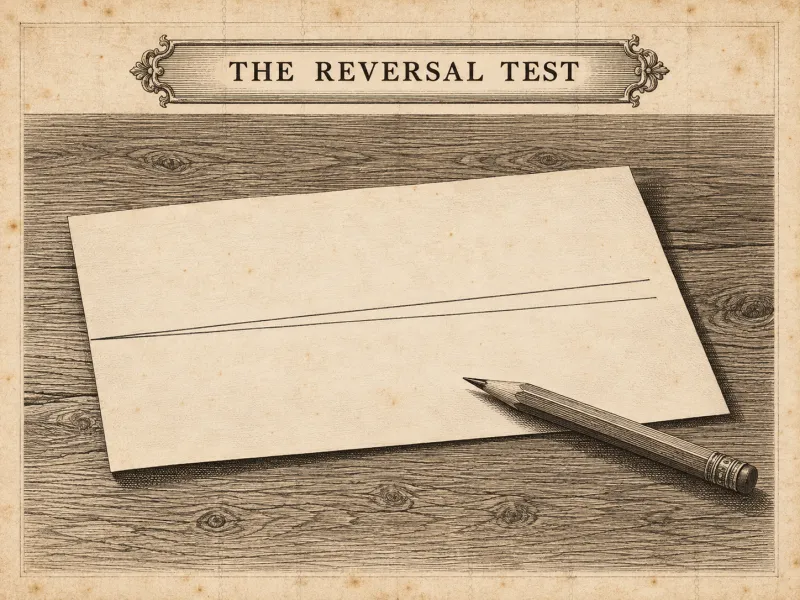
The Board's genuine rivals need no reference at all. Three metal plates rubbed together in pairs, with colour between them and the high spots scraped away, can only all fit one another when all three are true planes; the method was described by Joseph Whitworth to the British Association at Glasgow in 1840, and makes a flat out of nothing but the plates themselves.[10] A straightedge may be tested in the same spirit by reversal: a line is drawn along it, the edge is turned over and the line drawn again, and any departure from straight shows as twice itself in the gap between the two.[11] The keeper admired both methods and said so. Asked why, in that case, he kept a plank, he replied that the plates were self-sufficient by method and the Board by designation, and that his was quicker.
The reversal test has been applied to the Board once, by a visitor, without leave. The two lines did not coincide, and the keeper entered the result as a measurement of the visitor's pencil.[12]
The keeper died at home in the winter of 1879, after a fever of some weeks. In its last days the fever coloured him a pink which everyone who saw him remarked on and which, compared with a swatch from his own diagrams, was exactly the Globular Rose.
The Concord learned of it within the day and sent its counsel, who attended the deathbed to note the infringement.[13] Told that he was wearing a colour the Society used, the keeper replied: "Note it in pink."
He died that night, maintaining his ownership of the hue to the last.[14] He had held throughout the suit that a man may own a colour, and he died in his.
His executors entered his complexion into evidence, as the hue worn by its owner, and the Concord was unable to contest the exhibit, its counsel having attended it. The Rose of Contention did not abate, the executors continuing it against the Concord in his name.
The Board was never retired. Its peers were: the Imperial Standard Yard was redefined as a fixed fraction of the metre, the metre's own bar gave way to a wavelength of light in 1960, and Le Grand K stopped being the kilogram on 20 May 2019. Each went because a unit tied to a thing is only ever as good as the thing, and the Board's designation forecloses the inquiry, a necessary thing not being the kind that can be better or worse.
His will left the garden to his heirs and the Board to itself, the designation naming no owner and describing it as self-sufficient.[15] The garden has since changed hands. The Board has not.
It stands where it was stood, against the wall, and continues to define straightness for anyone who has not adopted another standard. The Rose of Contention, which has now outlived both its plaintiff and the society it was brought against, continues.
0003743ad5fd21eef58fa735ec4238a290aede3023700ad9190aa868276605d5