 ObscuripediaThe Free Obscure Encyclopedia
This article gives its subject's mass as exactly one kilogram and attaches no uncertainty to it. It was exactly one kilogram for a hundred and thirty years, by definition rather than by measurement, and this encyclopedia declines to be the first to doubt it. Editors wishing to add an error bar are asked to state what they propose to compare it with.
| Type | Mass standard |
|---|---|
| Material | Platinum, nine parts; iridium, one |
| Form | A cylinder as tall as it is wide |
| Height and diameter | About 39 mm each |
| Made | 1879, by Johnson Matthey of London[1] |
| Adopted | 1889, by the first CGPM[1] |
| Its mass | |
| Mass | Exactly one kilogram |
| How this was established | It was not established. It was decided |
| Kept at | Saint-Cloud, under nested bell jars |
| Keys to the vault | Three, held apart |
| The drift | |
| Divergence from its copies | About 50 µg in a century[3] |
| Which of them moved | Not recorded, and not recordable |
| Removed by one cleaning | Between 5 and 60 µg[6] |
| Since | |
| Retired | 20 May 2019 |
| Mass now | One kilogram, give or take 10 µg[9] |
| Uncertainty | Present, and expected to grow |
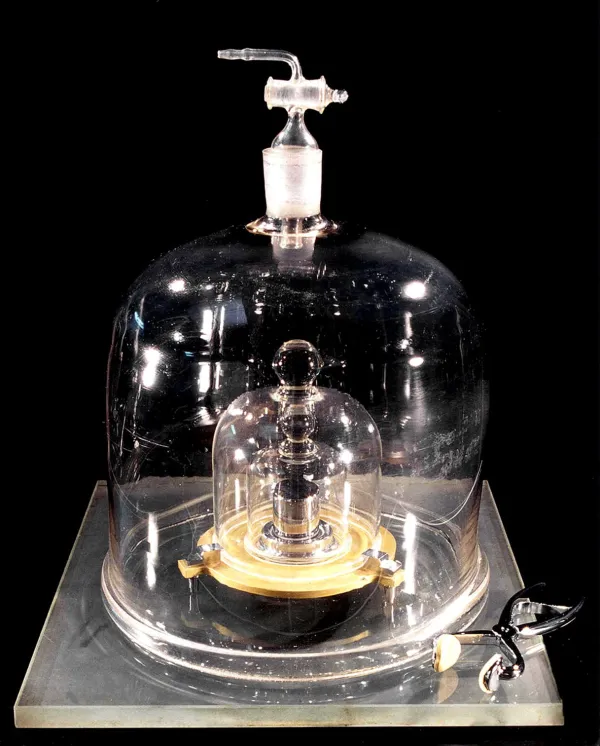
Le Grand K, formally the International Prototype of the Kilogram, is a cylinder of platinum and iridium about the size of a golf ball which, from 1889 until 2019, was the kilogram. Not a representation of the kilogram and not a close approximation to it: it was the unit, so that its mass was exactly one kilogram as a matter of definition and not of measurement.[1]
That arrangement has a consequence which sounds like a joke and is not. An object that defines a unit cannot be measured in that unit, there being nothing left to measure it against. Le Grand K could be compared with its copies, and was, and over a century they drifted apart by some fifty micrograms. Which of them moved is recorded nowhere, because it is not a question the definition permits anybody to ask.
It was made in London in 1879 by Johnson Matthey, from an alloy of ninety parts platinum to ten of iridium, chosen because it is dense, hard, and disinclined to react with anything. It is a right circular cylinder about thirty-nine millimetres high and thirty-nine across, those proportions being the ones that give a cylinder the least surface for its volume, and surface is where contamination lands.[1]
The first General Conference on Weights and Measures sanctioned it in 1889. It has been kept since at the Pavillon de Breteuil at Saint-Cloud, under nested bell jars, in a vault that opens to three keys held by three people who must therefore attend together.[2]
A standard of this sort is not accurate, and calling it accurate is a category error. Accuracy is agreement with a true value; here the object is the true value, and an object cannot agree with itself to a greater or lesser degree.
The point is worth dwelling on because everything else follows from it. Had Le Grand K been dropped, filed down, or had a corner taken off, it would have weighed exactly one kilogram afterwards, and the world would have been obliged to become correspondingly heavier. There was no procedure by which it could be found wrong, because there was nothing it could be wrong about.
What could be done was to compare it with the copies struck from the same alloy at the same time, and that was done three times: in 1889, in 1948, and in 1989.
A unit can be built the other way, out of nothing but comparisons. The dol, a real measure of pain intensity, was assembled from the smallest differences a person could notice and had no object behind it at all: nothing could be fetched out of a vault to settle it, and other laboratories could not reproduce it.
The isotropic antenna is a third arrangement again. It is a reference that was never built and is defined as hypothetical in the document that defines it, and real aerials are quoted against it anyway.
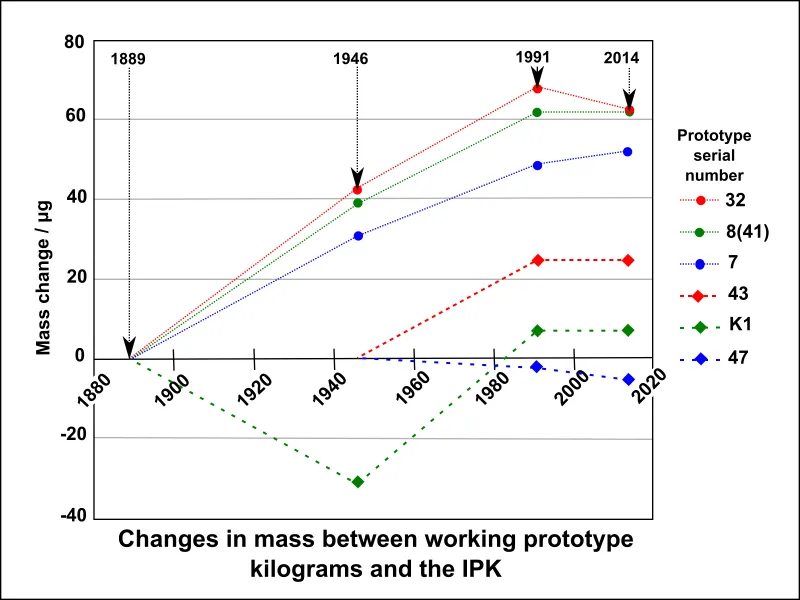
The comparisons showed the prototype and its copies parting company by something like fifty micrograms over the century.[3] That is about one part in twenty million, and about the mass of a single grain of table salt.[4]
It is also, in the strict sense, an uninterpretable result. If Le Grand K had shed fifty micrograms, then the kilogram had shrunk by that much and every mass on Earth expressed in kilograms had gone quietly up. If instead the copies had gained, the reverse. The measurement cannot separate the two cases and the definition will not allow the first to be stated: whatever Le Grand K weighed, it weighed a kilogram.
The literature accordingly speaks of the prototypes diverging from one another, which is the only sentence the arrangement permits.
One candidate cause was found in 2013 and is worth recording without comment. The prototype had been stored within a few centimetres of a mercury thermometer since at least the late 1980s, and platinum takes up mercury.[5]
Before the prototype can be compared with anything it has to be cleaned, since it collects a film from the air merely by existing. The method is prescribed: rubbing with a chamois soaked in equal parts ether and ethanol, then steaming with distilled water.
This removes between five and sixty micrograms.[6]
The drift under investigation is fifty. The preparation for measuring it is therefore capable of exceeding it, and the object starts taking the film back at once: about a microgram a month for the first three months, and a microgram a year thereafter.[7] A comparison is thus made against a moving object, at a moment chosen by the person doing the cleaning, and the chief virtue of the procedure is that everybody performs it the same way.
On 16 November 2018 the twenty-sixth General Conference voted, unanimously, to stop defining the kilogram with an object. The new definition took effect on 20 May 2019 and fixes the Planck constant at exactly 6.62607015 × 10⁻³⁴ joule seconds, from which a mass can be realised by anybody with a Kibble balance and no need to visit France.[8]
The advantage is not accuracy, which was never the difficulty. It is that a constant of nature does not need dusting, cannot be dropped, and is available in every laboratory at once.
The kilogram was the last of the base units to be defined by an object, and it went the way the others had gone before it. The metre, measured off a meridian in the 1790s, stopped being a bar in 1960 and became a fixed number for the speed of light in 1983; the nautical mile had made the same passage earlier still, from a minute of the Earth's own arc to a round count of metres. The second went the same way in 1967, from a fraction of the Earth's rotation to a count of oscillations in a caesium atom, and for the same reason in every case: a unit tied to a thing is only ever as good as the thing.[9]
At the instant the new definition took effect, Le Grand K stopped being the kilogram and became an object with a mass.
It inherited the uncertainty that had until then attached to the Planck constant: ten micrograms.[10] For a hundred and thirty years it had been exactly one kilogram and incapable of being anything else. It is now one kilogram give or take ten micrograms, and that figure is expected to grow, because it has become an ordinary thing, of the kind that can be wrong.
0002ec77f35f557f32502c65d5ac4e873ddbef0f44c75bb86ee3b0162f4fc71f