 ObscuripediaThe Free Obscure Encyclopedia
The date in the title is not a mistake and should not be corrected. February had thirty days in Sweden in 1712, by decision, and the almanac printed for that year says so in its header. Editors are asked to leave it alone; it has been amended to the 29th more than once by people acting in good faith, which is the difficulty with a fact of this shape.
| Occurred | Once |
|---|---|
| Where | Sweden and its possessions |
| Equal to | 29 February, Julian |
| And to | 11 March, Gregorian |
| The plan it ended | |
| Decided | November 1699 |
| Method | Omit every leap day |
| Next leap year would be | 1744 |
| Omissions actually made | One |
| Length of 1712 | 367 days |
| After | |
| Reverted to | The Julian calendar |
| Gregorian adopted | 1753 |
| By | 17 February, then 1 March |
30 February 1712 is the only date of that name known to have occurred anywhere. It happened in Sweden, it was deliberate, and it was the way out of a calendar reform that had gone wrong slowly over twelve years.[1]
The Gregorian calendar ran ahead of the Julian by ten days when Sweden took the decision, and by eleven from 1700; every country that adopted it did so by cutting the whole difference out of a single year and enduring the complaints. In November 1699 the Swedish government decided to do it gently instead.[1]
The scheme was to omit every leap day from 1700 to 1740 inclusive, eleven of them, so that the Swedish calendar would creep forward one day at a time until it met the Gregorian in 1740 without anybody losing a fortnight.[1] The next Swedish leap year after 1696 would have been 1744.
It is a defensible piece of administration and it has one obvious property, which is that for forty years the country would be on a calendar shared with nobody on earth. That was accepted as the price. A calendar, like a prime meridian or a kilogram, is true because enough people agree to act on it, and a country that steps out of the agreement is not wrong so much as alone.
The first omission was made: February 1700 had twenty-eight days in Sweden and twenty-nine everywhere else that kept the Julian calendar. Sweden was now one day ahead of the Julian and ten behind the Gregorian.
Then the Great Northern War began, and the calendar stopped being anybody's business. The omissions due in 1704 and 1708 were not made; both years were leap years in Sweden as they had always been.[1]
The result is worth stating plainly, because it is the reason the whole thing had to be undone. Sweden was not partway between two calendars. It was one day off the Julian, which most of its neighbours kept, and ten days off the Gregorian, which the rest of Europe kept, and it was not on a path to arriving at either. The gradual reform had produced a private calendar and then stopped moving.
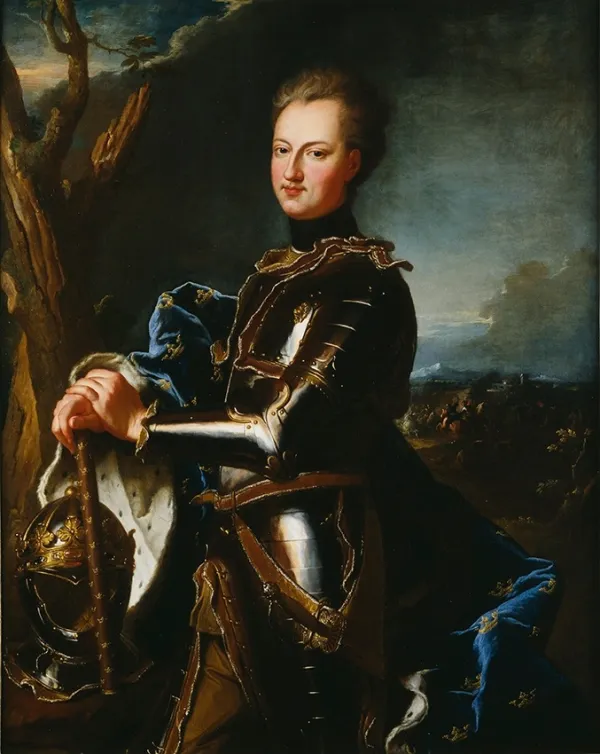
The order to abandon the attempt came from King Charles XII in January 1711, written from his camp at Bender, in what is now Moldova, where he had been living since losing his army at Poltava.[2] Going back to the Julian calendar meant giving back the one day taken out in 1700.
1712 was already a leap year, so February already had twenty-nine days. The day was returned by adding a second one. February 1712 in Sweden ran to thirty days, and the thirtieth of them corresponded to 29 February in the Julian calendar and to 11 March in the Gregorian.[2] The year itself ran to 367 days.
That is long, and it is nothing beside the record. In 46 BC Julius Caesar gave the Roman year 445 days – the annus confusionis, the longest year on record – to drag the calendar back into line with the seasons after the intercalations had been neglected during the civil wars.[4] The failure was of the same kind as Sweden's, seventeen centuries earlier: an adjustment that has to be made by hand, in a country with something else on its mind. Both were fixed by making a year longer than it should be.
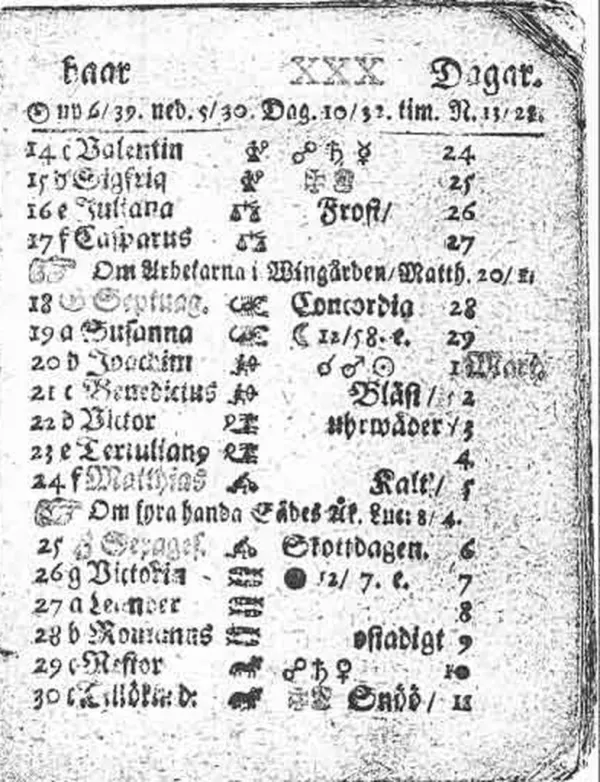
The almanac reproduced above is the document. The page is headed haar XXX Dagar – "has thirty days" – and the last line of the month reads 30, with the note Tillökad, "added". Beside it, as beside every other date, is the almanac's weather forecast for the day: Snöö, snow. The outer column gives the new-style date, and against the thirtieth it reads 11.
That column is the best evidence of what had gone wrong. A country whose calendar agreed with nobody printed the conversion in its own almanac, next to the saints' days, so that a reader could work out what the date was somewhere else.
Sweden adopted the Gregorian calendar in 1753, by the ordinary method it had spent half a century trying to avoid: 17 February was followed directly by 1 March, and eleven days went out of the year at once.[1]
The gradual version had cost twelve years, a war's worth of administrative neglect, one unique date, and a national calendar that agreed with no one; the abrupt version cost eleven days and some complaining. France would go the other way eighty years later, abolishing the week outright and starting the count again: see decimal time. This is the whole argument about phased transitions, conducted once, at national scale, with a controlled result. It is being had again over the leap second: the gradual option is to keep inserting one every few years, the abrupt one is to let the clocks part company with the Earth and settle up in a century, and the abrupt one has won.
There is a sense in which the thirty-day February never stopped.
Interest on bonds is very often reckoned on a 30/360 basis: every month is treated as having thirty days and every year as having three hundred and sixty, because it was devised to be done by hand and the arithmetic is trivial.[3] Under that convention February is paid as a thirty-day month, and has been for as long as there have been coupons to compute.
Nobody writes the date. The conventions adjust the day numbers that go into the formula and never produce a 30 February on paper, which is the difference between an almanac and a spreadsheet, and between a bookkeeping fiction and the Swedish one. Sweden printed theirs, in an almanac, with a weather forecast against it.
000026f10f17152246553574b928fa51e566c9aece6358e51adb8be0bac194c7