 ObscuripediaThe Free Obscure Encyclopedia
Every statement in this article about the length of a second carries a date, and needs to. The quantity has been redefined twice and restated once since 1960, is expected to change again around 2030, and this page's own revision history is timestamped in a scale that has been corrected by hand twenty-seven times. Editors adding a figure are asked to say which second they mean and when it was in force, and not to call any of them the true one, the previous three having been described that way too.
| SI base unit | The second |
|---|---|
| Symbol | s |
| Defined by | |
| Since 1967 | Caesium-133 |
| Counting | 9,192,631,770 oscillations[1] |
| Realised on | The rotating geoid |
| Which is to say | Sea level |
| 1960–1967 | A fraction of the year 1900 |
| Before that | 1/86,400 of a day |
| Effectively | The mean solar second of about 1820 |
| The Earth | |
| Civil clocks set against | A sun that does not exist |
| Former role | The standard |
| Present role | Monitored |
| One day, in seconds | 86,400.002[2] |
| Made up by | Leap seconds, inserted by hand |
| Inserted since 1972 | 27 |
| Removed | None |
| Next | |
| Leap seconds | To be abandoned by 2035 |
| Caesium | To be superseded, about 2030 |
| Elsewhere | |
| In quantum mechanics | Not an observable |
| Smallest interval | Not established |
Time is one of the seven base quantities of the International System of Units, and the only one whose standard was taken away from the object that had always supplied it.[1] Until the middle of the twentieth century a second was a subdivision of the day, and the day was the rotation of the Earth. Since 1967 a second has been 9,192,631,770 oscillations of a caesium atom, and the rotation of the Earth has been a thing that is measured against it.
The Earth has not taken this well. It runs slow, by about two thousandths of a second a day, and the accumulated error is corrected by inserting an extra second into the calendar every year or two by international arrangement. This article is largely a history of that demotion, which took about two hundred and seventy years and which nobody planned.
The oldest complaint in timekeeping is that the sun will not keep to a schedule.
A sundial measures apparent solar time, which is where the sun actually is. Because the Earth's orbit is an ellipse and its axis is tilted, the sun runs ahead of an even schedule for part of the year and behind it for the rest. In early November a sundial is about sixteen and a half minutes ahead of a clock; in the middle of February it is about fourteen minutes behind. The swing between the extremes is half an hour, and it is entirely regular, and it is called the equation of time.
The solution, adopted long before anyone could build a clock good enough to need it, was to invent a second sun. Mean solar time is reckoned against a fictitious mean sun, a body that travels the celestial equator at a constant rate and has no other properties, including existence. That is the technical term and it appears in the almanacs without embarrassment. Every civil clock in the world is set to an imaginary object, chosen because the real one is unpunctual.
This is the first substitution in the article and the pattern does not vary afterwards: when the standard proves irregular, it is replaced by something more even, and the irregular thing is thereafter described as an error.
The same trouble arrives at the other end of the scale, and it arrived first.
The year is not a whole number of days. It is about 365.2422 of them, so any calendar built out of whole days drifts against the seasons, and every calendar in history has dealt with this in one of two ways: insert days from time to time, or decline to care.
| Calendar | The year is | Correction | Drift |
|---|---|---|---|
| Egyptian civil | 365 days exactly | None, by policy | One day every four years; back in step after 1,460 |
| Julian (46 BC) | 365.25 days | One day every fourth year | Eleven minutes a year too long; one day in 128 |
| Gregorian (1582) | 365.2425 days | As Julian, less three leap days in 400 | One day in about 3,030 years |
| Hijri | 12 lunar months, 354 days | None against the seasons, deliberately | Through the whole year in about 33 |
| Hebrew | Lunar months, solar year | A whole extra month, seven times in 19 years | Small, and the rules are intricate |
| French Republican (1793) | 12 months of 30 days, plus 5 | Weeks of ten days; leap day argued over | Abandoned after twelve years |
The corrections are made by decree and they are always unpopular. To bring the Roman calendar back into line Julius Caesar gave 46 BC four hundred and forty-five days, the longest year on record and known afterwards as the year of confusion. Gregory XIII's reform of 1582 deleted ten days outright, so that the fourth of October was followed by the fifteenth. Britain, having declined the reform for a hundred and seventy years on the grounds of its provenance, deleted eleven in 1752: Wednesday the second of September was followed by Thursday the fourteenth.
The riots are the best-known part of that story and appear not to have happened. The cry "Give us our eleven days" is traceable to a banner in the corner of Hogarth's An Election Entertainment, painted three years later, where it is one of several slogans in a picture about a rowdy election and not about the calendar at all. Sweden's own attempt at the same correction was worse and produced a 30 February. Samoa, crossing the date line in 2011, went the other way and simply did not have a 30 December: Thursday the 29th was followed by Saturday the 31st, and the intervening day did not occur. The French tried to rebuild the whole thing on tens and gave up after twelve years.
All of these are the operation performed on the leap second below, at a coarser grain and with more public feeling. The difference is that a day can be seen to go missing.
The Earth's own rotation was next.
In 1695 Edmond Halley compared the records of ancient eclipses with the positions those eclipses ought to have occupied, and found that they did not agree: the old eclipses had been seen in the wrong places. Either the Moon was accelerating or the Earth was slowing. He concluded, correctly, that the day was getting longer.[3]
He published this in a paper entitled "Some Account of the Ancient State of the City of Palmyra, with short Remarks upon the Inscriptions found there". The first evidence that the Earth is an unreliable clock appears in an archaeological note about the ruins of a Syrian city, some way in, after the inscriptions.
The cause is tidal friction: the Moon raises a bulge in the oceans, the Earth drags that bulge ahead of it, and the resulting couple transfers rotational momentum to the Moon, which recedes by about four centimetres a year. The day lengthens by something like two milliseconds a century. Nothing could be done about this, and for two hundred and forty years nothing needed to be, because no clock was good enough to notice.
Halley had inferred the slowing from old records. Catching the Earth at it needed clocks better than the Earth, and before that could happen time itself had to be made uniform, which was done for the railways.
Every town kept its own local mean time, set by its own noon, so that Bristol was about ten minutes behind London and neither was wrong. This is workable until a timetable has to be printed. In November 1840 the Great Western Railway ordered London time to be kept at all its stations, and the other companies followed; the result was called railway time, and for forty years Britain ran on two systems, the legal one local and the practical one Greenwich.
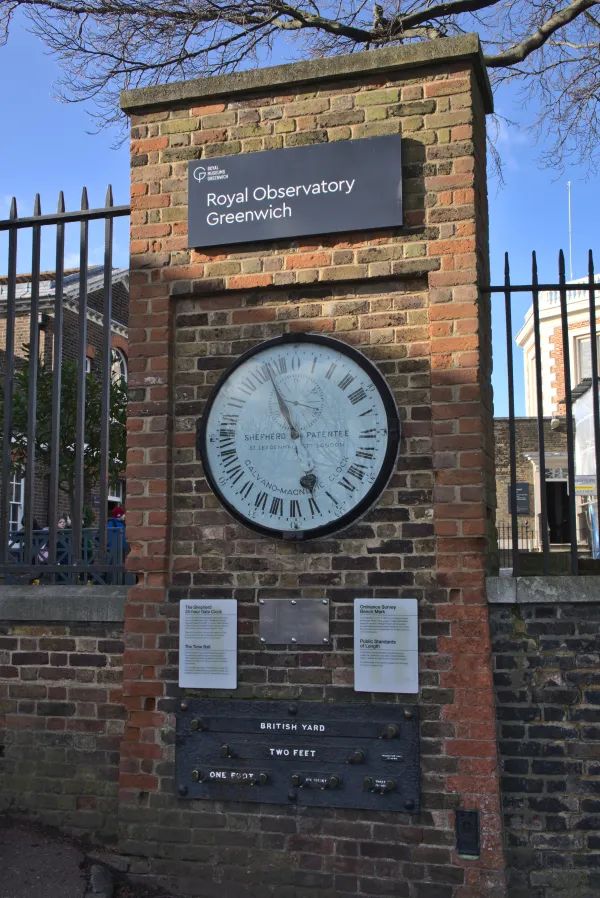
Parliament settled it in the Statutes (Definition of Time) Act 1880, which provided that any expression of time in a legal instrument meant Greenwich mean time in Great Britain and Dublin mean time in Ireland: a single Act creating two legal times for one archipelago, which is the sort of thing that happens when a fiction is codified rather than chosen. An international conference at Washington in October 1884 extended the arrangement to the globe and gave it the Greenwich meridian to hang on.
France abstained, and went on abstaining. When she at last adopted the same time in 1911, the law did not say so: it defined legal time in France and Algeria as Paris Mean Time retarded by nine minutes and twenty-one seconds, which is Greenwich exactly, arrived at by subtraction and without the word appearing.
Making distant clocks agree was, at that date, a commercial problem before it was a philosophical one. Railways, telegraph companies and municipalities all wanted networks of dials driven from a single master, and the applications piled up; a great many of them crossed the desk of the technical expert, third class, at the patent office in Bern, whose name was Albert Einstein. The historian Peter Galison has made the case that the hardware and the theory were the same question asked in two registers.
The question underneath had been put by Henri Poincaré in 1898, in an essay called The Measure of Time: to say that a clock here and a clock there read the same at the same moment, somebody must first say what the same moment means for two places, and no experiment supplies it. Einstein's definition of 1905 is a stipulation and does not pretend otherwise. Send a flash from A at , bounce it off B, catch it again at , and define B's clock to have read the average of the two at the moment of reflection. That takes it as given that light is as quick going as returning, which is the one thing the procedure cannot check, since checking it would need two clocks already synchronised.
None of this made time more accurate. It made it the same in more places, which is a different property, and it is the property that mattered to everybody except astronomers. It also means that the uniform time the railways wanted rests on a convention nobody can test: the second fiction adopted for convenience in this article, and not the last.
Defining a second is one problem. Handing it out is an older one, and for most of history the answer was to make a large object visible at a known instant.
From 1833 a red ball on a mast above the Royal Observatory has been hoisted before one o'clock and dropped exactly on the hour, so that masters of ships in the Thames could set their chronometers by watching it through a glass. It is still dropped daily. The signal is the fall, not the ball: an object cannot be seen to be at one o'clock, but it can be seen to move.
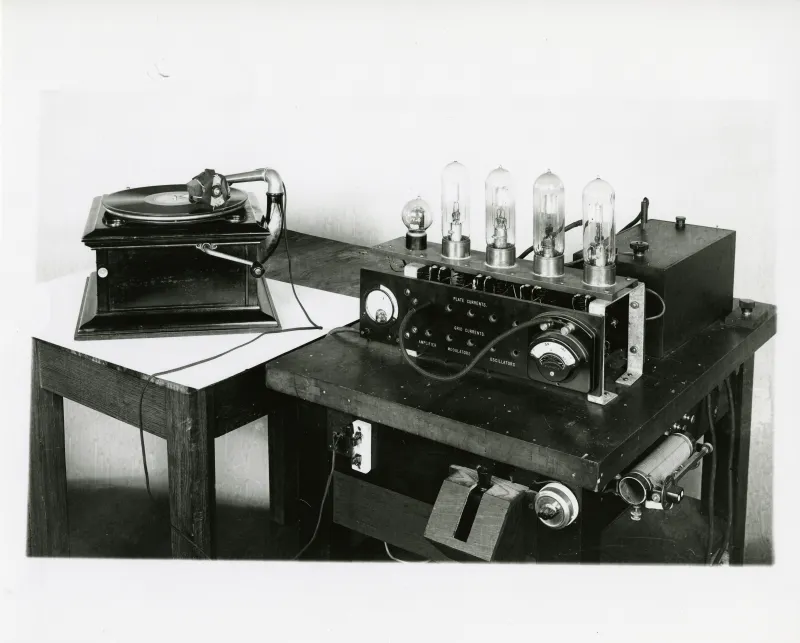
The telegraph replaced the sightline and the wireless replaced the wire. On 5 February 1924 the BBC broadcast six short tones arranged between the BBC and the Astronomer Royal, Frank Dyson, and timed by a clock at Greenwich; the sixth marks the hour, and the pips have been going out ever since. In the United States the Bureau of Standards had been transmitting from station WWV since 1920, at first as Friday evening gramophone concerts and only from 1923 as standard frequencies, which makes it one of the oldest continuously operating stations anywhere.
Its low-frequency sister WWVB has broadcast a time code on 60 kHz since 1963, and this is the part most people own without knowing it. The clock on the kitchen wall sold as an atomic clock contains no atom. It contains a radio, and once a night, usually between two and four in the morning when the signal carries best, it quietly asks Colorado what the time is.
Clocks had been pushed towards accuracy for two centuries by a practical difficulty, which is that a navigator who knows the time knows his longitude and one who does not knows nothing. The moment they overtook the thing they were set by can be dated to the 1920s.
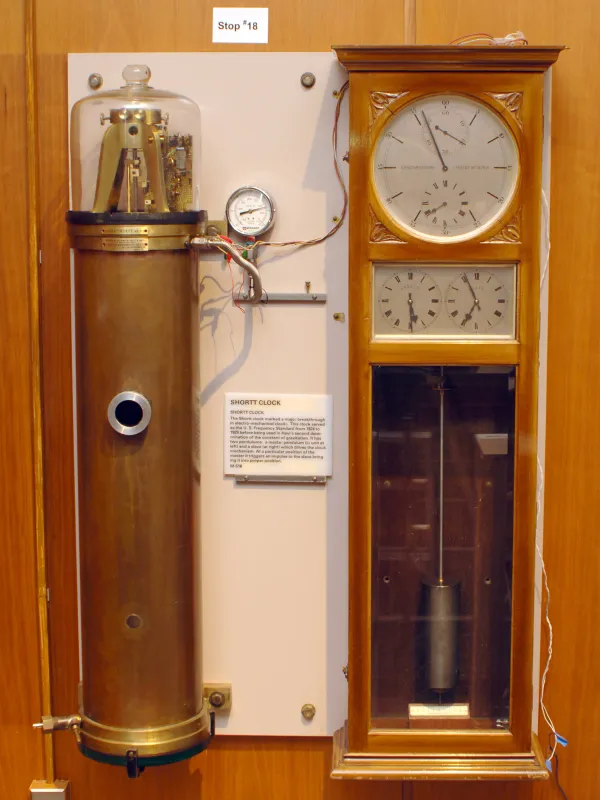
W. H. Shortt's free-pendulum clock separates the two jobs a pendulum clock had always done at once. A master pendulum hangs in a sealed vacuum tank and swings, and that is all it is allowed to do: it drives nothing, and is disturbed by nothing except a light impulse given to it twice a minute. A second, slave clock does the actual work of showing the time and is corrected by the master. To build a clock accurate enough to be useful, its designer had to build a pendulum forbidden to tell the time.
The result kept to about a second a year, one part in thirty million, and observatories bought them. Comparing one Shortt clock against another, and both against the sky, astronomers found in the 1930s that the discrepancies did not lie in the clocks. The Earth's rotation varies with the seasons, speeding and slowing by a millisecond or two over the year. The oldest standard in the world had been checked against something better and had failed.
If the day is not constant, then a second defined as of a day is not constant either, and every physical constant expressed in seconds moves with it. This was intolerable and the fix was strange.
In 1952 the International Astronomical Union adopted ephemeris time, reckoned not from the Earth's rotation but from its orbit, and in 1960 the eleventh General Conference on Weights and Measures redefined the second as
with the year taken at 1900 January 0, 12 hours ephemeris time.
Two things about this are worth dwelling on. The first is that the year in question was already over. The second was pinned to a particular year in the past precisely because a year in the past cannot change its mind, and the instant named in the definition is not an anniversary of anything: it is the moment at which the sun's mean longitude took a stated value, according to tables Simon Newcomb had published in 1895.
The second thing is the consequence. Newcomb had fitted those tables to observations running from 1750 to 1892, and the mean epoch of that run is about 1820. So the length of the ephemeris second is the length of a mean solar second when George IV came to the throne, and when the caesium second was calibrated it was calibrated to agree with the ephemeris second, and therefore also with 1820.[5]
That is the whole explanation of the leap second, and it is worth having in one sentence: the official second is a nineteenth-century second, and the Earth has been slower than the nineteenth century ever since.
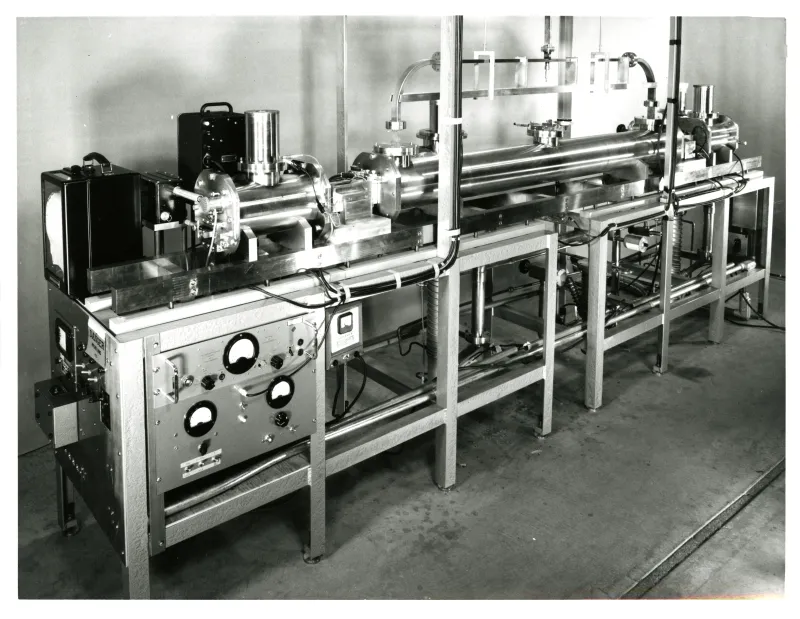
In 1967 the thirteenth General Conference cut the last thread. The second became
the duration of 9,192,631,770 periods of the radiation corresponding to the transition between the two hyperfine levels of the ground state of the caesium 133 atom.
The number is not a discovery. It was chosen so that the new second would match the old one as closely as the measurements of the day allowed, which is why it is a nine-digit integer with nothing memorable about it: it is the count that made the change invisible. The definition was restated in 2019, in the revision that also detached the kilogram from its lump of metal, so that the caesium frequency is now a fixed number and the second is what follows from it. What has never been touched, through all of this, is the face of the clock: the second was rebuilt twice while the sixties and the twenty-fours were left exactly as the Babylonians left them, and the one serious attempt to decimalise them is the only part of the metric system to have failed outright.
From that point the Earth is not a clock. The Earth is an object with a rotation rate, measured by radio telescopes against distant quasars, published as a bulletin, and compared unfavourably with a shelf of atomic standards in several national laboratories.
The atom made visible a further difficulty, which had been there all along.
A clock's rate depends on where it is and how fast it is going. Special relativity makes a moving clock run slow; general relativity makes a clock lower in a gravitational field run slow. Neither is a defect of the instrument and neither can be corrected away, because there is nothing to correct towards: the theory that predicts the disagreement also denies that any one of the readings is the true one. There is no universal instant, and the arrangement by which a whole planet agrees to say the same number at once is a convention, well kept.
The demonstration was made in the least dignified manner available. In 1971 Joseph Hafele and Richard Keating put four caesium clocks aboard scheduled airliners and flew them round the world, first eastward and then westward. The clocks travelled on tickets bought for them and sat in their own seats. Against the clocks left behind at the United States Naval Observatory the flying set lost 59 nanoseconds going east and gained 273 going west, both within the predicted margins.[6]
The consequence for the standard cannot be dodged. If a clock at one height disagrees with a clock at another, a world time scale has to say which height it means, and International Atomic Time says so in terms: it is the SI second as realised on the rotating geoid, the surface the oceans would settle to if nothing else were in the way. Some eighty-five laboratories contribute, and each contribution is corrected for its own elevation above that surface before its ticks are allowed to count. The most abstract unit in the system is referred to sea level.
The extreme case is light, and it is habitually overstated. The time elapsed along a light ray's own path through spacetime, its proper time, is exactly zero: the interval between the emission of a photon and its absorption, reckoned the way the theory reckons intervals, vanishes however far it has gone. From this it is usually concluded that light experiences no time and crosses the universe in an instant. The theory declines the conclusion, because it declines the observer. There is no rest frame for light: the Lorentz factor is undefined at exactly , so no transformation reaches one, and what the photon experiences is a phrase with nothing behind it. Proper time is a property of a path through spacetime, not a report from a traveller. The elapsed time is zero, and there is nobody for whom it is zero.
The effect has stopped being a nuisance and become an instrument. A clock gains about one part in for every metre it is raised, and the best optical standards resolve a few parts in , so a clock can be used to survey. In 2019 two transportable optical clocks measured a height difference of 450 metres to within about four centimetres, by the direct method of disagreeing with one another. The device that took the timekeeping away from the Earth is now used to measure its shape.
Two time scales now existed and they disagreed. International Atomic Time counts atomic seconds and nothing else. Universal Time, in the form called UT1, follows the actual turning of the Earth. The first is even and the second is not, and the difference grows by about a second a year.
The compromise, in force from 1 January 1972, is Coordinated Universal Time: it ticks at the atomic rate, so that a second of UTC is a proper SI second, but whenever it threatens to drift more than nine tenths of a second from the turning Earth, an extra second is inserted to let the planet catch up. The International Earth Rotation and Reference Systems Service decides, and announces it in a bulletin, and the world's clocks are expected to comply.
This is what the calendars had always been doing, performed eighty-six thousand four hundred times as finely and rather more often. The inserted second is written 23:59:60, a reading no clock face can display and a great deal of software does not believe. Twenty-seven leap seconds have been added since 1972. The most recent was at the end of 2016. None has ever been removed, because the Earth has been slow relative to an 1820 second for the whole period, and a standard fixed to the past can only be gained on in one direction.
Then, having behaved predictably for fifty years, the Earth did something else.
From about 2020 the rotation began to accelerate. The reasons are not settled and probably include the motion of the liquid core, the redistribution of mass as ice sheets melt, and the atmosphere; none of them is well enough understood to be predictive. On 9 July 2025 the planet completed the shortest day ever recorded by modern methods, 1.37 milliseconds under 86,400 seconds.
This raises the prospect of a negative leap second, in which a second is struck out rather than added: the clock would run 23:59:58 and then midnight. It has never been done. Nobody is confident that the world's computers would survive it, and the estimates put the first one around 2029 if the trend holds.
The trend may not hold. Through 2026 the days have been lengthening again, and the shortest day of this year is expected to come out about seven tenths of a millisecond longer than last year's record. The planet appears to have thought better of it.
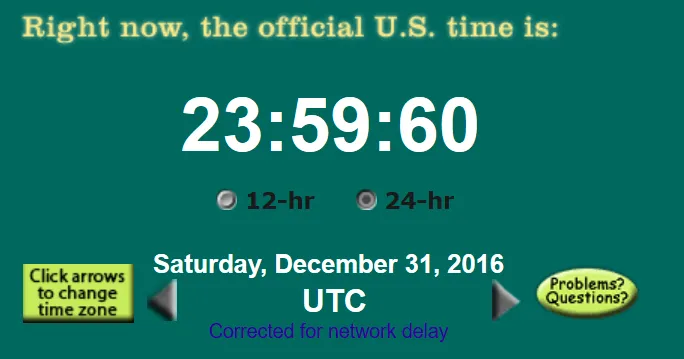
Computers were given the problem late and have handled it by declining it.
Unix time, the count of seconds since the beginning of 1970 that underlies most of the world's software, is defined as though every day contained exactly 86,400 seconds. It therefore does not count leap seconds, and is not, despite universal belief, a count of the seconds that have elapsed: it is a count of the seconds that would have elapsed had the Earth behaved. It is currently twenty-seven seconds short and the shortfall is deliberate. When a leap second arrives the number is made to repeat, so that the same instant is reported twice, which is the behaviour that brought down the servers in 2012.
Google's answer, adopted in 2008 and now widely copied, is to lie smoothly rather than abruptly. In a leap smear the extra second is spread across the twenty-four hours from noon to noon, every clock in the fleet running slower than the atom by about one part in eighty-six thousand for a day, so that no machine ever has to read 23:59:60 and none is ever more than half a second out. Nothing is broken and nothing is quite right, which suits everybody.
There is also a deadline, and it is not the first. On 19 January 2038 the Unix count overflows a signed thirty-two-bit integer and any system still keeping time that way will find itself in 1901. The famous one was Y2K, where years held as two digits would read 2000 as 1900: somewhere between three and six hundred billion dollars was spent worldwide on putting it right, almost nothing failed on the night, and the two facts have been arguing ever since, a disaster averted being indistinguishable from a disaster imagined. The GPS week number is a ten-bit counter that has rolled over twice, in 1999 and on 6 April 2019, the second time taking flight-management software and a number of airline schedules with it; it will do so again in 2038. Network Time Protocol reaches the end of its thirty-two-bit era at 06:28:16 on 7 February 2036, and its packets carry no era number, so nothing on the wire will say which one it means.
None of these is a fact about time. Each is a fact about how much room was left for it.
The most frequently encountered interval in domestic life, meanwhile, is in no standard at all. Alarm clocks snooze for nine minutes, near-universally, including on telephones that contain no gears whatever. The explanation always given is that the General Electric–Telechron mechanism of 1956 had a gear train able to deliver about nine minutes or about eleven, and that nine was chosen; the evidence is a good deal thinner than the confidence with which it is repeated, and the interval has now outlived the mechanism said to explain it by seventy years.
A different problem is worth separating from all of the above, because it is not about telling the time. It is about showing that a document already existed at a stated moment, and therefore cannot have been written afterwards. Stuart Haber and Scott Stornetta set it out in 1991: hash a document, chain each hash to the last, and publish the running value somewhere it cannot be quietly amended. From 1995 the chain was published weekly in the classified advertisements of the New York Times, which makes a newspaper's print run the unforgeable part, and which is the longest-running such chain there is.[7]
The mechanism proves order, not time. A blockchain is a poor clock: Bitcoin accepts a block's timestamp if it is later than the median of the previous eleven blocks and no more than two hours ahead of the network's own idea of now, limits chosen because they were good enough. What it establishes is precedence, which is a weaker claim and often the one actually wanted. This encyclopedia keeps one, for the same reason and with the same modest guarantee: not what time an article was written, but that it has not been altered since it was sealed.
| In force | A second was | Kept by | Given up because |
|---|---|---|---|
| Antiquity to 1960 | 1/86,400 of a mean solar day | The rotation of the Earth | The rotation is irregular, and clocks became good enough to show it |
| 1960–1967 | 1/31,556,925.9747 of the tropical year 1900 | Newcomb's tables of the Sun | Cannot be realised in a laboratory; the year cannot be run again |
| 1967 to now | 9,192,631,770 periods of caesium-133 | A caesium atom | Optical standards are about a hundred times better |
| Expected about 2030 | Some number of periods of an optical transition | An atom or ion, not yet agreed | Ask after 2030 |
In 2022 the General Conference resolved to stop patching the difference. Resolution 4 directs that the maximum permitted gap between atomic time and the turning Earth be increased, in or before 2035, to a value that will keep UTC continuous for at least a century. It does not say what the value is. That was handed to the CIPM to consult upon and bring back as a draft resolution to the conference of 2026, which is therefore deciding, in the same year, both how far the Earth may drift and which atom replaces the one that measures the drift. The correction itself is not abolished; it is postponed to about 2135.
And the caesium atom, which took the job from the Earth in 1967, is being measured out of it in turn. Optical clocks, which count oscillations of visible light rather than microwaves, are already about a hundred times better than the caesium standards that define the unit they are measured in. A redefinition was expected at the General Conference of 2026 and has been judged premature; the conference is instead expected to approve a road map towards one around 2030, after which caesium becomes a secondary standard.[8]
It will then be exactly what the Earth is now: a thing that used to keep the time, retained for reference, checked against its replacement.
Two questions have gone unanswered: how finely time divides, and when it began. Each has a famous answer, and the two famous answers are the same answer. Neither is about time. Both are about where the physics stops.
The Planck time is what you get by combining the three constants , and into a quantity with the dimensions of time. It comes to about seconds. It is very often described as the shortest interval that exists, an indivisible tick below which time does not go, and this is not known and is not what the quantity means. It is the scale at which quantum mechanics and general relativity both have to be used at once, and neither survives the meeting.[9]
| Interval | In seconds |
|---|---|
| Planck time | 5.39 × 10−44 |
| Shortest event ever measured (2020) | 2.47 × 10⁻¹⁹ |
| One period of caesium-133 | 1.088 × 10⁻¹⁰ |
| One second, being 9,192,631,770 of them | 1 |
| One mean solar day | 86,400.002 |
| The tropical year 1900, which defined the second from 1960 | 31,556,925.9747 |
| Age of the universe | 4.4 × 10¹⁷ |
Some approaches to quantum gravity do make time or space granular; others do not; none has been tested, because the scale lies far below anything an accelerator can reach. Standard quantum mechanics, meanwhile, does something stranger with time than chopping it up. It declines to treat it as a measurable quantity at all. Position, momentum, energy and spin are observables, each with an operator; time is a parameter, written into the equation from outside, and Pauli showed that a well-behaved clock observable of the usual kind cannot be constructed. The theory is a description of how things change with time and contains no instrument for measuring it.
Against the Planck time, the record for an interval anyone has actually clocked is instructive. In 2020 a group measured the passage of a photon across a hydrogen molecule: 247 zeptoseconds, or s. That is the shortest event ever timed, and it is some Planck times long: measured against the supposed smallest interval, the smallest interval anyone has managed is enormous.[10]
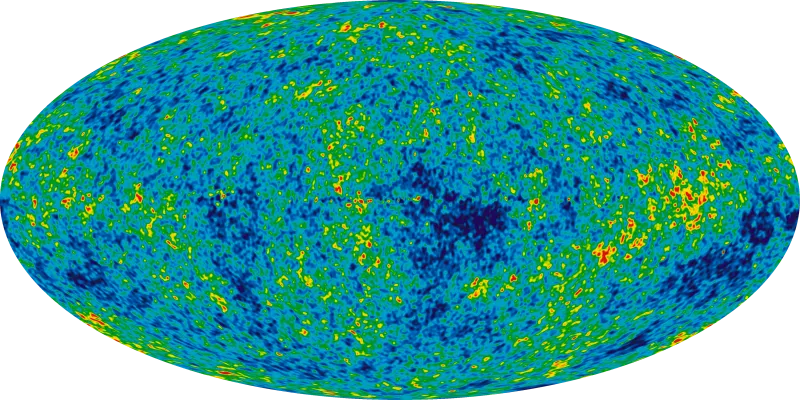
The other end of the scale tells the same story larger.
Run the expansion of the universe backwards and the whole of it converges on a hot dense state about 13.8 billion years ago. The measurement rests on the distance ladder Edwin Hubble began and on the microwave background, and it is one of the better determined numbers in science.
In the classical solution the scale factor reaches zero at a finite time in the past and the equations return infinities: infinite density, infinite curvature, no earlier moment. This is routinely reported as the beginning of time, and what it actually marks is the point at which general relativity stops describing anything at all. A theory that produces an infinity has not discovered one; it has announced that it is being used outside its range. The last moment we can speak about with confidence is not zero but the Planck time after it, and everything before that is a gap in the physics rather than an absence in the world.
Whether there was an earlier is not known, and may not be a well-formed question, and the difference between those two is also not known. It is the one place in this article where the honest entry is blank – which puts it in company with the rest of it, since every standard here was adopted because the previous one had been found wanting, and there is no reason to think the atom is the last of them.
Nothing above requires an answer to the question of what is being measured, which is fortunate, because there is not one.
The oldest position is that time is not a thing but a count. Aristotle has it as "the number of motion with respect to before and after", and draws the consequence without flinching: where there is no change, there is no time. On that view a clock does not detect time, it constitutes it, and the whole of this article has been about improving the counter rather than approaching the thing counted.
Newton took the other side, in the scholium at the front of the Principia, and took it absolutely: "Absolute, true, and mathematical time, of itself, and from its own nature flows equably without regard to anything external." Time on this account is a container. It would go on whether or not anything happened in it, and a clock reports it as a thermometer reports a temperature that is there either way. Leibniz thought this was empty talk and wrote back that time is "an order of successions", nothing over and above the events themselves.
The argument was not settled by physics, though physics has taken things from both sides. What relativity removed was the clause without regard to anything external: there is no single flow, and the rate depends on the path. What it left standing is a spacetime with its own geometry, which is not obviously the sort of thing Leibniz had in mind either. Philosophers still put the case each way, and in 1969 Sydney Shoemaker gave an argument that a universe could in principle produce evidence of a period in which nothing whatever changed, which if it works is bad for Aristotle.
The question becomes practical at the far end. In a universe at maximum entropy there are no gradients, no processes, and therefore no clocks: nothing that can be built, in principle, that would distinguish one moment from the next. On Aristotle's account time then stops, for lack of anything to count. On Newton's it continues, unattended and unrecorded, which is a distinction with no observable difference and may be the same statement said twice. Roger Penrose has proposed something stronger and less comfortable: that a universe left with nothing massive in it has no way to fix a scale at all, so that its remote future and a fresh beginning are not merely similar but indistinguishable.
This encyclopedia takes no position. It notes only that every standard described above was adopted because the previous one was found to wobble, that the atom is now wobbling, and that at no point in five thousand years of this has anybody needed to know what time is in order to get better at measuring it.
An illustration is to hand. At an ordinary pace this article has taken about half an hour to read. Counted by the standards it describes, that is one forty-eighth of a mean solar day, or of the tropical year 1900, or 16,546,737,186,000 periods of caesium-133. The three do not agree exactly. On Aristotle's account there is no further fact, over and above the three counts, about how long it really was; on Newton's there is, and no counter will ever reach it.
0002a535f7b866cf998ccae619ed4c8a447f839ffe0cc582d8544b726497f53b