 ObscuripediaThe Free Obscure Encyclopedia
The times in this article are given in ordinary hours. Its subject is a system in which they would be given otherwise, and the encyclopedia has considered doing so and concluded that nobody would be able to read it. Editors are asked not to convert them.
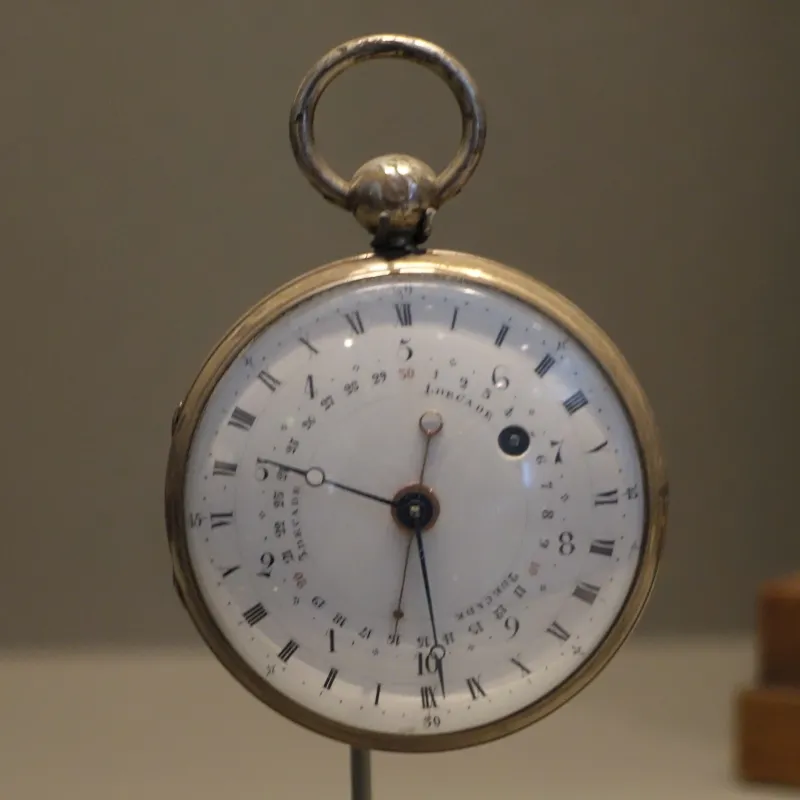
| Type | Timekeeping system |
|---|---|
| Decreed | 5 October 1793[1] |
| Amended | 24 November 1793, being 4 Frimaire, Year II |
| Compulsory from | 22 September 1794 |
| Suspended | 7 April 1795[2] |
| Compulsory for | 197 days |
| The divisions | |
| Hours in a day | 10 |
| Minutes in an hour | 100 |
| Seconds in a minute | 100 |
| Seconds in a day | 100,000 |
| One decimal hour | 2 h 24 min |
| One decimal second | 0.864 s[3] |
| Standing | |
| Clocks made | Yes, with two dials |
| Clocks surviving | Yes |
| Adopted | No |
Decimal time was the division of the day into ten hours of a hundred minutes of a hundred seconds, decreed by the National Convention on 5 October 1793 as part of the same programme that gave the world the metre and the kilogram.[1] It is the only part of that programme that failed.
The decree is worth quoting because it is not tentative: "The day, from midnight to midnight, is divided into ten parts or hours, each part into ten others, so on until the smallest measurable portion of the duration." It became compulsory for public records on 22 September 1794 and was suspended on 7 April 1795, having been the law of France for a hundred and ninety-seven days.[2]
A decimal day has ten hours, each of a hundred minutes, each of a hundred seconds: a hundred thousand seconds in the day against the usual eighty-six thousand four hundred.
The units are therefore not the familiar ones wearing new labels. A decimal hour is two hours and twenty-four minutes, long enough that a man could miss an appointment by most of an afternoon and be arithmetically in the right. A decimal second is 0.864 of an ordinary one, which is close enough to be confusing and far enough to be useless.[3]
Midday falls at five o'clock, which is the detail that does the most work in explaining what happened next.
The reform was not a proposal or a suggestion for the future. It was decreed, amended, made obligatory in public records, and then withdrawn, and the whole of its legal life fits inside a school year.
Nothing was found to be wrong with it. No commission reported against the arithmetic, which is impeccable, and no argument was published showing that the day resists division by ten, because it does not. The system was suspended because it was not being used. It is worth noticing the word: the obligation was lifted rather than the system repealed, and it has been in that condition ever since.
The instrument of its death is worth reading. The law of 18 Germinal, Year III is the law that made the metric system permanent: its Article 5 defines the metre, the gramme, the litre and the are, with the Greek and Latin prefixes that are still in use. Article 22 suspends the clock.[4] One document, seventeen articles apart, established the most successful measurement reform in history and gave up the only part of it that failed.
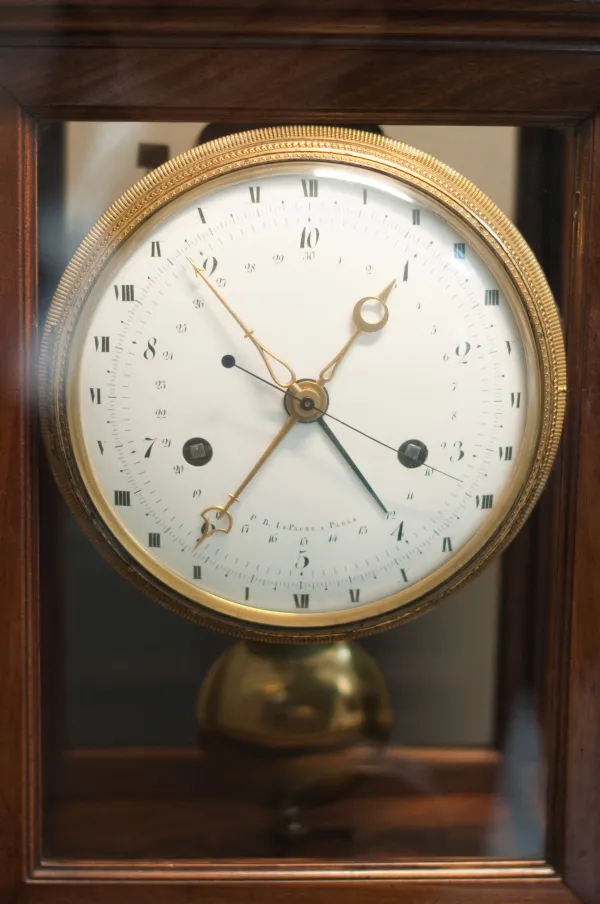
Clockmakers did build them. The characteristic survivor is a two-scale piece: the ordinary hours in one ring and the decimal hours, one to ten, in another, both driven off the same train, so that the owner could read whichever time he intended to keep.[5] Makers did not agree on which of the two to put first, and that disagreement is itself a measure of how the thing was going.
That arrangement is the reform's obituary in brass. A unit that has to be displayed next to the one it replaces has already lost, because the conversion has been moved from the law into the hand of every person who owns a clock, which is where reforms go to die.
Two of the four clock faces on the Tuileries showed decimal time until at least 1801, six years after anybody was obliged to keep it. A public clock in the centre of Paris went on telling a time the Republic had stopped asking for, and nobody appears to have minded, which is the same reason it failed and the reason nobody bothered to stop it.[6]
The metric reform of length, area, capacity and mass went through and stayed. The same men, in the same year, with the same argument, could not move the clock. The difference is not in the mathematics, which is identical, and it is not that time is natural while length is not: the day is given, but so is the meridian the metre was cut from, and the divisions of both were equally arbitrary. Twelve inches and sixty minutes are the same kind of accident.
The difference is that a length only has to agree with the other lengths in the same market, and a time has to agree with every clock its owner may ever stand in front of. Adopting the metre costs a merchant a new rule. Adopting the hour costs him a new clock, and costs him nothing at all unless everybody else buys one too, on the same morning.
There is a second reason and it is less flattering to the reformers. Nobody trades in seconds. The metric units were pushed hardest by people who bought and sold by them and were tired of being cheated by regional measures. No such constituency existed for the hour, because nobody was being short-changed by it.
The French Republican calendar, which decimal time had arrived alongside, outlived it by ten years and was abolished at the end of 1805. The two are commonly discussed as one thing and were not: the calendar was kept up long after the clocks had been given back. Calendar reform is the harder of the two to abandon tidily, and the clearest demonstration is Swedish: see 30 February 1712, the day a country needed in order to undo one.
The deeper survival is in the system that beat it. The International System of Units is the most thoroughgoing decimal scheme ever constructed, and its base unit of time is the second – sixty of which make a minute and sixty of those an hour, exactly as they did before the Convention sat.[7]
The second has been rebuilt since, and more than once: it became a count of caesium transitions in 1967, and was restated in 2019 by the same revision that detached the kilogram from its cylinder. What it has never been is divided by ten. No proposal to do that has been advanced since 1795 by anybody the subject was obliged to take seriously.
0002fcc3202fd6d2e9f81339c38653e35126d3d8f7a07316114e7502d0dc2dfd