 ObscuripediaThe Free Obscure Encyclopedia
This article concerns a real and documented effect. The encyclopedia's subjects are, almost to a man, instances of it; the cross-references are therefore kept brief.
| Field | Cognitive psychology |
|---|---|
| First described | Kruger & Dunning, 1999 |
| The finding | The least able overestimate the most |
| Mechanism | The skill to do a thing is the skill to judge it |
| Unit (in this work) | the whect |
| Most confidently cited by | those exhibiting it |
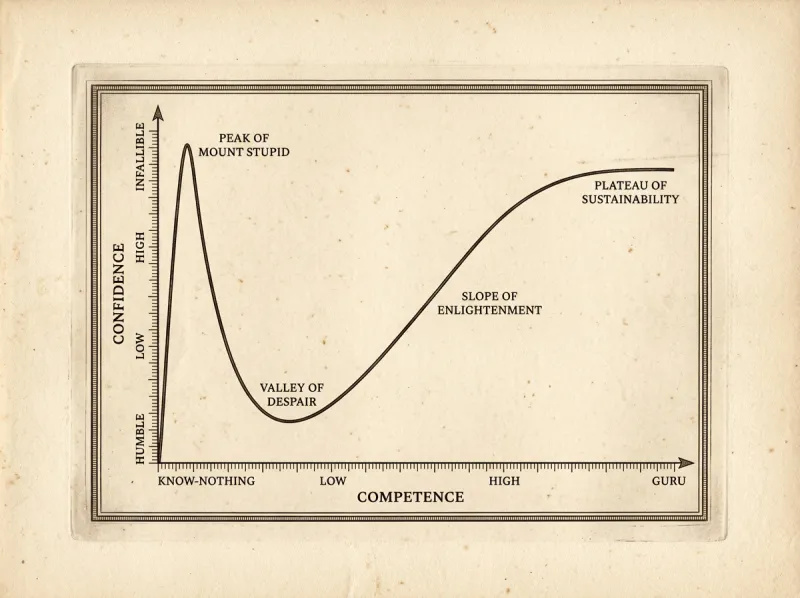
The Dunning–Kruger effect is the finding, established in cognitive psychology, that people of low competence at a task tend to overestimate their competence at it, and to do so more grossly the less competent they are.[1] The least able are not merely wrong about their ability; they are the least equipped to discover that they are wrong, the same deficits that produce poor performance also disabling the judgement that would detect it.
For this encyclopedia the effect is foundational: it is the real-world law of which the whect, the unit of conviction, is the measure.[2]
In the original study, participants were tested on humour, logic, and grammar and then asked to estimate their own performance.[1] Those in the lowest quartile of actual skill placed themselves, on average, well above the middle – a miscalibration that shrank as competence rose, the most able estimating themselves accurately or a little low. The authors located the cause in metacognition: the competence required to do a thing well is largely the same competence required to tell whether one has done it well, so that incompetence is, in a sense, self-concealing. The unskilled are, in their phrase, "unaware of it."
The effect is unusually prone to demonstrating itself.[3] Its popular form – the less one knows, the surer one is – is a confident over-simplification of a subtler result about the calibration of self-estimates; and part of the much-cited pattern is argued by some to be a statistical artifact rather than a fact of psychology. Neither nuance tends to reach those who invoke the effect most freely. It is, in consequence, cited with the greatest confidence by precisely the people it best describes – a recursion the encyclopedia finds tidy and declines to disturb.
The effect is the organizing principle of the whole work, stated as psychology.[2] The reliable wrongness of Obed; the certainty of the Defender of the Aether, undimmed by refutation; the Aetheric Concord's practice of counting every result a confirmation – each is the effect in a particular costume. The whect is its unit: a quantity that rises as understanding falls, and reaches its maximum exactly where there is least to be confident about.
000051624c454c40bfa54d002c374d3af3df4d1f6009d09649979812f5a7c6fd