 ObscuripediaThe Free Obscure Encyclopedia
This article draws heavily on the subject's own voluminous publications, there being little else. The challenge it describes remains, by his Society's account, unanswered to this day.
| Born | 9 June 1828 |
|---|---|
| Died | 12 July 1887, at the apparatus, mid-observation |
| Occupation | Aetheric theorist |
| Office | Defender of the Aether (self-conferred) |
| In the minutes | Corresponding Secretary, the Aetheric Concord |
| Known for | The aether explanation of everything |
| Standing challenge | "Refute it." |
| Output | Voluminous |
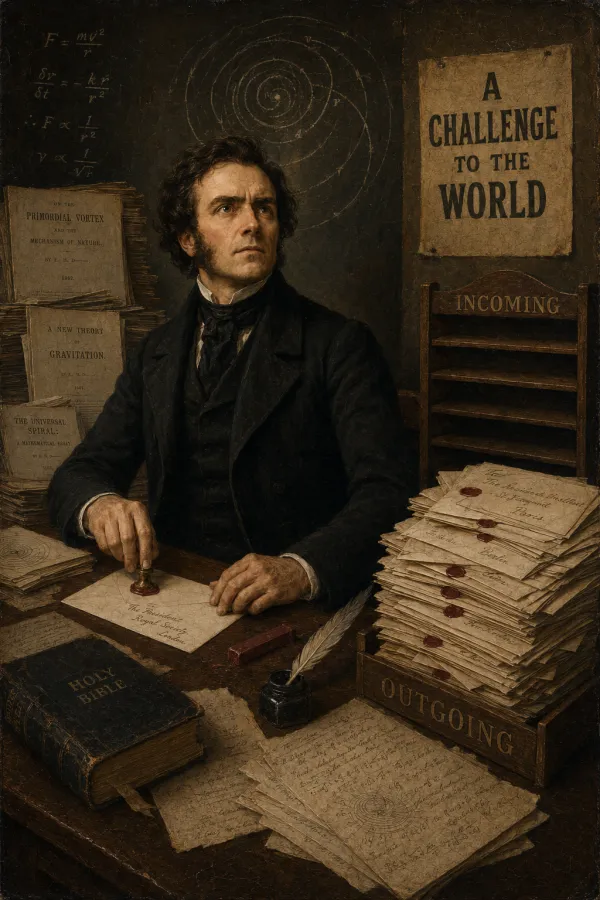
Ezekiel Quartz (1828–1887) was a Victorian aetheric theorist, the most prolific member of the Aetheric Concord, and the devoted lieutenant of its founder, Josiah Grimble.[1] Quartz held that the whole of natural philosophy – light, heat, matter, weight, and the motions of the heavens – reduced without remainder to the stirrings of a single medium, the luminiferous aether; and he issued, in the Society's name, a standing challenge to the world to prove him wrong.
He styled himself Defender of the Aether, a rank the Concord's minutes decline to confirm, recording him more soberly as Corresponding Secretary.[2] The two offices, in his hands, came to the same thing: he answered every question put to nature with the aether, and every objection put to himself with its name in Latin. Where Grimble kept the Society's door shut against dissent, Quartz flung open a window and dared the world to climb through. None did; and so, by opposite means, the two of them secured the same silence.
Quartz took the respectable physics of his day – the wave theory of light, the kinetic theory of heat, the vortex atoms lately proposed by serious men – and pressed it past the point its authors intended.[3] If light was a wave in the aether and matter a knot of it, then everything was the aether: gravitation a habit of the medium, inertia its reluctance, the planets so many eddies. Forces were not causes but bookkeeping. He was fond of saying that the equations of the natural philosophers were perfectly correct and explained nothing, being "the arithmetic of a debt that no one had incurred."
The doctrine reached its purest form in his treatment of weight. Taking the earth as the fixed centre of the world and assigning to it, by the accepted method, the whole mass of the system, Quartz found that the mass of the sun came out to nothing at all.[3] He published the figure without alarm – indeed with satisfaction – as the natural reward of putting the earth where it belonged. That the sun should weigh nothing struck his opponents as a difficulty; it struck Quartz as a proof.
Grimble had championed the Concord's celestial theodolite through forty-one Communications and then, when the world declined to attend, let it lapse from sheer indifference. Quartz could not.[4] He fixed instead upon a single demonstration – a signal-light shown across a great reach of sea and received, he maintained, exactly where the curve of a globe forbade it – and built around it a challenge he flung at the whole of the opposing party: refute this, or concede the plane.
The challenge was printed in the Communications, posted to societies and editors in every quarter, and renewed, with mounting confidence, year upon year. It was never taken up. Quartz recorded this as the strongest possible vindication – a proof that had stood unrefuted for decades – and did not appear to weigh the likelier explanation, which was that almost no one had read it. The demonstration remained, by the Society's reckoning, undefeated. It had simply never been engaged. The effect that accounts for the reasoning was not described until 1999, and would have been no use to him if it had: the competence wanted to see the error is the competence he was short of.
The office the Concord's books actually allowed him – Corresponding Secretary – Quartz discharged with one peculiarity worth recording.[2] The Society's correspondence, by the custom Grimble had established at the midden, ran one way only: challenges, refutations, and corrections went out under his hand, and nothing came back. He was thus the secretary of a correspondence with no second party – a distinction he bore as a mark of victory rather than of solitude.
To any opponent who did engage, Quartz extended the courtesies of the schoolroom. He named the fallacy of each objection in its proper Latin – ignoratio elenchi, petitio principii, argumentum ad verecundiam – a service he was known to perform for objections he had not finished reading, on the ground that their species could be told from the opening lines. He carried the same office, unasked, into the open meetings of the Telluric Athenaeum, where he policed the decorum of a society that had not appointed him to it.
Late in life Quartz submitted his principal proofs to a calculating engine, that they might be confirmed by a party holding no opinion in the matter.[5] The engine declined. Fed the reckoning that ended in the weightless sun, it is said to have halted at that very figure and returned the sheet unfinished – an outcome Quartz took not as a check upon his arithmetic but as evidence that the orthodoxy's reach extended even into the gears. That a machine without a view should refuse to share his was, to him, the most telling endorsement of all.
Quartz gave the glory, in the end, to God.[6] He held the firmament a solid vault and a lens, the earth fixed beneath it by appointment rather than accident, and his cosmography a reading of scripture that the instruments had merely caught up to. The piety was sincere and, by the testimony even of his opponents, gently held: a man furiously certain about the aether and unfailingly courteous about its Author.
In 1887, learning that two American philosophers meant to settle the question of the aether wind with an interferometer of unprecedented delicacy, Quartz crossed the Atlantic to attend, as he fully expected, its vindication before the world.[7] The instrument was a half-ton slab of sandstone, floated on a trough of quicksilver so that it might revolve without the least friction; observers walked slowly beside it, reading the fringes through an eyepiece as it turned. For a fortnight Quartz walked with it, and saw, as everyone saw, nothing move.
On the fourteenth night – the 12th of July – he could wait no longer, and demanded to read the fringes himself, certain that he alone would see the shift the others were suppressing. He bent to the eyepiece and stared into it a long while. Then he stiffened, cried out that the fringes had moved at last, and fell, and did not rise. The experimenters' notebooks record a null for that night, as for every night before it; Quartz's reading, the one dissenting observation, could not be taken down, he having died in the making of it.
The physicians blamed the quicksilver, breathed over the fortnight's vigils at the trough; the Concord – by then dwindled to the dead man himself – counted the death a confirmation, as it had counted everything. That its only surviving member was also its subject proved no impediment: the Society's verdicts had always been foregone, and this one wrote itself. Both accounts, in fairness, described the same man at the same eyepiece. He died, his Society maintained, of being right.
000242cfd5fbce208577079250a7914b54221dd138e8ee8f085ce67c63d60297