 ObscuripediaThe Free Obscure Encyclopedia
This article is about the instrument, not about what was seen through it. Nearly every other page here is about the second thing. Editors adding a discovery are asked to consider whether it belongs to the object, the observer, or the glass, and to note that the third of those has the weakest claim and the best record of being blamed.
| What it does | Gathers light, and resolves detail |
|---|---|
| First on record | 2 October 1608, refused[1] |
| Refused because | Too easy to copy |
| Named | 1611, by somebody else[3] |
| What limits it | |
| In principle | Diffraction, as the aperture allows |
| In practice, from the ground | The atmosphere, at about one arcsecond |
| Aperture beyond which more buys nothing | A few tens of centimetres |
| The largest of each kind | |
| Refractor | Yerkes, 40 inches, 1897. The lens sags |
| Speculum reflector | Parsonstown, 72 inches, 1845 |
| Above the air | Webb, 6.5 m, 2021. Hubble was 2.4[7] |
A telescope collects light from a distant thing and brings it to a focus, and it does two separate jobs in doing so: it gathers more light than an eye can, and it separates detail an eye would blur together. The first job is why faint things become visible and the second is why close things become two. Almost everything in this encyclopedia that was settled rather than argued was settled by one.
Its history is not a history of glass improving. It is a history of instruments being checked against other instruments, and of the check going wrong: a defect declared incurable and then cured, a size race that ended when the sky rather than the mirror became the limit, and a mirror in orbit ground to an exquisite tolerance and the wrong shape.
On 2 October 1608 Hans Lippershey, a spectacle-maker of Middelburg, petitioned the States General of the Netherlands for the exclusive right to make an instrument he called a kijker, a looker, which magnified about three times.[1]
He did not get it. Within weeks two other men, Jacob Metius of Alkmaar and Sacharias Janssen, were before the same body with the same device, and the States General concluded that the thing could not be granted to anybody because anybody could make one. What Lippershey received instead was 900 florins and a contract to supply copies, on the condition that he build them with two tubes rather than one: the first order ever placed for a telescope was a request for opera glasses.
The refusal is the most consequential decision in the instrument's history. Within a year there were telescopes in Italy, England and France, and the men using them had not paid anybody. A patent granted in Middelburg in 1608 would have bound almost nothing and delayed a great deal.
Galileo did not invent the telescope, never said he had, and is nonetheless where the story is usually told from.
He heard of the Dutch instrument in 1609, worked out the arrangement himself, and built better ones than anybody else had: by 1610 he had reached about thirty times, at a period when most were managing three or four. That is the achievement, and it is a real one. What he did with it was not, however, first.
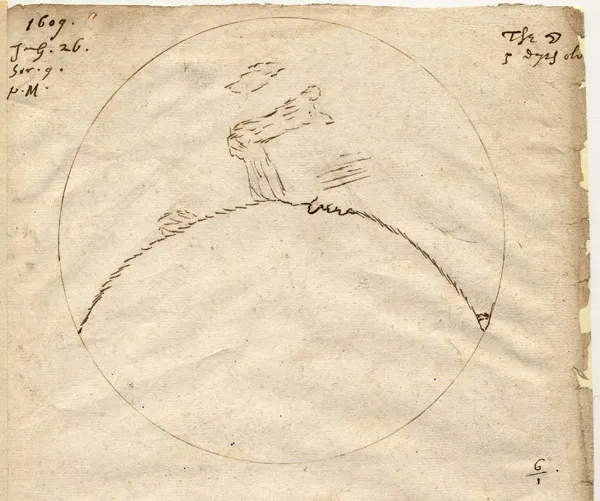
Thomas Harriot turned a six-power glass on the Moon from a house in London on 26 July 1609, and drew what he saw. It is the first known drawing of any astronomical object made through a telescope, and it precedes Galileo's by more than four months.[2] Sixteen months later he had a full map of the face, fifty features numbered on it, not bettered for decades. He published none of it, and the consequence is the ordinary one: Stigler's law does not require the eponym to have been second, only to have been louder.
Galileo, by contrast, published. Sidereus Nuncius was in print by March 1610, within months of the observations, and had made him famous across Europe inside a year. Harriot's papers stayed in private hands and were not properly worked through for centuries.
The word is not Galileo's either. He called his instrument a perspicillum. Telescope was coined in 1611 by Giovanni Demisiani, a Greek mathematician, at the banquet in Rome at which Galileo was admitted to the Accademia dei Lincei, and it stuck immediately.[3]
The first telescopes had a defect that no amount of care removed. A single lens brings blue light to a focus nearer than red, so every bright object arrived wearing a coloured fringe, and the only remedy known was to make the instrument absurdly long: focal lengths of fifty, a hundred, at last a hundred and fifty feet, with the objective hoisted on a mast and the eyepiece carried about the garden on a string.
Newton concluded that the defect was incurable. He held that dispersion was proportional to refractive power in every glass, so that any lens correcting colour would also cancel the focusing, and he drew the natural conclusion and built a reflector instead, in 1668, in which a mirror does the work and colour cannot arise.[4]
He was wrong, and the way he was wrong is worth having. Different glasses do not disperse in proportion to their power: crown and flint disperse differently, and a converging crown lens paired with a diverging flint one can cancel most of the colour while leaving focusing behind. Chester Moore Hall, a gentleman-amateur, worked this out around 1733 and had achromatic doublets made, ordering the two halves from different opticians so that neither would understand what he was building. He told nobody. John Dollond arrived at it independently and patented it in 1758, and the patent is his.[5]
So the greatest optical authority of the age declared a thing impossible; the man who first did it anyway kept it quiet on purpose; and the name attached to it belongs to the third party, who filed.
The colour problem is the first of a series, and the series has a shape. Each of the standard optical layouts exists because the previous one had a defect somebody wanted out of, and each is named after the man who got out of it.
| Design | Date | What it was getting away from |
|---|---|---|
| Galilean | 1609 | Nothing yet. A convex objective and a concave eyepiece; upright image, and a field of view like a keyhole |
| Keplerian | 1611 | The keyhole. Two convex lenses give a wide field and an upside-down image, which no astronomer minds |
| Newtonian | 1668 | Colour, by using a mirror and refusing to refract at all |
| Gregorian, Cassegrain | 1663, 1672 | The long tube, and the eyepiece stuck up at the mouth of it. Fold the light back down through a hole in the primary and observe from behind |
| Achromatic doublet | 1733 | Colour again, this time without giving up the lens |
| Ritchey–Chrétien | c. 1910 | Coma at the edge of the field. Two hyperbolic mirrors; almost every professional telescope since |
| Schmidt | 1930 | The narrow field, for surveying. A thin corrector plate and a curved focal surface |
| Segmented primary | 1990 | The casting limit. A single disc of glass that size cannot be made, so make thirty-six and hold them in step |
| Not on this list: the atmosphere, which no arrangement of glass has ever escaped, and which had to be measured and cancelled instead | ||
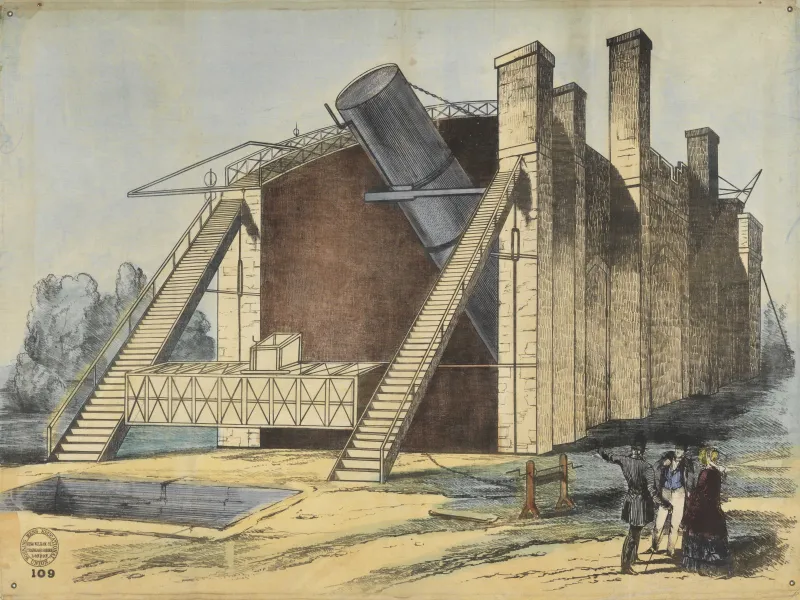
The Cassegrain row is the one that shaped the buildings. Putting the eyepiece behind the primary rather than up at the mouth is why a modern telescope can be sat at rather than climbed, and why the observing platform in the plate above, forty feet up in the Slough air, is a period detail rather than an arrangement anybody repeated.
For two centuries afterwards the argument was about size, and the argument was sound: aperture gathers light as its area, so a mirror twice across collects four times the light and reaches objects four times fainter.
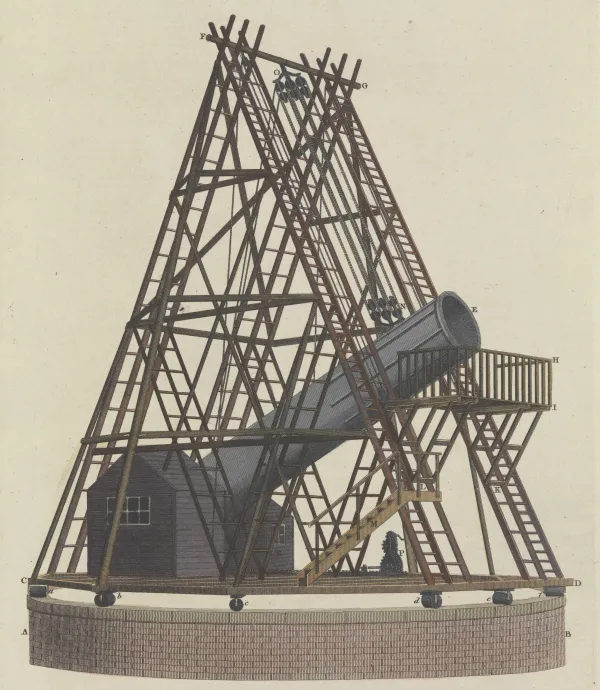
William Herschel built a reflector of forty feet with a mirror of forty-seven inches, finished in 1789 and the largest in the world until Rosse's, fifty-six years later. It was a monster to work, needing a crew to move and constant attention to a speculum mirror that tarnished and had to be repolished, and Herschel did most of his actual observing with a twenty-foot instrument he could point. His son dismantled the forty-foot in 1840.[6]
Lord Rosse went further at Birr in 1845 with a mirror of seventy-two inches, the Leviathan pictured above, and immediately did something no smaller instrument could: in April 1845 he saw that the nebula M51 had a spiral structure, and drew it. Nobody had suspected that nebulae had shapes of that kind. The instrument also could not be pointed: slung between two walls, it reached only about an hour either side of the meridian, and it sat in the Irish midlands, where the sky is what it is.
The refractors ended more precisely. The Yerkes forty-inch of 1897 is the largest ever built for astronomy and will remain so, because a lens can only be supported at its rim, and glass that wide sags under its own weight. The Yerkes objective has to be rotated periodically so that it droops evenly. Mirrors can be held up from behind across their whole face, and after 1897 everything large was a mirror.
Somewhere in that race the thing being improved stopped being the thing setting the limit.
A perfect telescope is limited by diffraction: it cannot resolve detail finer than about the wavelength of light divided by the aperture, which is the Rayleigh criterion and is entirely correct. Larger aperture, finer detail, without end. That is the promise on which every large telescope was funded.
The atmosphere does not honour it. Air of varying temperature is air of varying refractive index, and starlight arrives having been bent, unbent and bent again by cells of the stuff a few centimetres to a few tens of centimetres across. The relevant size has a name, the Fried parameter, and the resolution available from the ground is not the wavelength divided by the aperture but the wavelength divided by that. Past an aperture of a few tens of centimetres, the sky is what you are looking through and a wider mirror stops buying detail.
The figures are not marginal. The Very Large Telescope has a diffraction limit of about 0.057 arcseconds at two microns; through the atmosphere it gets about 0.7, which is a factor of twelve thrown away.[8] Every large ground telescope built between Rosse and about 1990 was in that position: gathering ever more light, and resolving no better than a good amateur instrument on a steady night.
This encyclopedia has an interest to declare here. Its recurring subject is that the air between an observer and a distant object does something to the light and gets the blame for nothing: the looming of a far shore, a coastline standing too high, a horizon that will not sit where it should. Seeing is the same phenomenon, indoors, admitted, funded and worked around. The difference between an astronomer and the observers documented elsewhere in these pages is not what the air does to the light. It is whether the air is entered in the account.
Two answers arrived at almost the same moment. Adaptive optics measures the distortion hundreds of times a second and bends a small mirror to undo it, which from the 1990s let ground telescopes reach their diffraction limits after all. The other answer was to leave.
The Hubble Space Telescope went up in April 1990 with a mirror of ninety-four inches, ground more accurately than any large mirror before it. Its images were blurred. The outer edge of the mirror was too flat by 2.2 micrometres, about a fiftieth the width of a human hair, and the mirror was therefore not slightly imperfect but precisely the wrong shape.[7]
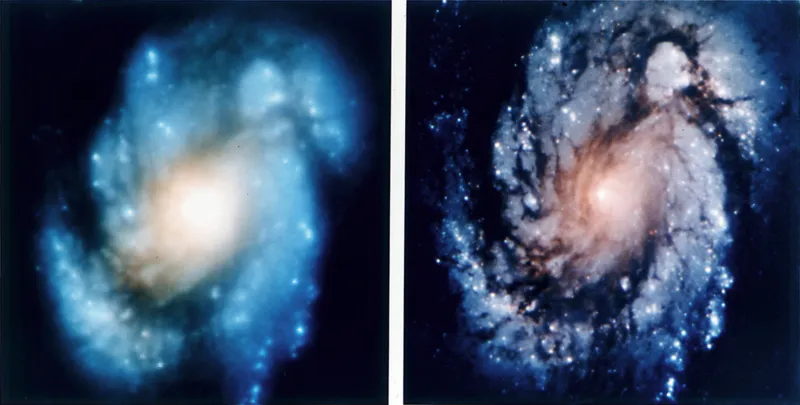
The cause was found in the instrument that had measured it. The mirror had been checked interferometrically, which compares a surface against a reference and says nothing whatever about the reference; the reflective null corrector serving as that reference had a lens 1.3 millimetres out of position, so the mirror had been polished, with great skill, until it matched a faulty gauge. The part that belongs in this encyclopedia is what happened next: the makers cross-checked that corrector against two simpler ones, both of which showed the mirror was wrong, and both results were set aside on the ground that the simpler instruments were less accurate. The error was detected twice and filed as noise. A corrective package went up in December 1993 and the telescope has worked ever since.
The ground's answer turned out to be the stranger of the two, and it deserves describing properly.
Adaptive optics needs a reference: a point source in the same patch of sky as the target, bright enough to measure the distortion against, hundreds of times a second. There usually isn't one. So observatories make their own. A laser tuned to 589 nanometres is fired up the telescope into the sodium layer, a band of loose sodium atoms about ninety kilometres up, laid down by meteors burning away; the sodium fluoresces, and the telescope has an artificial star exactly where it wants one.[9]
The consequences are administrative and they are the best part. Because the beam continues past the sodium layer, observatories must file their pointing with the Laser Clearing House days in advance and shutter the laser during windows when a satellite would cross it. Spotters, or an all-sky camera, watch for aircraft and cut the beam if one approaches. The remedy for the atmosphere is therefore to put a counterfeit star into it, on a schedule agreed in advance with the people who own the satellites.
| Instrument | Aperture | Date | Note |
|---|---|---|---|
| Lippershey's kijker | An inch or so | 1608 | Three times. Refused a patent |
| Herschel's forty-foot | 1.2 m | 1789 | He used the twenty-foot |
| Leviathan of Parsonstown | 1.8 m | 1845 | Could not be pointed off the meridian |
| Yerkes refractor | 1.0 m | 1897 | The last big lens. It sags |
| Hooker | 2.5 m | 1917 | Hubble's instrument |
| Hale | 5.1 m | 1948 | The end of the single-mirror era |
| Keck I | 10 m | 1993 | Thirty-six segments, acting as one |
| Simonyi Survey Telescope | 8.4 m | 2025 | Smaller, and the camera is the point |
| Extremely Large Telescope | 39 m | 2029 | 798 segments; the correction is built into the optics |
| Above the air, and not competing on this column at all: Hubble at 2.4 m in 1990, Webb at 6.5 m in 2021, Roman at 2.4 m again in 2026. Beaten on aperture by a dozen instruments on the ground, and out-resolving every one of them | |||
The last line is the argument of this article in one row. The Extremely Large Telescope, due to open its eye in 2029, will be thirty-nine metres across in seven hundred and ninety-eight hexagonal pieces, and adaptive correction is not an attachment to it but one of the five mirrors in its optical train: the atmosphere has been designed for from the start, as a component of the instrument rather than a nuisance outside it.
The other direction is not aperture at all. The Simonyi Survey Telescope at the Vera C. Rubin Observatory, which took its first images in June 2025, is smaller than telescopes built thirty years earlier; what is remarkable about it is a camera of 3,200 megapixels and the intention to photograph the whole visible sky every few nights for ten years. It found some two thousand asteroids in its first ten hours of testing, which is a comment on how much had simply never been looked at twice. It is named for Vera Rubin, who established that galaxies rotate wrongly, using instruments a fraction of its size.
The plainest statement of the whole argument went up on 30 August 2026. The primary mirror of the Nancy Grace Roman Space Telescope is 2.4 metres across, which is exactly Hubble's; its field of view is at least a hundred times larger and it is expected to survey perhaps a thousand times faster.[10] Nothing about the aperture changed. What changed was the optical design behind it and the detectors at the focus. Nor was the mirror made for this: it was built for the National Reconnaissance Office, to be pointed at the other side of the atmosphere, and handed to NASA as surplus.
00028e2d5838aab2bb945588c373b06156d092cbd1a0f9d6e383bec531610520