 ObscuripediaThe Free Obscure Encyclopedia
The anomaly described in this article no longer exists. It was real, it was measured for as long as the spacecraft kept transmitting, and it was accounted for in 2012 by the heat leaving their own generators. Editors are asked not to reinstate the phrase "still unexplained", which was correct for a long time and has not been correct since.
| Observed | Pioneer 10 and Pioneer 11 |
|---|---|
| First noticed | About 1980 |
| Published | 1998, in Physical Review Letters[1] |
| Resolved | 2012, in the same journal |
| Magnitude | (8.74 ± 1.33) × 10−10 m/s², sunward |
| Appeared beyond | About 20 AU |
| How small that is | |
| Against solar gravity there | About 1 part in 17,000 |
| Change in speed, per decade | 0.28 m/s, or 1 km/h |
| Displacement, per decade | About 43,000 km |
| To alter your speed by 1 m/s | Thirty-six years |
| What it was | |
| New physics | No |
| Instrument error | No. The measurement was correct |
| Cause | Heat, leaving the spacecraft unevenly |
| Residual afterwards | None |
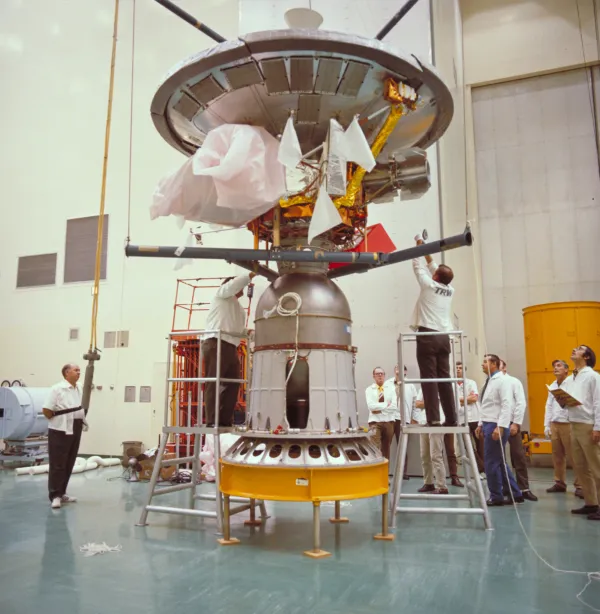
The Pioneer anomaly was a small unexplained acceleration of the Pioneer 10 and Pioneer 11 spacecraft, directed towards the Sun, which appeared in their radio tracking once they were beyond about twenty times the Earth's distance from it and persisted for the rest of both missions.[1] Its size was metres per second per second, which is very small and was nonetheless far too large to ignore.
For about thirty years it was the best-known unexplained result in solar-system dynamics, and a serious if minority candidate for a failure of gravity at large distances. It was resolved in 2012 by a group who rebuilt both spacecraft as thermal models and showed that the missing force was the recoil of their own escaping heat.[2] The measurement had been right the whole time. What was wrong was the assumption that a spacecraft radiates evenly in all directions, which nothing does.
Pioneer 10 left the Earth in March 1972 and Pioneer 11 in April 1973, the first vehicles built to cross the asteroid belt and the first to reach Jupiter.[3] Both were spin-stabilised, which is the important part: a spinning craft needs no thrusters to hold its attitude, so it can be left alone for years at a time, and its motion is not being continually disturbed by small corrections nobody logged.
Their positions were followed by Doppler tracking. The spacecraft returned a radio signal locked to the frequency sent up to it, and the shift between the two gives the velocity along the line of sight, continuously and to a precision measured in fractions of a millimetre per second. Over years, the accumulated difference between where a spacecraft ought to be and where the Doppler says it is becomes very sensitive to forces far too small to detect any other way.
What the tracking showed, from about 1980 onwards, was a residual. After every known effect had been modelled out, both spacecraft were falling behind the trajectories predicted for them, as though something were pulling them very gently back towards the Sun. John Anderson and colleagues at the Jet Propulsion Laboratory pursued it from 1994 and published the analysis in 1998, drawing on the tracking of the Galileo and Ulysses probes as well.[1]
The two most persuasive features were these. It appeared in both spacecraft, which had left in different years on different trajectories and gone to different places, Pioneer 11 by way of Saturn. And it did not go away. It was still there after ten years, and after twenty, and it was still there in the last data returned before Pioneer 10 fell silent.
The obvious question is why nothing else showed it, and the answer is the spin. The Voyagers, launched five years after Pioneer 10 and travelling out through the same emptiness, are stabilised on three axes and fire small thrusters to hold their attitude. Each firing puts an unmodelled push into the trajectory, and the residue of those pushes is far larger than a billionth of a metre per second squared. A Voyager could have been carrying the same effect and nobody would have been able to see it. The Pioneers were legible precisely because they were simple.
There was a further difficulty which turned out to be a clue. The anomaly's direction could not be pinned down. Over these trajectories the Sun, the Earth and the direction of travel were all nearly the same way from the spacecraft, so an acceleration towards the Sun, an acceleration back along the line to Earth, and a deceleration along the flight path were very hard to tell apart. Most accounts called it sunward, which sounded gravitational. It was in fact along the spacecraft's own axis, which is the axis the dish points down and therefore the axis pointed at the Earth, and that is exactly what a lopsided source of heat bolted to a spinning body would produce.
The size deserves stating properly, because the interesting thing about the anomaly is that a quantity this small could be measured at all, let alone argued about.
Where the spacecraft were, at twenty astronomical units, the Sun's gravity is about m/s². The anomaly is about one part in seventeen thousand of that. Applied to a person it would take thirty-six years to change their speed by one metre per second.
What makes it detectable is that a constant acceleration does not accumulate in the velocity, where it would be hopeless, but in the position, where it grows with the square of the time:
Ten years of m/s² is a change in speed of 0.28 metres per second, which is about a kilometre an hour, and nobody could see that. But it is also a displacement of about forty-three thousand kilometres, which is three and a half Earth diameters, and a Doppler track long enough will see that easily. The anomaly was visible for the same reason a slow clock is: not because the error is large but because it is patient.
Almost as soon as the figure was published, somebody noticed that it is close to the speed of light multiplied by the Hubble constant.
This was widely repeated, and it did a great deal of work in persuading people that something cosmological was going on, because an acceleration of that size falling out of two unrelated constants looks like a message. Several proposals were built on it.
It is worth being blunt about the strength of the coincidence. The anomaly is and is about , in the same units. That is a mismatch of a third. Agreement to within a factor of 1.33 between two quantities of the same order is not evidence of anything, and there was never a mechanism proposed that would have made them equal rather than merely comparable. The resemblance is now generally treated as having meant nothing at all, which it did.
There is a sharper way to see it. The coincidence depends on the value of the Hubble constant, and that value has itself moved a great deal: Hubble's own figure in 1929 was 500 kilometres per second per megaparsec against a modern 70. Had the comparison been made with the number its discoverer published, would have come out near m/s², and the anomaly would have missed it by a factor of more than five. A coincidence that depends on which decade you look it up in is not a result.
The episode is a clean example of a habit this encyclopedia keeps meeting: a number that arrives with an air of significance, is repeated because it is memorable, and is never subjected to the question of how close the agreement actually is. The speed of light supplies the other half of the coincidence and had, at that point, been exact for fifteen years.
Explanations divided into the interesting and the dull, and the interesting ones attracted most of the attention.
On the interesting side: modified Newtonian dynamics, which alters gravity where accelerations are very small and was already accounting for the rotation of galaxies; modified inertia; a drift in the rate of clocks; unseen mass in the Kuiper belt; and a slow change in the gravitational constant. Most of these had the same difficulty, which is that whatever slows a spacecraft at twenty astronomical units ought also to disturb the orbits of the outer planets, and those are fitted by general relativity to a precision that leaves no room for it.[4]
The most-cited of them fits worse than its popularity suggests. Modified dynamics switches on below an acceleration of about m/s², and the Sun's pull where the Pioneers were is some hundred and twenty thousand times that: the theory is deep in its ordinary Newtonian regime out there and predicts no departure at all. The solar field does not fall to the threshold until about seven thousand astronomical units, which is a good deal further out than anything has ever been tracked. Whatever the anomaly was, it was not the modification that explains galaxy rotation.[7]
On the dull side: drag against the interplanetary medium, which is far too thin; leaks of propellant, which would not be so steady or so alike in two vehicles; and the recoil of heat radiating away unevenly. The thermal explanation was proposed early and was never actually refuted. It was set aside because nobody could show that it was big enough, and nobody could show that because the information needed to work it out had not been assembled.
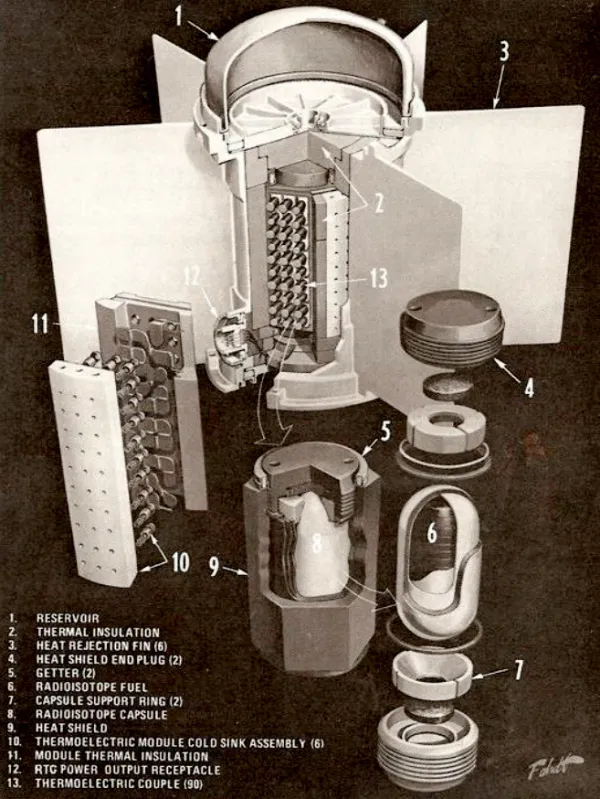
Each Pioneer carried four SNAP-19 radioisotope thermoelectric generators, fuelled with plutonium-238, which supplied 155 watts of electricity at launch and rather less later. That is the electrical figure, and it is the smaller one. A generator of this kind turns only a few per cent of its heat into electricity and rejects the remainder, so the heat leaving each spacecraft was many times the power it ran on, continuously, in a vacuum, with nothing to carry it away but radiation. A very small asymmetry in where that radiation goes produces a very small net push, and the question was never whether the effect existed but whether it was of the right size.[6]
The obstacle was record-keeping, and the solution to the anomaly is in large part an exercise in data recovery. Nothing about the delay was intellectual. The information needed had been transmitted from beyond the orbit of Neptune, received, written down and filed, and the difficulty was that it had been filed.
The Doppler tracking that had been analysed covered part of the mission. The spacecraft telemetry – the housekeeping stream reporting temperatures at points around the vehicle, power drawn by each system, the state of the generators – had been received, archived and never used for this purpose, because nobody had needed it. It sat in obsolete formats for decades. From about 2006 those records were located and converted, together with a large body of the original project and design documentation.[5]
That is what made the difference. A thermal model of a spacecraft is only as good as its boundary conditions, and the recovered telemetry supplied them directly: not an estimate of how warm the vehicle was in 1983, but the reading.
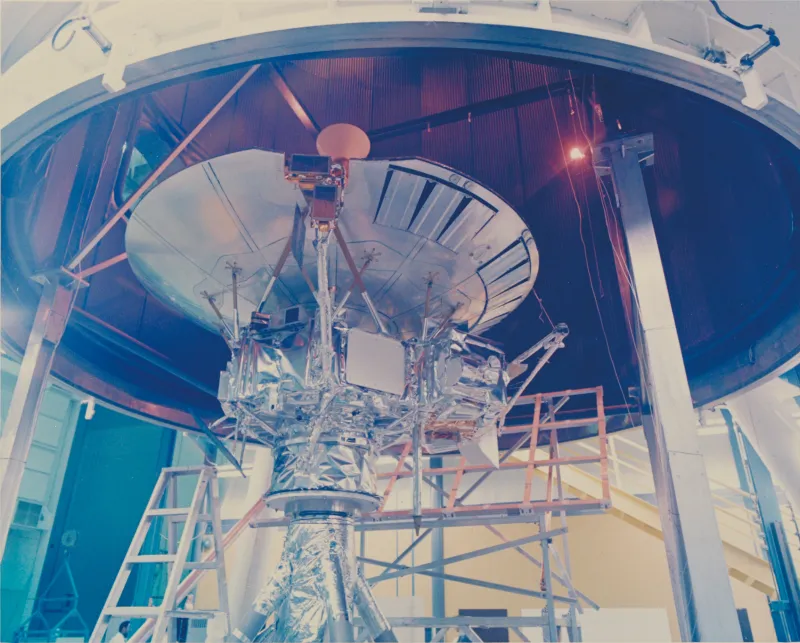
Slava Turyshev and colleagues built a finite-element thermal model of both spacecraft from the engineering documentation, solved the conduction and radiation equations across it using the recovered flight telemetry as boundary conditions, and computed the recoil from the resulting pattern of emitted heat. The magnitude came out right, the direction came out right, and the way it declined over the mission came out right as well, following the generators as they cooled.[2]
Then they did the part that makes the result convincing rather than merely plausible. They wrote the thermal recoil as a model with free coefficients and estimated those coefficients a second time, from the navigational Doppler data alone, without reference to the engineering at all. The two independent estimates agreed.
"We find no statistically significant difference between the two estimates and conclude that once the thermal recoil force is properly accounted for, no anomalous acceleration remains."
– Turyshev, Toth, Kinsella, Lee and Lok, 2012
There is no residual. The anomaly is not reduced or partially explained; it is gone, and what remains is a spacecraft behaving exactly as a warm object in a vacuum must.
It is tempting to file the episode as thirty wasted years, and that reading is wrong in three separate ways.
The measurement was correct, and it is worth being exact about how, because this encyclopedia holds two neighbouring cases that are not the same. Peter van de Kamp's planets were never there: the wobble was his lens, and no star moved. Dayton Miller's fringe shifts were real readings of something real, but what they were reading was the temperature of his hut rather than a wind in the aether. The Pioneer case is the third and least common kind. The acceleration was real. The spacecraft genuinely were being pushed towards the Sun, the tracking reported it accurately, and the arithmetic was sound throughout. Nothing had to be unmeasured or reinterpreted. What was missing was a term in the list of forces.
The conduct was also correct. The 1998 paper is titled an indication of an apparent anomalous acceleration, which is about as much hedging as a title can carry, and it lists the mundane candidates including the thermal one. Nobody claimed a discovery. The anomaly was published as a problem, and the community treated it as one for fourteen years until somebody did the work.
And the work left something behind. Recovering three decades of telemetry from dead formats produced the most complete record of those two missions that has ever existed, which did not exist while the spacecraft were flying and would not exist now had the anomaly never been noticed. An unexplained residual turned out to be the only reason anyone went looking for the tapes.
The moral, if the article is to have one, is narrower than "it was mundane after all". Both spacecraft were pushing themselves, gently, for their entire working lives, with heat that everyone knew was there. What nobody had was the number, and getting the number required treating the vehicles as objects to be modelled rather than points to be tracked. The speed of light took three centuries to stop being a measurement; this took thirty-two years to stop being a mystery, and in both cases the last step was somebody deciding to account properly for the apparatus.
000188deac85133cb7e864eb49a17fe5f88907a779a970132fb36f82ed5917cb