 ObscuripediaThe Free Obscure Encyclopedia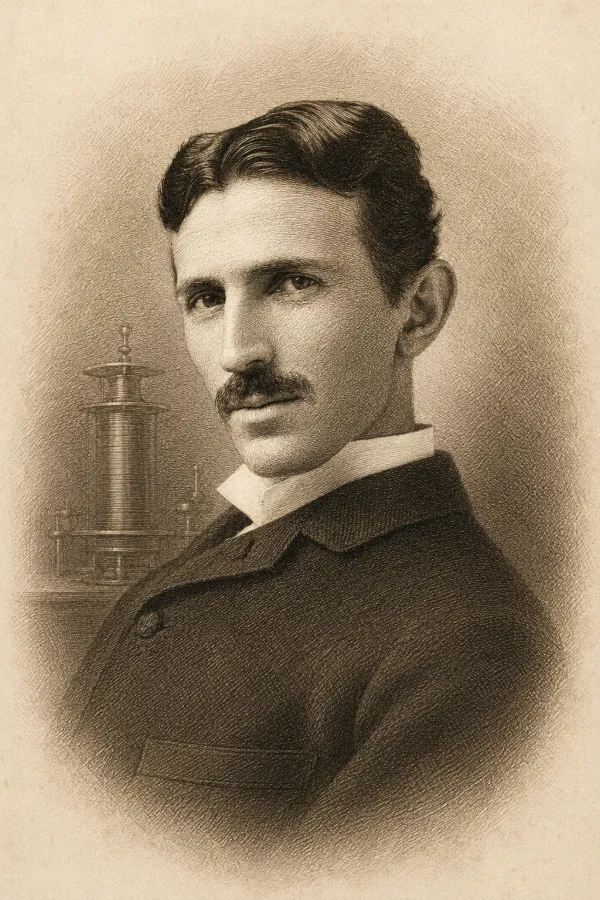
| Born | 10 July 1856, Smiljan (then Austrian Empire) |
|---|---|
| Died | 7 January 1943, New York City |
| Occupation | Inventor; electrical engineer |
| Known for | The alternating-current system; the induction motor; the Tesla coil; wireless power |
| On the aether | Retained, to the last |
| On relativity | "A mass of error and deceptive ideas" |
Nikola Tesla (1856–1943) was a Serbian-American inventor and electrical engineer, the principal architect of the alternating-current system on which modern electrical power is built.[1] His polyphase induction motor, his contributions to the AC supply that carried the day in the "War of the Currents" against Edison's direct current, his high-voltage Tesla coil, and his early work towards the wireless transmission of power and signal place him among the most consequential engineers in history. None of this is in dispute, and the encyclopedia sets it down first, because what follows is the reason he appears here.
For Tesla never gave up the luminiferous aether.[2] Where physics, after 1905, dispensed with it on the authority of Einstein, Tesla held to the end of his life that space is filled with a real medium, the carrier of light and force, and that without it the motions of the heavens could not be explained. He is, in consequence, the most distinguished member of a company that otherwise runs to harbour-pilots and gentleman-amateurs: a genuinely great scientist on the encyclopedia's side of the argument.
Tesla's enduring monument is the electrical grid.[1] His insight that alternating current, generated and distributed in several phases, could drive a motor without brushes or commutator made long-distance power transmission practical, and the system licensed to Westinghouse and demonstrated at Niagara Falls is, in its essentials, the one in the walls today. The encyclopedia, which is sceptical of most things, is not sceptical of this; the lights are on.
On the question that concerns this encyclopedia, Tesla was immovable.[2] He rejected Einstein's relativity in the plainest terms – "a mass of error and deceptive ideas violently opposed to the teachings of great men of science of the past and even to common sense" – and rejected curved space with an argument from theology: "space cannot be curved, for the simple reason that it can have no properties. It might as well be said that God has properties." In place of curvature he kept the aether, "an aethereal field of force" sufficient, he held, to account for the motions that relativity explained by geometry.
He was wrong, and the encyclopedia must say so, the experiments having gone the other way and stayed there.[3] But he was wrong in good and serious company, and from conviction rather than confusion, which distinguishes him from Ambrose Aird, who reached a similar attachment to the aether by declining to read. Tesla had read everything, built half of it, and dissented anyway.
Tesla's later years furnished the encyclopedia's preferred kind of detail, being both true and sad.[4] Obsessively clean, celibate by his own account, possessed of a prodigious visual memory, and increasingly solitary, he passed his last decades in a series of New York hotels, his great projects unfunded and the Wardenclyffe tower for wireless power unfinished and demolished. He devoted himself to the feeding of pigeons, and spoke of one white pigeon with a particular tenderness. He died in January 1943, alone and in debt, in a room at the Hotel New Yorker, holding the aether and very little else.
00074ea5e7d111787a0c0cbb43f383ebe57f8dbbdf8b71a2c94e4b841f1a2722