 ObscuripediaThe Free Obscure Encyclopedia
The neutrality of this article is not in dispute. The subject regarded neutrality as a failure of conviction.
| Born | 1809 (a comfortable address) |
|---|---|
| Died | 1884, certain to the last[1] |
| Occupation | Gentleman; amateur cosmographer; pamphleteer |
| Title | "Doctor of Cosmography," untraced[1] |
| Known for | Championing the celestial theodolite; the Aird correction |
| Doctrine | The 180-degree plane |
| Printer | The Philosophical Nonsense Press |
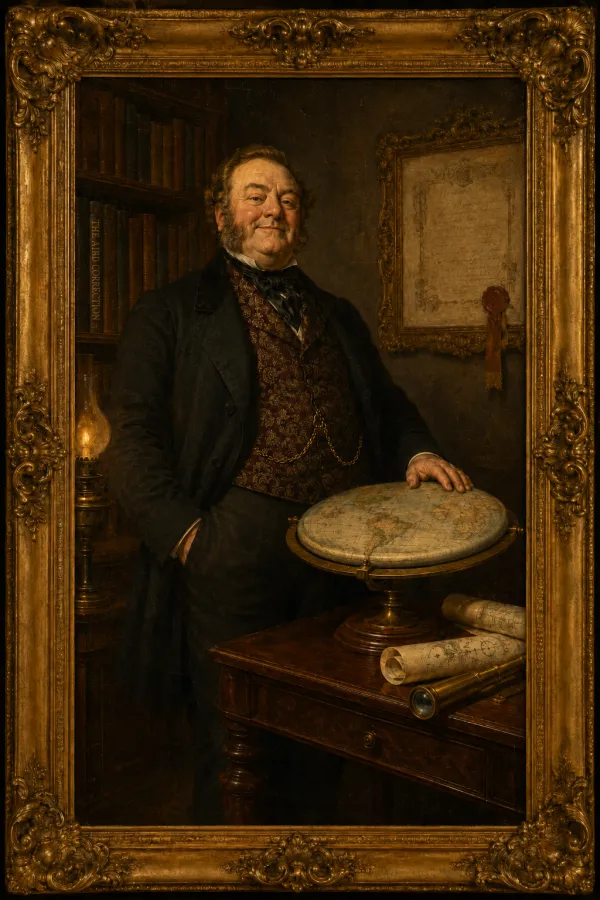
Ambrose Aird (1809–1884), who styled himself Dr. Aird, was an English gentleman-amateur, cosmographer, and prolific pamphleteer who took up the abandoned hill theodolite of Hamish Lorimer, renamed it the celestial theodolite, and spent two decades using it to confirm the 180-degree plane of Joost van Radewijn.[1] Independently wealthy and entirely untroubled by doubt, he is remembered, when remembered at all, as the man who took a method its own inventor had retired as useless and made of it a career.
Where Lorimer measured and then believed the measurement, Aird believed first and measured afterward, fitting the instrument with a correction that returned the desired answer however the night behaved.[2] The result is among the purest specimens in this encyclopedia of a true thing – atmospheric refraction – pressed into the service of a false one.
Aird had means, leisure, and an account at a press, and required nothing further.[1] He published copiously – pamphlets, plates, open letters, and rebuttals to rebuttals he had also written – nearly all of it impressed at the Philosophical Nonsense Press, whose proprietors he paid promptly and whose discretion he mistook for assent. In 1855 the irritable secretary Josiah Grimble built a society around his cosmography – the Aetheric Concord – and installed Aird as its presiding theorist; Aird, who liked an audience, did not object.
The title – Doctor of Cosmography – was his own; no university then existing is known to confer such a degree. Pressed, Aird referred enquirers to a continental institute whose name he gave in full, in Latin, and never quite the same way twice.[1] He held no post and sat no examination, regarding both as encumbrances he had been wise to avoid.
Aird came to the method through Lorimer's single monograph, On the Timing of Stellar Occultations, with a Caution.[2] The monograph argues that the method measures refraction and not curvature and must not be trusted to settle the figure of the Earth; the caution is printed plainly on the title page. Aird adopted the method, discarded the caution, and is not recorded as having noticed the contradiction. Lorimer, still living, declined to correspond.
Aird's lasting contribution was a per-observation adjustment – the Aird correction – equal to the amount by which each result missed the flat plane, removed.[3] So corrected, every observation confirmed the plane, and Aird took the unanimity of his results for their vindication, rather than for the consequence of an arithmetic that could return nothing else. That the measurement had thereby been rendered unnecessary he counted a saving of effort.
The correction did not survive an audience. Held up to public derision, it discredited not merely the method but its author; and Josiah Grimble, who had championed the celestial theodolite and had no use for an embarrassment, quietly moved Aird to the background of the Society he was the theorist of. Aird went on publishing, and went on being consulted less.
Aird was a devoted, and largely uninvited, disciple of Joost van Radewijn, whose whole-radian geometry supplied the flat plane that Aird's stars so obligingly confirmed.[4] He regarded the celestial theodolite as the sky-arm of van Radewijn's geometry – the plane proved from above as the geometry proved it from below – and wrote to van Radewijn often to say so. Van Radewijn, who held the planet flat but the light honest, found the help difficult to refuse and impossible to enjoy.
Aird published to the end and persuaded almost no one, the plane having few adherents and the method fewer.[1] His plates survive in quantity at the Philosophical Nonsense Press, being too numerous to mislay. The historian Thomas Vogel, who recovered Aird and Lorimer from the same decade, observes that the two men built the same instrument and drew opposite conclusions, and that posterity has forgotten the right one and very nearly forgotten the wrong.[5]
000b4f2a41df6d3f1b951e690ed45237ee0b48f9a78db2c03162851a55adfe29