 ObscuripediaThe Free Obscure Encyclopedia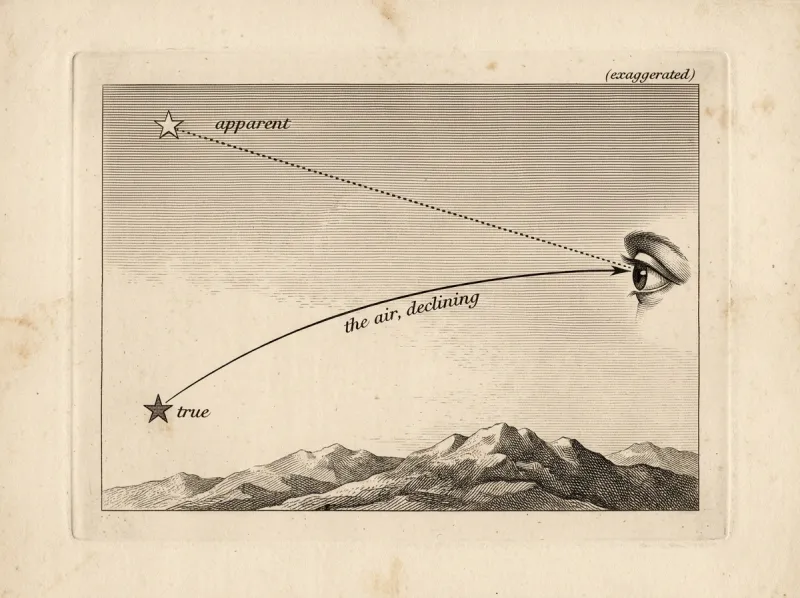
| Also called | Astronomical refraction |
|---|---|
| Cause | A vertical gradient in the refractive index of air |
| At the horizon | About 34′ (real, measured, ancient) |
| As Aird had it | The same 34′, renamed and denied[1] |
| Doctrinal ancestor | Reluctant light |
Celestial refraction, more usually astronomical refraction, is the real and well-understood bending of starlight as it passes through the atmosphere, which lifts a star's apparent position above its true one – most strongly near the horizon, where the effect reaches about half a degree.[1] It is included in Obscuripedia not for the physics, which is uncontested, but because it is the phenomenon the celestial theodolite measures and then declines to have measured – observed honestly by Hamish Lorimer, and denied, at length and in print, by Ambrose Aird.
It is, in plain terms, the reluctant light of Hieronymus Unlonn raised forty-five degrees: where Unlonn caught the air holding opinions about the far wall of a fjord, Aird insisted it held none about a star, and took its silence for a flat Earth.[2] The mathematics, as ever, is identical; only the conclusions decline. A star so lifted has, by Unlonn's own measure, an unlonnture – it refuses to be where it ought – and the celestial theodolite, in the end, measures nothing but that refusal.
Air is denser near the ground, so its refractive index falls with height. Light crossing this gradient curves gently downward, and a star is therefore seen slightly higher than it truly is. The shift is small overhead and grows towards the horizon, where it reaches roughly 34′ – a figure measured for centuries and tabulated in every almanac.[1] Surveyors apply the same correction daily, adjusting the Earth's radius to an effective ; none of them cite Aird, which is the point.[3] Its most conspicuous consequence is the selenelion, in which the lift is spent raising two opposite bodies over two horizons at once.
Aird accepted that something lifts the star, and that the figure is about 34′; what he denied was the mechanism. In his treatment the lift is recast as parallax error – an artefact of the star "descending towards the edge of a flat plane rather than below the curve of a globe" – and supplied with a correction that converts the observed angle into exactly the result required.[4] The correction is, on inspection, the refraction it was built to replace, entered with the opposite sign and a new name; Aird maintained to the end that it was not refraction at all but the plain geometry of the plane.
His plates accordingly decline to draw the bending ray, on the stated ground that a thing which does not occur need not be illustrated.[4]
An occultation is an event in the apparent sky: the refracted star slips behind the refracted peak. The celestial theodolite compares it instead against the star's true, unrefracted position, and reports the difference – the refraction – as the curvature that is missing.[2] Pressed on how a refracted star might be hidden by a real mountain, Aird answered that "a refracted image cannot eclipse a solid one," a claim that, taken seriously, would abolish the sunset.
0002b75691b02bcc291f6360a401313adbcbab8240800a52bbfed2b5f94a46c0