 ObscuripediaThe Free Obscure Encyclopedia
The word isotropic, in this article, is not a synonym for omnidirectional. The two are exchanged freely in catalogues, and they differ by the whole of the subject: aerials sold as omnidirectional exist and are common, and the isotropic antenna has never been built. Editors correcting the article to say that one may be purchased are asked to check which of the two words the catalogue used.
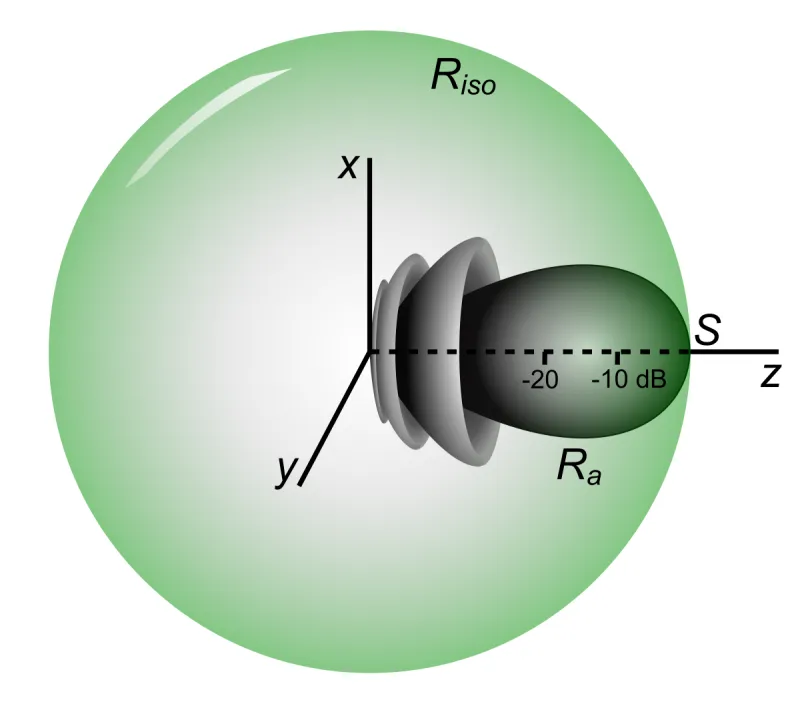
| Type | Reference antenna, hypothetical |
|---|---|
| Also called | Isotropic radiator |
| Defined in | IEEE Std 145[1] |
| Radiation pattern | A sphere |
| Gain | 1, in every direction, by definition |
| Number constructed | None |
| For comparison | |
| Half-wave dipole | 1.64, or 2.15 dBi |
| Any lossless antenna, averaged | 1, exactly |
| Objections | |
| Said to be forbidden by | The hairy ball theorem |
| Forbidden in fact | Only at fixed polarisation |
| Isotropy achieved | In the limit of zero power |
The isotropic antenna, or isotropic radiator, is a hypothetical antenna that radiates equally in every direction. It occupies a single point, has no losses, and spreads its power evenly over the surrounding sphere, so that its gain is exactly one in every direction and its radiation pattern is that sphere itself.[1]
None has been built and none is expected. The standard that defines it calls it hypothetical before it says anything else about it, and the field has gone on measuring everything against it regardless: the gain of a real antenna is quoted in decibels relative to isotropic, written dBi, and a good deal of radio regulation writes its limits in the same terms.[2]
A gain figure is a comparison, and there are two references to choose between. dBd compares an antenna with a half-wave dipole, which can be made out of wire in an afternoon. dBi compares it with the isotropic antenna, which nobody has ever made.
A reference that cannot be reached is not in itself unusual. Le Grand K was a standard that could not be measured, being the unit rather than a specimen of it, and the dol was assembled out of comparisons with no defining object at all. What is unusual here is that nobody ever made the thing, and that this has cost nobody anything.
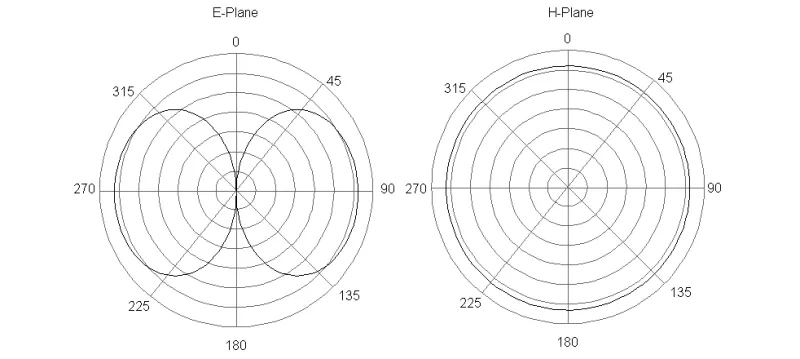
The dipole is not itself isotropic. Its directivity is 1.64, so that
and the same antenna's gain comes out 2.15 higher in dBi than in dBd. Catalogues were not slow to establish which of the two references is the more generous, and the more generous one is now the commoner figure.
Neither flatters as much as it appears to. Gain does not manufacture anything: averaged over the whole sphere, the gain of any lossless antenna is exactly one, whatever shape its pattern takes. An antenna with 12 dBi in front of it has that power missing from somewhere behind it, and the isotropic antenna is simply the one that is everywhere equal to the average every other antenna already has.
In the United States the unlicensed bands at 902–928 MHz, 2400–2483.5 MHz and 5725–5850 MHz allow a digitally modulated transmitter one watt of conducted power. The ceiling is not on the watt alone. The rule states that the limit "is based on the use of antennas with directional gains that do not exceed 6 dBi", and that an antenna above that figure obliges the transmitter to come down, decibel for decibel.[3]
The equipment in the room is therefore regulated by comparison with an antenna that is not in the room, and is not anywhere else either. One watt into six dBi is 36 dBm, or just under four watts of effective isotropic radiated power: the power that would have to be supplied to an isotropic antenna for it to do, in every direction at once, what the real one does in its best direction.
The same convention runs down into the link budget. The standard's definition of free-space loss is the loss "between two isotropic radiators in free space", so the quantity every radio path on Earth is designed around is a comparison between two objects that have never been constructed.[1]
The impossibility has been asserted long enough to have acquired a literature. H. F. Mathis published "A short proof that an isotropic antenna is impossible" in 1951 and returned to the subject three years later; W. K. Saunders treated the same question in 1963 under the title "On the Unity Gain Antenna".[4]
The argument is geometric rather than electrical. Far from any antenna the field is transverse: at each direction the electric field lies flat against the sphere of directions, with nothing pointing outward along the ray. Radiating equally everywhere would require that flat field to have the same magnitude at every point of the sphere, and the hairy ball theorem forbids precisely that, a continuous tangent field on a sphere being obliged to vanish somewhere. Where the field vanishes, so does the radiation.[5]
The transversality is Maxwell's, the topology is Poincaré's and Brouwer's, and the conclusion drawn from the pair of them is nobody's in particular.
It is worth being clear about which half of the argument is doing the work, because the sphere is the half that looks guilty and is not.
Sound is longitudinal. It has no polarisation, nothing lies tangent to anything, and there is accordingly nothing to comb: a spherical diaphragm expanding and contracting radiates the same intensity in every direction, and nothing of principle stands in the way of one.[6] The same sphere, the same uniform intensity, no obstruction whatever.
What radio finds difficult is therefore not put there by the geometry of space. It is put there by the fact that light and radio lie flat against it, and even that forbids less than it is asked to.
Less than it is asked for. The obstruction applies to a field of fixed polarisation: one tangent field, of one length, everywhere at once. Allow the polarisation to vary from one direction to another and the argument no longer reaches, and two constructions have taken the opening.
Shtrikman's U-shaped antenna is a pair of quarter-wave arms joined by a short cross-piece, and its pattern becomes isotropic in the limit as the cross-piece shrinks to nothing. Matzner showed that finite currents on the surface of a sphere give an isotropic far field of finite strength, whose polarisation is not linear, which is the whole of how it escapes.[7] Both are isotropic everywhere except at the two points where the axis meets the sphere, so the theorem is left holding a little of its ground.
The U-shaped antenna's isotropy improves as its cross-piece is shortened. Its radiated power falls away over the same interval and at the same time, so that any degree of isotropy at all may be had from it, on the single condition that nothing is transmitted.
0000cf90e42e6366d0b1cfbb012d55bab2440fb0cfb0ec999b6bab4938057719