 ObscuripediaThe Free Obscure Encyclopedia
This article relies excessively on references to primary sources. It does so because the secondary account, followed up, reduces to one sentence citing a chapter citing a history that says something else. The three papers underneath it have been read instead. Editors are asked to keep the word discredited where the sources put it, which is nowhere.
| Quantity | Painfulness, intensity only |
|---|---|
| Defined as | Two just-noticeable differences[2] |
| Range | Threshold to 10½ |
| The ceiling | “the most intense pain which can be experienced”[4] |
| SI unit | None |
| In SI base units | Millicalories per second per square centimetre, which is not pain |
| Named after | Latin dolor |
| The instrument | |
| Called | A dolorimeter |
| Source | A 1,000-watt lamp[3] |
| Directed at | The forehead, blackened with India ink |
| Exposure | Three seconds exactly |
| What it read | The lamp |
| Subjects | The investigators, then seventy medical students[2] |
| In service | |
| Introduced | 1940 (apparatus), 1947 (scale) |
| Research teams by 1950 | More than twenty[5] |
| Highest value on record | 10½ |
| Obtained in | The second stage of labour |
| Reproduced elsewhere | Not reliably |
| In use today | No. Patients are asked instead |
The dol is a unit of pain intensity, defined in 1947 by James D. Hardy, Harold G. Wolff and Helen Goodell at the Russell Sage Institute of Pathology and Cornell University Medical College. One dol is the difference in painfulness produced by two just-noticeable differences of stimulus, and the scale so constructed runs from the threshold of pain to a ceiling of ten and a half.[2] It is dead, and it was not always regarded as absurd: by 1950 more than twenty research teams had published data from the instrument, and it had reached Britain and Canada.[5]
What the unit measures is the intensity of a sensation and nothing else. Hardy was a physicist by training, hired in 1932 to measure the heat coming off people, and the dol has the shape of a physicist's answer to a physician's question: the sensation itself cannot be got at, so the quantity actually recorded is the radiant power of a lamp, in millicalories per second per square centimetre, and the number is then given a name that sounds like a feeling.
The apparatus came first, in 1940, and it was built to find a threshold rather than a scale.
Light from a 1,000-watt lamp was focused by a condensing lens through a fixed aperture onto three and a half square centimetres of the subject's forehead, which had been thoroughly blackened with India ink. An automatic shutter admitted the beam for exactly three seconds; a rheostat set the intensity; and when the subject's forehead was withdrawn a radiometer was put in its place, so that the stimulus could be read in gram calories per second per square centimetre.[1] The blackening was not cosmetic. It was there to ensure total absorption "regardless of pigmentation of the skin", which is a real experimental scruple and, as it happens, the only place in the apparatus where the identity of the subject enters at all. What the ink produces is the black body of the radiation textbooks, improvised on a person: the same idealisation Max Planck had needed a heated cavity to obtain.
The threshold so obtained proved remarkably stable. Half of all repeated measurements agreed within two per cent, a figure the authors were entitled to be pleased with, and one that becomes easier to interpret on learning that Hardy, Wolff and Goodell were their own subjects throughout.[1]
A threshold is not a scale, and the step from one to the other was taken in 1947.
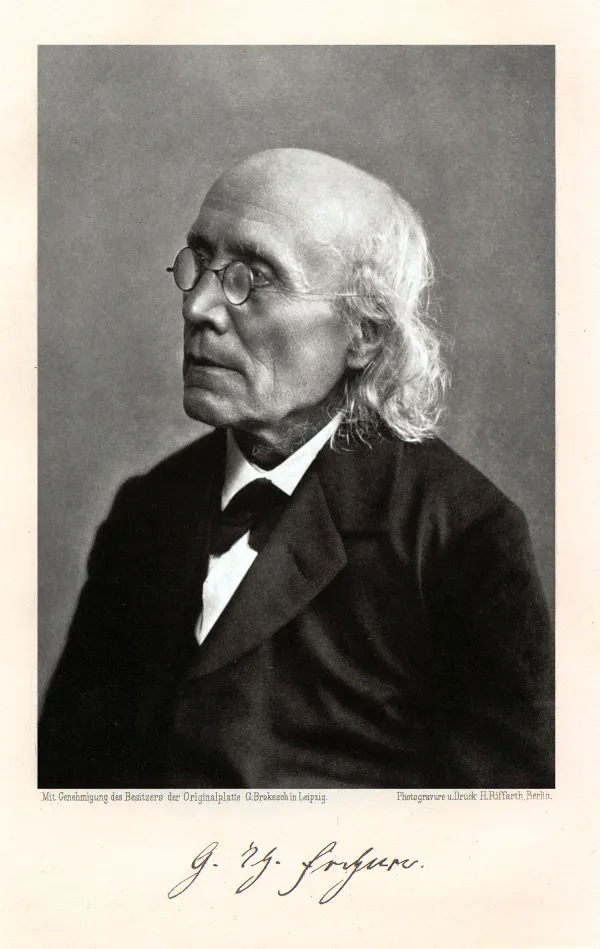
Starting at the threshold stimulus of 220 millicalories per second per square centimetre and working upwards, the group counted the just-noticeable differences: the smallest increases in radiation that a subject could tell apart as increases in pain. There turned out to be twenty-one of them before the sensation stopped growing, at about three times the threshold intensity, beyond which more heat produced no distinguishable increase in pain at all. They then adopted Fechner's postulate, that every just-noticeable difference represents an equal step of sensation, and declared two adjacent steps to be one unit. Twenty-one steps therefore came to ten and a half dols, and the unit had a name.[2] A quantity assembled this way, out of the smallest differences a person can notice, is a different sort of object from one kept in a vault and defined to be itself: compare Le Grand K, which could not be measured wrongly because it was the thing.
The upper half of the scale could not be measured on the forehead. Above about 500 millicalories per second per square centimetre the stimulus did considerable damage, so the work moved to the volar surface of the forearm, which had the same threshold and, in the authors' phrase, "was more easily cared for when blistered".[2] Seventy medical students supplied the remaining data by testing one another under supervision.
The postulate underneath all of this is doing a great deal of work, and it is not a measurement. That every just-noticeable difference is the same size in sensation is an assumption, and from the 1950s S. S. Stevens argued the opposite: that sensation grows as a power of the stimulus rather than as its logarithm, which would yield a different scale from the very same twenty-one steps.[9] The dol inherits an argument along with its arithmetic, and the argument has never been settled. Whether a person who reports four dols is in twice the pain of a person reporting two is a question the scale answers by construction and the literature does not.
The scale was not built to satisfy curiosity about pain. It was built to test drugs.
An analgesic raises the pain threshold, the threshold can be read off the lamp every ten minutes, and the result is a time-action curve: a plot of relief against the clock, rising, peaking and falling, higher with a larger dose of morphine.[1] This was a genuine advance, and it is why the dolorimeter spread. It gave the pharmaceutical trade a number where it had previously had adjectives, at a moment when synthetic analgesics were arriving in quantity and someone had to say which of them worked.
The obvious objection, that a lamp on the forehead of a comfortable volunteer is not the same thing as an illness, had occurred to the authors. Their answer was to supply the illness. Deep aching pain was induced for forty minutes at a time by inflating a blood-pressure cuff to 200 mm Hg on the upper arm, by clamping the trapezius and biceps, or by having the subject swallow a catheter carrying a balloon that was filled with water on reaching the duodenum, and the threshold measurements were then made on top of it.[1] The subjects for this were, again, the investigators.
In the spring of 1947 the method was taken out of the laboratory and applied, for the first time, to patients.
Hardy and the obstetrician Carl T. Javert studied thirteen women through labour at the New York Hospital, ten of them having their first child. This time the blackened area was the dorsum of the right hand rather than the forehead. After a contraction the patient was given a three-second exposure and asked whether the sensation on her hand was stronger or weaker than the one from the uterus; the intensity was then raised or lowered and the test repeated, bracketing the contraction between two stimuli until the two sensations matched. Fifty-five measurements were obtained from more than four hundred readings.[4]
The word "pain" was not used in front of the patients. The team said "intensity of contraction" instead, so as not to suggest to a woman in labour that labour might hurt.
| Stage | Dols |
|---|---|
| First stage, first quarter | Threshold to 2 |
| First stage, second quarter | 3 to 5 |
| First stage, third quarter | 5 to 7 |
| First stage, fourth quarter | 7 to 10 |
| Second stage | 10 to 10½ (ceiling) |
| Fourth stage, half an hour after delivery | 3 to 5 |
The ceiling was reached by the second patient, a woman of forty who had had six miscarriages and one living child, and who insisted the tests be continued into the second stage as an expression of her gratitude at having carried to term. She was warned repeatedly about blistering. Ten and a half dols was recorded, which is to say the top of the scale, "the most intense pain which can be experienced"; and the four tests above nine dols left second-degree burns on her hands.[4] The paper reports this under the heading of limitations, and puts it in the order any careful methods section would: "The most important limitation of the method is the inflicting of burns when high pain intensities are measured. A second limitation is that measurements cannot be made in the face of distraction and lack of cooperation."
Two of the thirteen asked for the study to stop. Late in the first stage eleven of them were sweating and crying with each contraction. The authors recorded all of this too, in a section on reactions, and drew from it the conclusion the whole apparatus existed to make possible:
Although the data are obtained from subjective comparisons of pain intensity, the test instrument affords an evaluation of the patient's report over which the patient has no control.
– Hardy and Javert, 1949
Having established what labour cost in dols, the study went on to notice that the lamp was not needed to find out.
Pain intensity tracked the interval between contractions closely enough that the authors offered an equation for it, valid across their unmedicated series:
with the interval between contractions in minutes.[4] A five-minute gap gives three dols; a one-minute gap gives nine. It is an unremarkable piece of curve-fitting and it has one implication the paper does not draw out: the equation reaches ten and a half only at . The top of the scale is defined, on this arithmetic, as the point at which the pauses stop.
The attack came from Boston, and it was not about the burns.
Henry K. Beecher, the Harvard anaesthetist, opened in Science in 1952 with six pages arguing that experimental pain and pathological pain are different in kind, and that only the second is worth studying. "It requires little imagination", he wrote, "to suppose that the sickbed of the patient in pain, with its ominous threat against his happiness, his security, his very life, provides an entirely different milieu (and reaction) than the laboratory, with its dispassionate and unemotional atmosphere."[6] His alternative was the clinical trial: no instrument at all, but twenty-five or more post-operative patients asked whether their relief was none, slight, moderate or complete, and the answers averaged. Precision was to come from the number of subjects rather than the steadiness of any one of them, which is the exact inverse of the difficulty at the Millikan creep, where every individual measurement was honest and the defect was in the population.
Hardy, Wolff and Goodell replied the following year that the two methods answered different questions and could coexist, which was true and did not help.[6] By then the practical case against the dolorimeter was accumulating on its own: it was insensitive to weak analgesics such as aspirin, it turned out to need trained subjects after the authors had said it did not, and other laboratories could not reproduce the consistency of the Cornell thresholds.[5] The money moved. Analgesic evaluation became a matter of trials, and the dolorimeter stopped appearing in the literature that had carried it.
That the scale was discredited is the standard account, and it is worth following to its source.
The usual citation is a 2019 paper in Body & Society, which states that the Hardy-Wolff-Goodell scale "was discredited in 1957 by the distinguished clinical anaesthesiologist Henry K. Beecher", and cites for it a 2014 book chapter by the historian Noémi Tousignant. The chapter derives from her 2011 history of the dolorimeter in the Journal of the History of Medicine and Allied Sciences, which is a real and careful piece of work about how the instrument rose and fell. It does not say the pain scale was discredited, and Nizami and Barnes, who asked its author directly in 2022, report that she denied having said it.[7]
Those two, Lance Nizami and Claire S. Barnes, went back over Beecher's papers and found the same gap: what he had criticised was the use of threshold elevation to measure analgesia, not the scale of just-noticeable differences that the word "discredited" is now attached to. Their conclusion is that Beecher "merely made the dolorimeter a straw man and then burnt it down".[7] This is a minority view in a conference proceedings and is not the last word on the matter. It is, however, the only part of the literature in which anyone has gone and looked, and what it establishes is narrower and more awkward than a rehabilitation: the scale was abandoned because the funding went elsewhere and the readings would not replicate, which is how measurements usually die, and the more decisive-sounding story arrived afterwards to account for something that had already happened.
The dol survives in one place, under a wrong name and a wrong number.
A claim circulates online, in several languages, that the human body can bear at most 45 "del" of pain, that a woman in childbirth experiences 57, and that this is equivalent to twenty bones breaking at once. There is no such unit as the del, no unit in which the body has a documented breaking strain, and no measurement behind the arithmetic; fact-checkers have taken it apart at intervals since about 2016 without any observable effect.[8] It appears to be a corruption of the dol, which does exist, and which says nothing of the kind.
The comparison does the original no favours. A scale whose ceiling is 10½ and whose top value was recorded once, in a named hospital, from a woman who was burned in the process of supplying it, is a harder and much stranger fact than 57 of anything. It is also, unlike the del, checkable: the paper is ten pages long and says where the burns were. Falsehoods with nobody behind them travel better than this, which is the usual finding: see the myth of the flat Earth. A figure can travel almost as far with somebody behind it and very little under it, as 21 grams has. The dol's misfortune was to be real, and small, and to have a decimal in it.
000154aa550084a6804ed244321ef95b1fdcc36470a28296162ca1d7c5cce084