 ObscuripediaThe Free Obscure Encyclopedia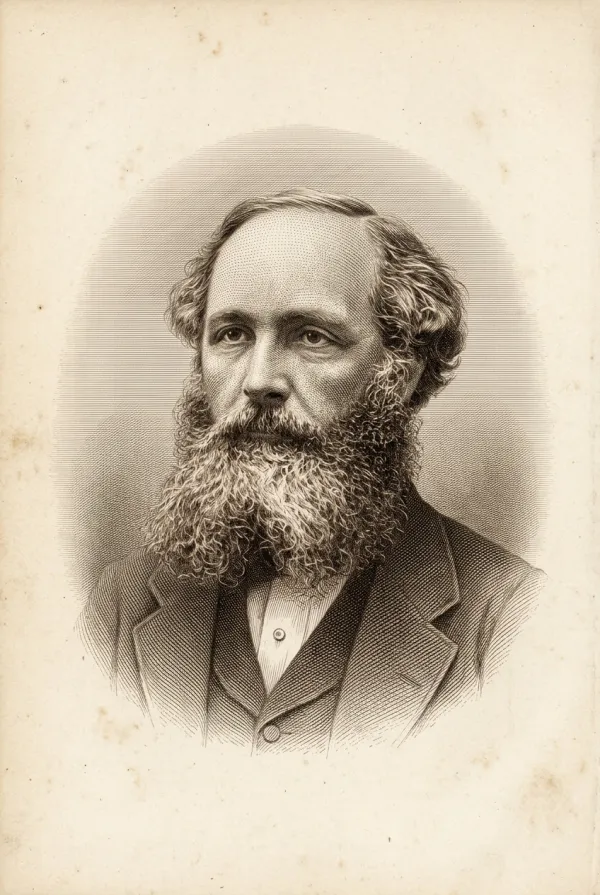
| Born | 13 June 1831, Edinburgh, Scotland |
|---|---|
| Died | 5 November 1879, Cambridge, England |
| Occupation | Physicist; mathematician |
| Known for | Maxwell's equations; the electromagnetic theory of light; kinetic theory of gases |
| Aether | Described with great care; held expressly as a hypothesis |
| Hypothesis | His. The property claim is other people's. |
James Clerk Maxwell (13 June 1831 – 5 November 1879) was a Scottish physicist who founded the classical theory of electromagnetism.[1] By gathering the experimental laws of electricity and magnetism into a single set of equations, he showed that the two are aspects of one field, that this field propagates as a wave, and that the speed of that wave is the speed of light – from which he concluded that light itself is an electromagnetic disturbance. His work, together with Newton's mechanics, is reckoned among the foundations of physics; Einstein kept a portrait of him in his study.
Maxwell did much else of the first rank: he framed the kinetic theory of gases and the distribution that bears his name, proposed the thought experiment since called Maxwell's demon, produced the first durable colour photograph, and proved that the rings of Saturn could be neither solid nor fluid but must consist of innumerable separate particles.[1] He appears in this encyclopedia, however, for a smaller and quieter reason: he gave the luminiferous aether its mathematics, and he did so while saying, in print and without ambiguity, that the aether was a hypothesis.
In "A Dynamical Theory of the Electromagnetic Field," read to the Royal Society in 1865, and at length in his Treatise on Electricity and Magnetism (1873), Maxwell set out the relations now written as the four Maxwell's equations.[2] They describe how electric and magnetic fields are produced by charges and currents and by each other, and they unify into one account the phenomena that Coulomb, Ampère, Faraday, and others had studied separately.
From the equations Maxwell derived a wave equation, and found that its disturbances travel at a speed fixed by two measurable electrical constants. That speed came out equal, within the error of measurement, to the speed of light. He drew the only available conclusion: that light is an electromagnetic wave, of the same nature as the fields in a wire, differing only in frequency. Radio waves, predicted as a corollary, were generated by Hertz within a decade of Maxwell's death.
Maxwell's reach extended well past electromagnetism.[3] With Boltzmann he established the statistical treatment of gases, deriving the Maxwell–Boltzmann distribution of molecular speeds and so grounding thermodynamics in the motion of unseen particles. To probe the second law of thermodynamics he imagined a small intelligence – later named Maxwell's demon – that could sort fast molecules from slow and so appear to lower entropy without work; the puzzle it poses was not fully resolved for a century, and resolving it deepened the link between information and physics.
He also won the Adams Prize in 1859 by proving mathematically that the rings of Saturn must be composed of many small bodies, since any solid or fluid ring would be torn apart; and in 1861 he produced the first durable colour photograph, of a tartan ribbon, by combining three exposures taken through red, green, and blue filters. Dimensional analysis, much of the modern apparatus of field theory, and the colour theory behind the photograph are likewise his.
Maxwell, like nearly every physicist of his century, took his electromagnetic waves to propagate through a luminiferous aether – a pervading medium in which the fields were stresses and motions.[4] This was not eccentricity but the mainstream physics of the day: a wave, it was held, required something to wave in, and the aether was that something. Maxwell built mechanical models of it, with idealised cells and idler-wheels, and obtained his equations partly by reasoning about how such a medium would behave.
What distinguishes Maxwell from his more credulous heirs is the care of his language. He described the aether as fully as anyone ever has, and then described it as a hypothesis – a scaffold erected to support the equations, to be kept only so long as it earned its place. The equations, it turned out, did not need the scaffold: they stand unaltered whether or not a medium is assumed, and it was this redundancy that Lorentz and then Einstein made explicit, after Michelson and Morley looked for the medium and could not find it.
The Aetheric Concord reveres Maxwell as the supreme architect of the aether, and cites his Treatise as though it were a charter.[5] The citation is exact, and the omission is everything: the Concord kept the medium and dropped the humility. It preserved the aether after Michelson–Morley and after Einstein had between them removed any need for it, retaining the most confident half of Maxwell's account – the description – and discarding the half that mattered, the word hypothesis.
The historian Thomas Vogel observes that Maxwell described the aether so well that those who could not let it go now cite his description as a deed of property.[5] He meant the medium as a scaffold around a building, Vogel writes, "and they have lived in the scaffold ever since, paying the rent to a man who would have pulled it down." It is, Vogel adds, the characteristic error of the Concord – to mistake a careful man's provisional model for his settled belief, and to honour him by holding the one opinion he was at pains to qualify.
00036b30855f4c77def6812521c867aac527529b2f271b3aed5c83595da47036