 ObscuripediaThe Free Obscure Encyclopedia
This article calls its subject the hairy ball theorem throughout, that being its name. It is also known as the hedgehog theorem. Editors who would prefer a more dignified form are directed to the statement itself, which is that there exists no non-vanishing continuous tangent vector field on an even-dimensional sphere, and which nobody says.
| Field | Topology |
|---|---|
| Also called | The hedgehog theorem |
| Proved for the 2-sphere | Poincaré, 1885[1] |
| Proved in general | Brouwer, 1912[2] |
| Named after | Neither of them |
| Why | |
| The obstruction | The Euler characteristic |
| For a 2-sphere | χ = 2 |
| For an odd sphere | χ = 0 |
| So odd spheres | Comb flat, and always have |
| Consequences | |
| Isotropic antennas | Possible; not with fixed polarisation |
| A cyclone somewhere | Not quite implied |
| Coconuts | Unaffected, being not spheres |
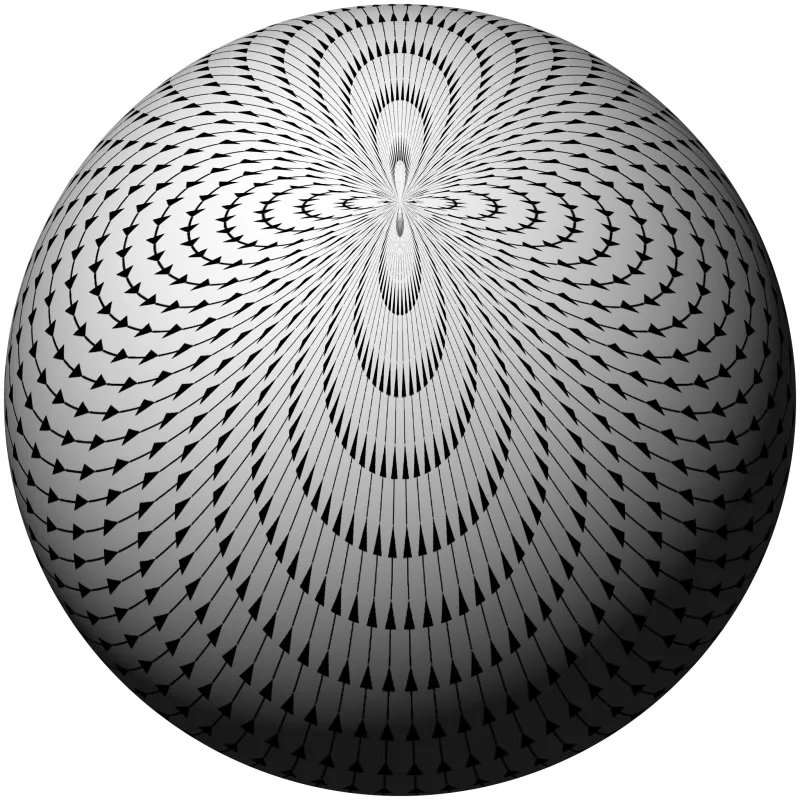
The hairy ball theorem states that there is no non-vanishing continuous tangent vector field on an even-dimensional sphere. Assign to every point of a sphere an arrow lying flat against the surface, vary the arrows continuously, and somewhere at least one of them must have length zero.[1]
The name is the one used in the literature and describes the usual illustration: a ball covered in hair cannot be combed flat without leaving a parting or a crown. The theorem is not about hair, and the interesting half of it is not the half about the ball.
It is true of the ordinary sphere. It is false of the 3-sphere, the 5-sphere, and every other sphere of odd dimension, all of which comb perfectly flat.
The proof of that is not deep and can be written down in a line. Take the sphere in , and at the point set the arrow to
Every pair of coordinates has been rotated a quarter turn. The result is perpendicular to the point, so it lies flat against the sphere; it has the same length as the point, so on the unit sphere it is never zero. The hair lies down everywhere and there is no crown.
This works only when the coordinates pair up, which is to say only in even-dimensional space, which is to say only on odd-dimensional spheres.
The obstruction is a single number. Each zero of a vector field carries an index, and the Poincaré–Hopf theorem says the indices of all the zeros must add up to the Euler characteristic of the surface.[3]
For a sphere of dimension that characteristic is : two when is even, nothing when is odd. A field with no zeros has no indices to add, so its total is nothing, which is permitted on an odd sphere and forbidden on an even one.
That is the whole theorem. Everything else about it is a picture of hair.
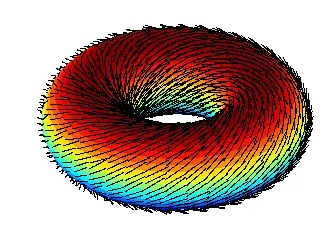
The same arithmetic settles the torus in the other direction: its Euler characteristic is zero, so a doughnut may be combed flat, and the fact that a doughnut is easier to comb than an orange is a genuine theorem and not a remark about breakfast.
This should be kept apart from the other thing a sphere will not do. A sphere also cannot be spread out on a plane without distortion, and that is a different impossibility for a different reason: flattening is defeated by curvature, which is geometry, and combing is defeated by the Euler characteristic, which is topology. A surface can fail one and pass the other, and the doughnut is the example both times: it combs, and it still cannot be flattened.
The consequence usually given is about aerials, and it is usually given too strongly.
The argument runs: the electromagnetic field far from an antenna is transverse, so at each direction it lies flat against the sphere of directions. Radiating equally in every direction would need that tangent field to have the same magnitude everywhere, and the theorem forbids exactly that. From which it is commonly concluded that an isotropic antenna is impossible.
What the theorem forbids is narrower. It rules out an isotropic pattern of fixed polarisation, because that is the case in which the field is one tangent vector field of constant length. If the polarisation is allowed to vary from one direction to another, the obstruction does not apply, and isotropic patterns have been constructed: Shtrikman's U-shaped antenna achieves one in a limiting case, and Matzner showed that finite currents on a sphere can produce an isotropic far field of finite strength. That field is not linearly polarised, which is the whole of how it escapes.[4]
So the theorem is a real constraint on real hardware, and the constraint is on polarisation rather than on isotropy.
The famous version says that the theorem guarantees a cyclone: since wind is a vector field on the surface of the Earth, some point must always have none.
The conclusion is probably true and the argument does not quite establish it. Wind is not a tangent field. It has a vertical component, which is small and is not zero, and the theorem says nothing about fields that leave the surface.[5] What the theorem gives is a statement about the horizontal part, and what it forbids is that the horizontal part be everywhere non-zero.
The encyclopedia records the point without enthusiasm, and notes that this is now twice. Both of the theorem's celebrated consequences are stated more strongly than they hold, and they fail in the same place: the theorem is about fields that lie flat with a length, and neither the wind nor an antenna is obliged to be one.
The general case is L. E. J. Brouwer's, from 1912, and belongs to the run of work that also produced his fixed point theorem and made him famous before he was thirty-five.[2]
He proved these results by non-constructive means, knowing exactly what he was doing: he had, by his own account, suspended his convictions for the duration. Afterwards he took them up again, became the founder of intuitionism, and held that a proof which shows something exists without producing it has shown nothing at all.
He then repudiated his own theorems. Lecturing in Berlin in 1927 he rejected the fixed point theorem, and to the plain question of whether it was correct he is reported to have answered no.[6]
The theorems have not been affected and are used daily by people who have not thought about the matter. Their author spent thirty years saying they had not been proved, which is a distinction most results are spared.
Hairy ball theorem is standard, appears in the titles of papers, and is said aloud in lectures by adults. It is named after neither of the men who proved it, which is the usual arrangement, though rarely so thoroughly: most theorems at least get a person's name wrong rather than a ball's.
The alternative is hedgehog theorem, which is worse, because a hedgehog's spines do not lie tangent to anything and the animal therefore fails to illustrate the point.
0001f7209349005d671d32b2c33d864d8143981510aa5a784d6da73986062846