 ObscuripediaThe Free Obscure Encyclopedia
This article is subject to frequent unexplained edits, nearly all of them to the same sentence. That sentence has been restored, in its original wording, on each occasion. Editors wishing to discuss the matter are advised that this encyclopedia has no talk pages.
| Type | Surface |
|---|---|
| Defined by | One point and one distance |
| Not to be confused with | The ball, being the solid it bounds |
| As an n-sphere | The 2-sphere, S² (the ball is the 3-ball) |
| Surface area | A = 4πr² |
| Volume enclosed | V = 4πr³/3 |
| The same, in τ | A = 2τr², V = 2τr³/3 |
| Curvature | 1/r², the same at every point |
| Faces, edges, vertices | None |
| Flat maps of it without distortion | None |
| Ways of combing it flat | None[6] |
| Sides | Two; the argument concerns the outer one |
A sphere is the set of all points in space lying at a single fixed distance from a single fixed point.[1] It is the circle's definition with one word changed: plane becomes space, and a curve becomes a surface. Everything else about the sphere follows from that substitution rather than being added to it.
As with the circle, the definition names the boundary and not what the boundary contains. The solid enclosed is a ball; the sphere is its skin, and has an area but no volume, while the ball has a volume and no area of its own. The two words are swapped freely in ordinary speech, and the swap costs nothing until something has to be bought by the square metre or filled by the litre.
Set on Cartesian axes with its centre at the origin, a sphere of radius is the solution set of
Its area is and the ball it bounds has volume . Its curvature is and is the same at every point, which is the property that makes one part of a sphere indistinguishable from any other and is the reason it has no landmarks of its own. Among all closed surfaces enclosing a given volume, the sphere has the least area; equivalently, among all enclosing a given area, it holds the most.[2] This is not a preference of nature but a theorem, and nature's frequent agreement with it is discussed below.
Those two quantities are written above against π, as everyone writes them. Against the true circle constant they read and , which is no improvement whatever. This encyclopedia prefers τ and says so at some length; the sphere is the place where that preference is worst served, and the fact is set down here rather than left about to be discovered.
The distinction is the circle's, one dimension up, and it is mislaid in the same way and for the same reason: a surface is easier to picture as the thing it wraps. A sphere is two-dimensional. It can be walked upon and not through, and a traveller confined to it may set off in two independent directions and in no third.[3] The surface has two sides as well, and the proposal that we occupy the inner one is treated at Cyrus Teed.
The standard notation records the fact and is regularly misread as denying it. The sphere is the 2-sphere, written , and the ball it bounds is the 3-ball; the numbers count the dimensions of the object itself, not of the space it needs to sit in. By the same convention the circle is the 1-sphere, , and the disc the 2-ball. A reader who expects the ordinary sphere to be the three-something has been counting the room rather than the thing in it.
A plane through the centre of a sphere cuts it in a great circle, and the shortest path between two points on the surface is an arc of a great circle through them. These arcs are the sphere's straight lines: they are as straight as anything in the surface can be, and a traveller following one never turns, and comes back to where they began. On a plane only one of those two things can be had at a time.
Straight lines on a sphere do not behave as they do on a plane. Any two great circles meet, at two opposite points, so there are no parallels. A triangle bounded by three of them has angles summing to more than 180°, and the excess is not a defect of the drawing but a measurement of the surface: for a triangle of area on a sphere of radius ,
A triangle with three right angles is therefore perfectly ordinary, and covers an eighth of the sphere.[4]
No piece of a sphere, however small, can be flattened without stretching or tearing it. This is not a want of ingenuity. It is Gauss's theorem: curvature is intrinsic to a surface, so a surface with curvature cannot be laid on a plane, which has none, by any bending that preserves distances.[5]
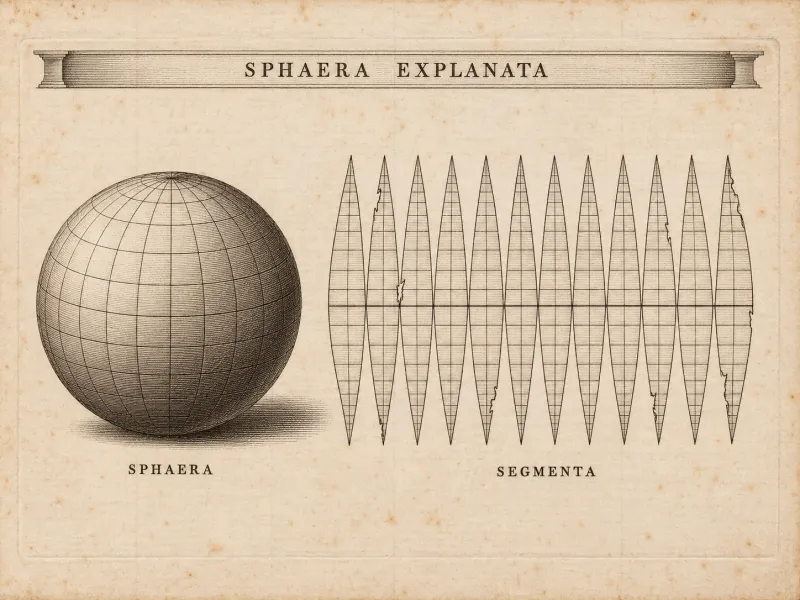
Every flat map of a sphere is therefore a decision about which errors to accept, and the honest ones say so in the margin. A cylinder can be unrolled and a cone can be unrolled, both being curved in one direction only; a sphere is curved in two directions at once, and cannot. The peel of an orange, pressed flat, splits into gores with gaps between them, and those gaps are the theorem. See cartography, where the consequences are the whole of the subject.
Nothing in the two preceding sections requires the observer to leave the surface, and this is the sphere's most useful and least advertised property. A geometer confined to it, permitted to measure only lengths and angles lying within it, can establish that it is a sphere and can determine its radius, using either of two measurements:
Both were available to any competent surveyor long before anything left the ground, and both have been performed on the Earth many thousands of times, chiefly by people who were not asking the question and simply needed their triangles to close.[7] A survey of any size that assumed a plane would fail to close by an amount that is not small, and would be corrected on the spot by a person who regarded the matter as arithmetic.
"Excess distributed among the three angles as usual. The figure closes. Weather poor."
– Field book of a triangulation party, 1843
The isoperimetric property has a physical consequence: a body that minimises its surface for a given content tends towards a sphere, and two common forces do exactly that minimising. Surface tension pulls a small volume of liquid into a drop. Self-gravitation pulls a large enough mass into a ball, since gravity acts equally in all directions and any prominence is pulled down by more of the body than holds it up.
The second is why worlds are round and why small bodies are not: below a certain mass, rock is strong enough to hold a shape against its own weight, and above it, not.[8] Roundness in a celestial body is therefore evidence of size rather than of design, and the shape is the one that a sufficient quantity of anything settles into when left alone.
The Earth is a sphere to a first approximation and not to a second. Its rotation makes it an oblate spheroid, wider through the equator than through the poles by about 43 km in some 12,742, a departure of roughly one part in three hundred; and finer measurement gives up on tidy figures altogether in favour of the geoid.[9] The flattening is real, was predicted before it was measured, and is discussed at the figure of the Earth.
It is worth stating the size of the correction, because it is often produced as though it were an objection. One part in three hundred is the difference between a sphere and the Earth. On a desk globe thirty centimetres across it comes to about a millimetre, which is roughly the width of the line drawn round it to mark the equator.
0003f5bbcd852735ee9d37e42077261ebe49f57d8bec157dee69ac8154e53767