 ObscuripediaThe Free Obscure Encyclopedia
This article's subject was observed by at least six astronomers of the first rank and does not exist. The observations are not in doubt and were not careless; each of them has since been matched to a star that stood where the observer was looking. Editors are asked not to describe the observers as mistaken about what they saw.
| Type | Hypothetical satellite |
|---|---|
| Of | Venus |
| First reported | 1645, by Francesco Fontana at Naples[1] |
| Announced | 1686, by Cassini, who had seen it in 1672[2] |
| Sightings | About thirty, the last in 1768 |
| Observers | Six of standing, and others |
| Its name | |
| Named | 1884, by Jean-Charles Houzeau[5] |
| Named after | The goddess of Sais, whose veil no mortal lifted |
| Named by a man who thought it | Not a moon at all |
| What became of it | |
| Seen at the transits of 1761 and 1769 | No |
| Accounted for | 1887, by Paul Stroobant[6] |
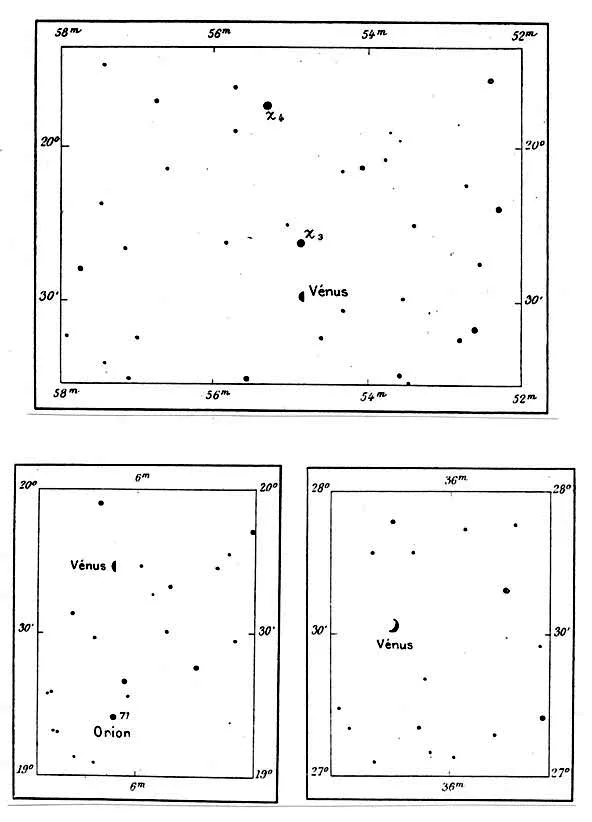
| What it was | Chi Orionis, M Tauri, 71 Orionis, Nu Geminorum, Theta Librae, and others |
| Exists | No |
Neith was a moon of Venus. It was reported some thirty times between 1645 and 1768, by observers including Cassini, and it is not there. Every sighting that can still be checked has been matched to a star that stood near Venus at the hour the observation was made.[6]
The case is not one of carelessness, and this is the whole of its interest. Venus is the brightest thing in the sky after the Sun and the Moon; a telescope of the period showed a small brilliant disc surrounded by a good deal of glare; and a fifth-magnitude star a few minutes of arc away, seen through that, looks exactly like a companion. The observers did the work correctly. What they had no way of doing was finding out afterwards what else had been in the field.
Francesco Fontana at Naples reported it three times in 1645. Giovanni Cassini saw it at Paris in 1672, said nothing, saw it again in 1686 and then announced it.[2] James Short had it at London in 1740, Andreas Mayer at Greifswald in 1759, Jacques Montaigne at Limoges on four nights in 1761, and Christian Horrebow at Copenhagen in 1764 and again in 1768.[3]
That is a century and a quarter of sightings by people whose other observations are still good. Cassini found four moons of Saturn and the division in its rings; Short made the finest telescopes of his generation and sold them to everybody.
By 1686 the Earth had a moon, Jupiter had four, and Saturn had five. Venus is the planet most like the Earth in size, sits next to it, and is easier to see than either. A satellite was not a wild expectation; the absence of one was the thing that would have wanted explaining.[4]
It is worth saying plainly, because the story is usually told as a comedy of credulous men. They were looking for something they had good reason to expect, in the one place it would have been easiest to find, and they kept finding it.
Nor was any of it fraud, which is a different trade with its own literature. For the exhibitor who dispensed with the sky entirely, clipping a painted card over the open end of his telescope and charging admission to the result until a sceptic got past him to the front of the instrument in 1769, see C. Fome.
Venus crossed the face of the Sun in 1761 and again in 1769, and both transits were watched by more observers, from more places, than any astronomical event before them.
A transit is the one occasion on which a satellite cannot hide. Venus appears as a black disc on a bright ground, and anything going round it must appear as a second black disc, smaller, on the same ground.
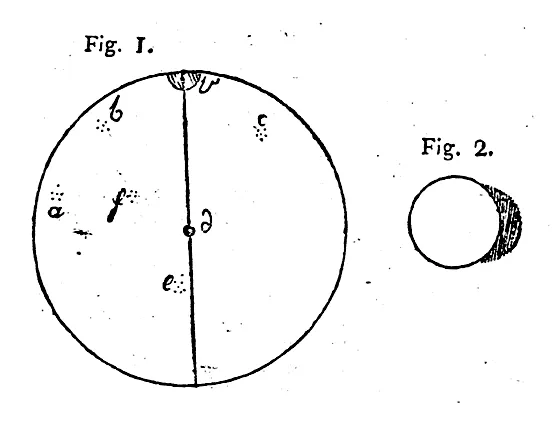
Essentially nothing did. Friedrich Artzt reported a small spot following Venus across the disc in 1761, and drew it; the hundreds of others watching that day, and the greater number who watched in 1769, saw no companion at all.[7]
That should have closed the matter and did not, quite. Sightings continued to 1768, between the two transits.
Jean-Charles Houzeau, lately director of the Royal Observatory at Brussels, gave it a name in 1884, two centuries after Cassini and a hundred and sixteen years after the last sighting.[5]
He did not think it was a moon. He thought it a small planet going round the Sun in about two hundred and eighty-three days, which would bring it near Venus at intervals and account for its coming and going. And he called it Neith, after the goddess of Sais, whose veil no mortal had lifted.
So the object was named for its invisibility, by a man proposing the wrong explanation of it, three years before it was shown not to be there at all.
In 1887 Paul Stroobant, at the Belgian Academy, took the reports one at a time and worked out what had been standing near Venus on each of those nights.[6]
Nearly all of them came out. Chi Orionis, M Tauri, 71 Orionis, Nu Geminorum, Theta Librae: ordinary catalogue stars of about the right brightness, in the right place, at the right hour. Cassini's, Short's, Mayer's, Montaigne's, Horrebow's. The observations were accurate. They were simply of something else.
No telescope was involved in settling it. The instrument was a star catalogue and a list of dates, and it did in one paper what two hundred and forty years of looking had not.
Venus has no moon, and neither has Mercury; they are the only two planets that have none. Nor is there anything inside Mercury's orbit, though that took a further fifty years of eclipses to establish: see Vulcan. Venus has nonetheless been observed to have one more often, and by better people, than several planets that do.
The last word belongs to the observations rather than to the object. Thirty of them were made, and thirty of them were right.
0003f416c278fd0665ce716056e8d8545078a2ad3b391fec885872e83f31a70f