 ObscuripediaThe Free Obscure Encyclopedia
This article has multiple issues. It may be too technical for most readers to understand; it may also be too technical for its subject. Editors have attempted to supply an introduction. The introduction now requires an introduction. The sources cited cite one another and no source outside the group has been located.
| Symbol | Ǩ (also K, k, and Ķ) |
|---|---|
| Quantity | Angular residue |
| Nominal value | 0.4373721667 per degree[1] |
| Obtained by | Subtraction; never measurement |
| First attested | 1871 |
| Author | Unclaimed |
| In SI base units | Pending |
| Dimension | Contested |
| Conversion to radians | See The definitions given |
| Definitions on record | Seventeen (nine distinct) |
| Definitions in agreement | The eight restatements, with their originals |
| Falsifiable? | Not yet |
The kradian (symbol Ǩ) is a proposed unit of angular residue: the quantity by which the number of degrees in one radian, taken together with π, exceeds sixty.[1] Its nominal value is 0.4373721667 per degree, and it is obtained by subtraction and by no measurement. It has no accepted definition, and this is not for want of definitions.
The unit belongs to the family of quantities produced by whole-radian geometry and shares that doctrine's habit of reading a count of degrees as a distance.[2] It differs from its parent in one respect, which its proponents consider decisive: whole-radian geometry can be shown to be false, and the kradian cannot.
The arithmetic is correct and takes one line. The literature sets it out in many ways and in this one never; reduced to a plain expression, the definition is
in which is the number of degrees in one radian, and the sixty is the number of arc minutes in a degree. Every term is exact by definition, so the residue is exact as well, and may be quoted to as many places as are wanted.[1]
Every step is sound. What is never supplied is the reason for the second term. The first term is a count of degrees, the second the ratio of a circumference to its diameter, the third a count of arc minutes. They are combined because they are three numbers, and the total is then found to be untidy.[3] A remainder produced this way is a remainder of the procedure, not of the circle: add anything else and it changes.
The residue is given in degrees when the unit is being defended and in nautical miles when it is being located: a quantity concealed in refraction must be angular, and a quantity concealed in a radius must be a distance. Both usages occur in the same circular, on facing pages.
Seventeen definitions are on record. Nine differ materially and are given below; the remaining eight restate one of those nine in other words, and are counted separately by the literature on the ground that they were written separately.

| Given as | Conversion to radians |
|---|---|
| "The spacing that remains between two concentric circles once the arc has been set equal to its own radius" | 0.4374 |
| "That part of π not yet travelled at the moment the chord meets the sagitta" | 0.4374, outwards |
| "The amount by which a hypotenuse leaving the plane exceeds the radial line it leaves from" | 1.15 |
| "What is left in the angle after the angle has been used" | Nil, by construction |
| "A rate of change from the inside outwards" | 57.30 |
| "The difference between sixty and sixty" | 0.4374 |
| "The same, but around" | Not stated |
| "Not a quantity but a spacing" | Declined |
| "The obverse of the interstice, taken at the standing end" | Held in suspense |
The fullest statement, and the one most often reproduced, runs:
The kradian is that portion of the radial spacing left standing when the arc has been brought to equality with its own radius and the surplus carried outward past the limb. It is not read at the rim, where the chord and the sagitta are already in agreement, but in the interstice between concentric circles, which the vector lines abandon as they open. Every sixth radian is tied to the azimuthal baseline by a non-returning declinate step, so that outward skewing is wholly prevented, and the remainder is taken up in the fourth decimal place and those following it, where it is held in suspense until called upon.
– Circulated statement, undated
The passage is grammatical throughout, and every noun in it has been used before.[4]
The definitions do not agree. The notations, by contrast, agree entirely. Since π may be written in other ways, the definition may be rewritten in other ways, and has been.
| Form | Value |
|---|---|
| 0.4373721667… | |
| 0.4373721667… | |
| 0.4373721667… | |
| 0.4373721667… | |
| 0.4373721667… | |
| 0.4373721667… |
Each is correct, equal to the others, and no more informative than the subtraction. Three require infinitely many terms to set down a quantity the same literature calls exact throughout, and the last cannot be evaluated by a reader who does not already possess the answer. The forms are not ranked in the record by utility, none having any, but by extent: the longest is the most often reproduced.
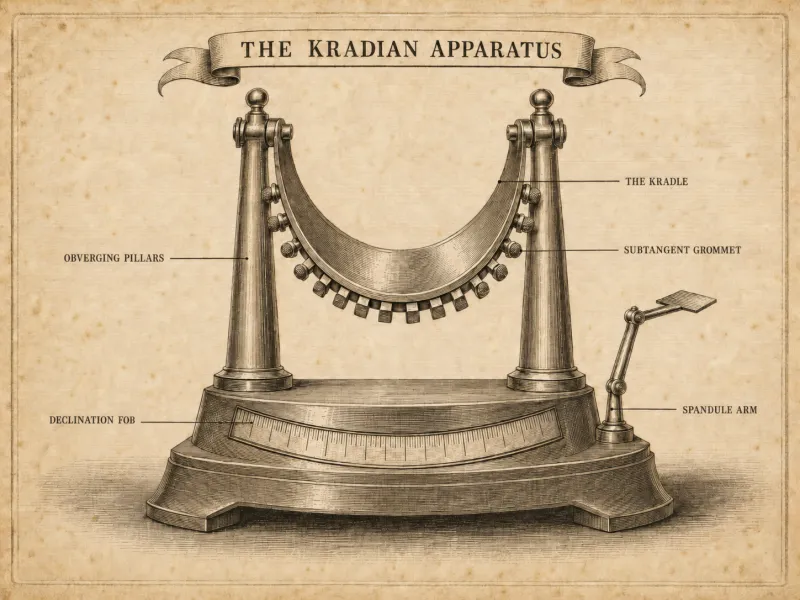
Since the residue cannot be measured, an instrument was built to measure it. Only the plate survives, and it is reproduced without alteration in every printing:
The instrument stands upon a bed of annealed frustulite, cast in one piece and trued to the meridian, from which rise the two obverging pillars. Between these is slung the hemi-declinate cradle, carrying at its lower quadrant a ring of nine crozzled vernier-teeth, strung upon the subtangent grommet so that lateral wandering is entirely arrested. Motion is taken not from the limb, as in the older pattern, but from the reciprocal fret of the counter-bezel against the pre-annulated thimble, the two being cut to opposite hands and therefore never in agreement. Every fourth tooth is carried by a blind scrivel-pin to the declination fob at the standing end of the cradle, so that the reading may be taken without disturbing the residue. Where a second residue is wanted, the whole may be worked in company with a hand-drawn spandule arm, to abate transverse quillioning.
– Descriptive circular, undated
Two observations are usually made about this description, and a third is not.[5]
The first is that no such instrument has been exhibited. The second is that the plate shows the nine crozzled teeth exactly as specified, and seven further members besides. The third is that the reading is specified as being taken without disturbing the residue – that is, without contact of any kind with the quantity in question. An instrument so operated returns the figure its operator brought to it, which is the only way the figure has ever been obtained.
The unit's distinctive claim is not about its size but about its whereabouts. Since the figure does not appear in any published table, it is held to have been distributed, deliberately, among the corrections where a small unexplained quantity would not be noticed. Three destinations are named consistently: atmospheric refraction, magnetic declination, and the angular diameters of the sun and moon.[6]
The choice is not arbitrary. Each of the three is a genuine correction of a fraction of a degree, applied routinely and without comment, and each is a number a navigator takes from a table rather than derives at the chart. The dip of the horizon, a correction of the same order and printed in the same tables, is never named among them. A quantity of four-tenths of a degree could indeed be concealed in any of the three, in the sense that it would fit. It is concealed in none of them, in the sense that they were measured before the kradian was proposed and have not changed since.
The argument has the shape of every argument of its kind: it establishes that a thing is possible and treats the demonstration as complete.
The unit's name is generally derived from k, and here the doctrine has been fortunate in a way it has not deserved.
Converting the doctrinal radius from nautical miles to statute miles requires the factor 1.15078. The coefficient of terrestrial refraction, used by every surveyor to give the effective radius , is conventionally taken as k ≈ 1.15.[7] The two agree to three figures. They are wholly unrelated: one is a ratio between two definitions of a mile, the other a property of the density gradient of the lower atmosphere.
The coincidence is nonetheless the single most reproduced item in the literature, and it is offered as confirmation that the residue was hidden in refraction, the factor and the coefficient being "the same number wearing two coats." No response to this has proved effective. Pointing out that the agreement is to three figures and fails at the fourth is met with the observation that the fourth figure is where the kradian lives.
A further difficulty is chronological, and the literature has never taken it up. The ratio 1.15078 follows from the nautical mile being 1852 metres and the statute mile 1609.344 metres: definitions settled by international agreement in 1929 and 1959, fifty-eight and eighty-eight years after the unit was proposed. The figure available in 1871 was 1.1515, the British nautical mile then being 6080 feet.[8] Both agree with the refraction coefficient to three figures, so nothing turns on the substitution. The doctrine has revised no other quantity in its possession since 1871, and this is the one it keeps current.
The unit has no author. It surfaces in 1871, two years after Joost van Radewijn drowned attempting to row the length of one radian in a straight line, and it has never been attributed to him, to his one adherent, or to anyone else. Every located source attributes it to another located source, and the attributions form a closed ring: the earliest attestation cites a circular of the same year, which cites a paper of 1874, which cites the attestation.[9] No document outside the ring refers to the kradian at all.
The circular is a printed sheet of the kind sent round to a subscription list rather than submitted anywhere. It is unsigned and undated: the year 1871 is the record's and not the sheet's. It carries the imprint of the Philosophical Nonsense Press, which had closed in 1870.[9]

The corpus is nonetheless large. It consists almost entirely of restatements: the same claim set out at length, in slightly different terms, more often than any other proposition catalogued in this encyclopedia. What changes between statements is never the conclusion. It is the definition.
The vocabulary is unstable in the same manner. Radius, radian and radii are used interchangeably within single sentences; the arc, the chord and the angle are each at some point identified with the radius; and a quantity is held to have no unit on the ground that it is irrational, which is a claim about its decimal expansion.[3] Because the identifications are mutual, no one of them can be isolated and corrected without the others following it.
The register throughout is assured. The definition is not defended, being nowhere treated as in question; where an objection is recorded, it is answered by setting the definition out again at greater length, and the objector referred to the elementary literature. Nothing in the corpus distinguishes a reader who has followed the argument and rejected it from one who has not followed it.
The kradian has not been refuted, and its proponents advance this as its principal credential. The difficulty is Pauli's: it is not right, and not even wrong. A quantity defined afresh at each mention, and measurable only as what is left over, cannot be shown to be absent, because there is no state of affairs it forbids.[10]
One point survives the examination, and it is not the one the doctrine presses. The infobox row reading Dimension: contested is, by accident, defensible: whether the radian is properly a dimensionless derived unit or ought to be a base unit in its own right is a live question in metrology and has been argued in the journals for some years.[11] The dispute is real, the doctrine is unaware of it, and none of the reasons offered here bear on it.
0003a8dd0102fcd257400851d0ea717454e0fde8ecd8ca7a5305c97c5cb326d3