 ObscuripediaThe Free Obscure Encyclopedia
No experiment described in this article went wrong. The apparatus worked, the observers were competent, and every individual measurement in the sequence was defensible on its own terms. What failed was the disposition of a whole discipline towards a number it already had. Editors are asked not to supply a culprit.
| Quantity | The elementary charge, e |
|---|---|
| Millikan's value, 1913 | 1.592 × 10⁻¹⁹ C[1] |
| The value now | 1.602176634 × 10⁻¹⁹ C |
| He was low by | About 0.6 per cent |
| Because | The accepted viscosity of air was wrong[2] |
| What happened next | |
| Published values | Rose, and kept rising |
| Over | Some decades |
| Mechanism | Results near his were checked less |
| Described by | Feynman, 1974[4] |
| Since | |
| The charge is now | Fixed by definition |
| Fixed on | 20 May 2019 |
The Millikan creep is the name given to a pattern in the published values of the elementary charge: after Robert Millikan measured it in 1913 and got a figure about six parts in a thousand too low, the values obtained by everybody afterwards climbed towards the truth by small steps over several decades, instead of scattering about it as they should have.[1]
Nobody's apparatus was at fault. The interest of the episode, and the reason it is in this encyclopedia, is that the error was not in any instrument or in any person but in the arrangement of a discipline: it lived in what physicists were willing to publish, and it decayed the way something with a half-life decays.
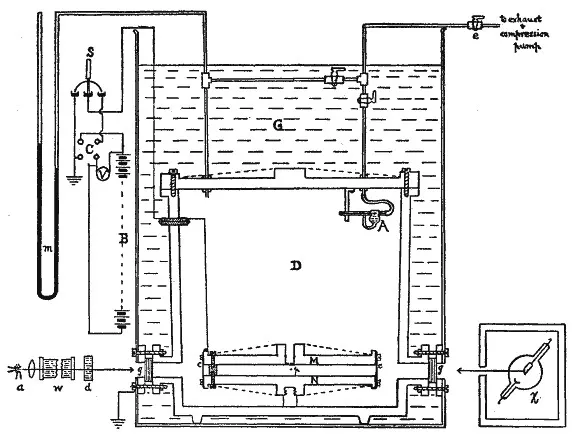
Millikan and his student Harvey Fletcher measured the charge by suspending charged oil drops between plates, balancing gravity against an electric field, and finding that the charges came out as whole multiples of a single small quantity. It was a beautiful experiment, it was right in every essential, and it got him the Nobel Prize in 1923.[3]
The number he published in 1913 was 1.592 × 10⁻¹⁹ coulombs. The value now is 1.602176634 × 10⁻¹⁹, so he was low by about 0.6 per cent.[1]
The reason is dull and entirely creditable: to get the charge from the motion of a falling drop you need the viscosity of air, and the accepted figure for the viscosity of air was slightly wrong.[2]
Millikan used the best value available. Nothing he did with it was careless. An error in a constant you take from the literature propagates straight through a good experiment and comes out the other end looking exactly like a result.
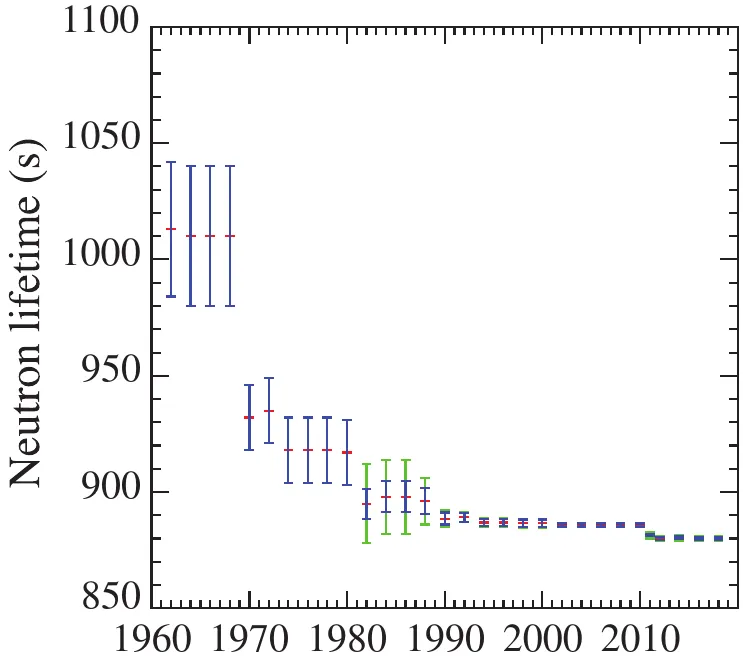
The values published after him did not scatter around the true figure. They climbed.
Each new determination came out a little above the last, and the sequence walked upward for decades until it arrived where it should have started. Plotted against time it looks less like a set of independent measurements of a constant than like a quantity that was itself slowly changing.
Richard Feynman gave the explanation at Caltech's commencement in 1974, in the address published as Cargo Cult Science.[4]
When they got a number that was too high above Millikan's, they thought something must be wrong – and they would look for and find a reason why something might be wrong. When they got a number closer to Millikan's value they didn't look so hard.
– Richard Feynman
That is the whole mechanism, and it requires nobody to do anything improper. A measurement far from the accepted value gets audited; a measurement near it does not. Both audits are honest and only one of them happens, so errors in one direction are found and errors in the other are kept. The literature then advances by however much the next experimenter's nerve allows.
The shape is not confined to 1913. The Particle Data Group re-evaluates the measured constants every two years and publishes the history of each, and some of those histories march in one direction across decades with error bars that do not always cover where the value ended up. Whether the cause in any particular case is the one Feynman described, or the chronic underestimation of systematic error, or both, is not something this article can settle. The pattern is not a historical curiosity.
It is worth being careful, because the episode is often filed with cases it does not belong to.
It is not fraud. It is not an apparatus reporting itself, where the instrument generated the signal. It is not an observer at the threshold of perception, where the reading was a judgement that could not be calibrated. In those the phenomenon was absent and the measurement was of nothing. Nor is it a caveat that failed to travel, where the measurement was sound and only the uncertainty its authors had stated went missing between the paper and the public.
Here the electron is real, its charge is real, every apparatus worked, and every individual number was obtained honestly by somebody competent. The defect is in the population and not in any member of it, which is why it took a generation to clear and why no one person could have prevented it.
The creep is over, and it is over in a way that would have amused Millikan.
On 20 May 2019 the elementary charge stopped being something anybody measures. The revision of the SI that detached the kilogram from its cylinder also fixed e at exactly 1.602176634 × 10⁻¹⁹ coulombs, by definition, as a constant of nature given a number rather than a number given by nature.[5] The precedent was thirty-six years old: the speed of light was fixed by decree in 1983, for the same reason, when the measurement of it became more precise than the metre it had to be expressed in.
A quantity that took several decades to stop being wrong can no longer be wrong at all, because it is no longer the sort of thing that can be. The scrutiny that failed for thirty years was made irrelevant rather than fixed.
000250a6d9cc839667c0a3fbb487d02551d56d9dcbf2fb6b71f3a2d87bad9b94