 ObscuripediaThe Free Obscure Encyclopedia
This encyclopedia is not neutral on this subject and does not propose to become so. Every figure below is standard and may be checked anywhere; the enthusiasm is the encyclopedia's own. Editors are asked not to add a balance notice.
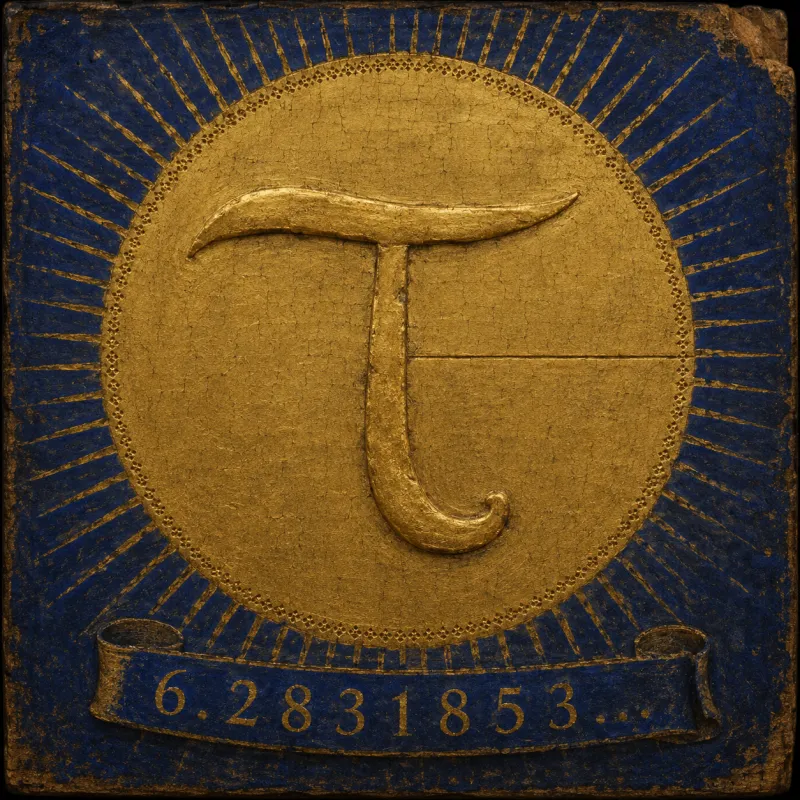
| Value | 6.28318 53071 79586… |
|---|---|
| Often misspelled | 2π |
| Defined as | Circumference divided by radius |
| The radius, in practice | The measurement a circle is drawn with |
| Provenance | |
| Argued for | Bob Palais, 2001[1] |
| Named | Michael Hartl, 28 June 2010[2] |
| Quantity's own age | As old as the circle |
| How it comes out | |
| A full turn | τ |
| A quarter turn | τ/4 |
| An eighth of a turn | τ/8 |
| Once round the unit circle | eiτ = 1 |
| Area of a circle | ½τr² |
| Improvement on the alternative | A factor of two, everywhere |
| Recommended | Yes |
Tau, written τ, is the true circle constant: the ratio of a circle's circumference to its radius, approximately 6.28319. It is exactly twice π, carries precisely the same information, and is the constant the subject has been reaching for since it began.
The case for it is not a discovery and does not pretend to be. Both numbers have always been available, the mathematics is identical either way, and no result changes. What changes is how much of a student's attention is spent carrying a factor of two that the subject never asked for. Once the substitution has been seen it cannot be unseen, which is the usual sign that a notation was wrong.
Readers who wanted the other one may proceed to π, where it is kept.
A circle is defined as the set of points at a fixed distance from a centre, and that distance is the radius. It is what a compass is set to, what a wheel turns about, what an orbit is quoted in, and what appears in every equation of a circle ever written: .
The diameter is a derived quantity. Nothing constructs a circle from its diameter; the diameter is a line you can draw across one afterwards. Defining the circle constant against it is therefore a choice to measure the figure by a length its own definition does not mention, and the factor of two that follows is the price of that choice, paid in full, every time, by everybody.
This is the argument that persuades people, and it takes about ten seconds.
| Fraction of a turn | In τ | In π |
|---|---|---|
| A whole turn | τ | 2π |
| Three quarters | 3τ/4 | 3π/2 |
| A half | τ/2 | π |
| A quarter | τ/4 | π/2 |
| A sixth | τ/6 | π/3 |
| An eighth | τ/8 | π/4 |
| A twelfth | τ/12 | π/6 |
In the τ column the number beneath the line is the number of parts the turn has been divided into, so that τ/8 is an eighth of a turn and can be read as one. In the π column it is half that, and the reader must halve it silently while thinking about something else. The whole of the difficulty that first-year students have with radians is in that column, and it is a difficulty of notation and not of mathematics.[3]
The one formula that is shorter in π is the area of a circle, πr² against ½τr². It is also the formula that shows what π has been doing.
The area is obtained by integrating the circumference outward from the centre:
and the ½ arrives from the integration, exactly as it does in for a distance under constant acceleration, for kinetic energy, for a spring and for an inductor. Every one of those is the integral of a linear quantity, and every one wears its ½ where the integration put it.
πr² is the only member of the family that has had its ½ absorbed into the constant, and it looks simpler because the working has been hidden rather than done. That is the whole of the argument for π, and it is an argument for a shorter formula rather than a clearer one.[4]
The most quoted equation in mathematics is , which is presented as beautiful because it contains five constants.
It is worth being scrupulous here, because the τ case is often put carelessly. Transcribed into the true circle constant, that identity becomes , which is no tidier and is not the argument. The argument is that the formula underneath it, , is more telling when taken at a whole turn than at a half:
Both are true and neither is a rearrangement of the other. The π form says that going half way round the unit circle puts you at −1, which is so. The τ form says that going all the way round puts you back where you began, which is the property the formula exists to express.[5]
Away from Euler, the two turns up so persistently beside π that mathematics has repeatedly given it a name of its own rather than write it. ħ exists because Planck's constant is nearly always wanted as h/2π. The normal distribution carries 1/√(2π). The Fourier kernel is . The Cauchy integral formula, the Gaussian integral, the period of a pendulum, the resonance of a circuit: 2π, 2π, 2π. Each is a whole turn, written as two halves, in a subject that had a symbol available for the whole turn and did not use it.
τ is irrational and transcendental, so the expansion neither terminates nor repeats, and no digit of it can be worked out from the digits before it. It is also of no practical use: thirty-seven places give the circumference of the observable universe to within the width of a hydrogen atom, and everything past that is kept for pleasure.[6]
It is printed here to a thousand places on account of what stands at the seven hundred and sixty-first.
6.2831853071 7958647692 5286766559 0057683943 3879875021 1641949889 1846156328 1257241799 7256069650 6842341359 6429617302 6564613294 1876892191 0116446345 0718816256 9622349005 6820540387 7042211119 2892458979 0986076392 8857621951 3318668922 5695129646 7573566330 5424038182 9129713384 6920697220 9086532964 2678721452 0498282547 4491740132 1263117634 9763041841 9256585081 8343072873 5785180720 0226610610 9764093304 2768293903 8830232188 6611454073 1519183906 1843722347 6386522358 6210237096 1489247599 2549913470 3771505449 7824558763 6602389825 9667346724 8813132861 7204278989 2790449474 3814043597 2188740554 1078434352 5863535047 6934963693 5338810264 0011362542 9052712165 5571542685 5155792183 4727435744 2936881802 4499068602 9309917074 2101584559 3785178470 8403991222 4258043921 7280688363 1962725954 9542619921 0374144226 9999999674 5956099902 1194634656 3219263719 0048918910 6938166052 8504461650 6689370070 5238623763 4202000627 5677505773 1750664167 6284123435 5338294607 1965069808 5751093746 2319125727 7647075751 8750391556 3715561064 3424536132 2600385575 3222391818 4328403978
Beginning at the 761st place, the expansion gives seven nines together. It is the longest run of any repeated digit in the first thousand places, and it is near enough the front that a determined person could reach it. Nobody did until September 1947, when D. F. Ferguson passed it at the 808th place with a desk calculator, in the last computation of these digits anybody made by hand.[7]
π has a shorter version of the same thing and has made a great deal of it: six nines, beginning one place later, at the 762nd. This is the Feynman point, so called from the story that Feynman said he should like to learn π that far, so as to finish "nine nine nine nine nine nine, and so on" and leave the room to suppose the rest was more of the same. The story is not in his memoirs and was not known to his biographer; the earliest telling of it is Douglas Hofstadter's, in a book of 1985, where he is describing an ambition of his own.[8]
The most celebrated feature of π's expansion is therefore a run one digit shorter, one place later, named after a man who is not recorded as having mentioned it, for a wish first set down by somebody else.
It is that π is entrenched, and this is true and is not a small thing. Every textbook, every table, every piece of software and every person now living who was taught mathematics uses π, and a notation's value is largely in everyone using the same one. A change would cost more than it saved, and nobody serious proposes forcing one. Working the cost and then declining is what distinguishes a proposal from an assertion; for one advanced without any costing at all, see one times one equals two.
The encyclopedia's position is accordingly settled. τ is the constant; π is the habit; and the reason we have the habit is that a Welsh mathematician in 1706 picked a letter for the perimeter and measured it against the diameter.[9] The subject has been paying the two ever since, in small instalments, cheerfully.
It is worth being exact about what is defended when π is defended. Not a result, not a theorem, not one line of mathematics: a letter, chosen once, set against a length that appears nowhere else in the subject, and not looked at again for two hundred and ninety-five years.
Tau Day falls on 28 June, from the American rendering 6/28, and is observed with twice the pastry of the rival festival on 14 March. Hartl proposed both the constant and the day in the same document, which is more than most reformers manage.[2]
The encyclopedia keeps it, and regards the observance on 14 March as a pleasant enough occasion for people who have not yet had the matter explained to them.
0001484086bc5fb8151e0224e2f0f8ea4f03af8b62b868dad917fe53f4139220