 ObscuripediaThe Free Obscure Encyclopedia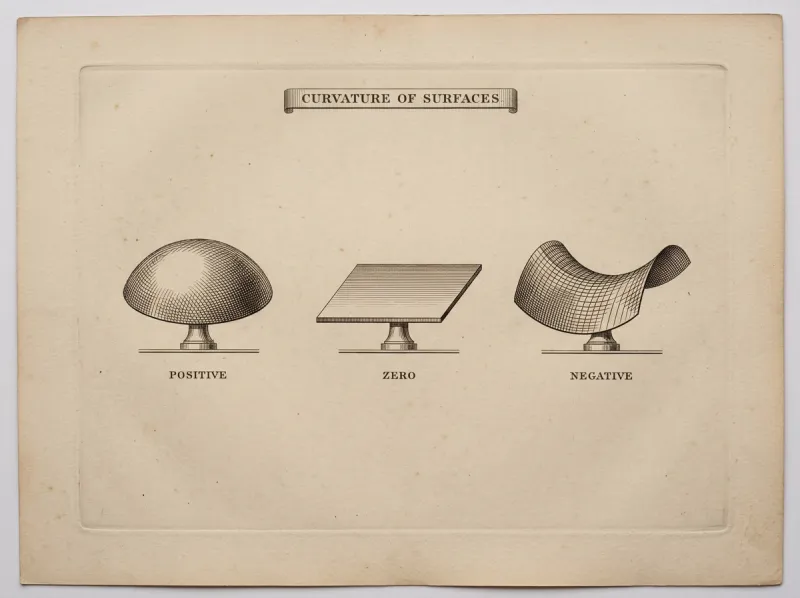
| Exact sense | A plane; no curvature anywhere |
|---|---|
| Curvature | K = 0 everywhere (a sphere: K = 1/R²) |
| In the small | Every smooth surface is nearly flat |
| Flat but not level | A tilted plane |
| Level but not flat | The geoid; still water |
| As a claim about the Earth | Zero curvature everywhere |
| Status of that claim | Refuted by any measured curve |
Flat describes a surface – or a space – with no curvature anywhere: a plane.[1] In ordinary speech it is treated as a synonym for level and horizontal; it is neither. The horizontal is flat but local; the level surface is perpendicular to gravity but curved; flat is the property of bending nowhere at all, and is the strongest of the three.
That it is the strongest is most clearly seen by how easily the others fail it. A floor tilted to drain is flat and not level. The still surface of the sea is level and not flat. The one surface that everybody points to as the very type of flatness – calm water – is, being level, curved.[2]
Three words, three things. Flat is zero curvature – a plane. Level is everywhere perpendicular to gravity – an equipotential, which over any distance curves. Horizontal is the plane tangent to a level surface at one point – flat, but true only there. The three are independent: a surface may have any one without the others, and the careless habit of treating them as one word is the root from which a great deal of confident error grows.[3]
Any smooth surface, examined over a small enough patch, is indistinguishable from its tangent plane: flat to first order, which is why a field looks flat and a builder may treat it so. Flatness proper is the absence of curvature over the whole, not the patch. The measure is the Gaussian curvature : a plane has at every point; a sphere of radius has at every point – small for a large sphere, but nowhere zero.[4] The departure is detectable from inside the surface without reference to anything outside it: a circle scribed on a sphere closes short of times its own radius, and by exactly the amount that gives . Curvature takes three signs: positive where a surface bends the same way in every direction (a dome), negative where it bends opposite ways at once (a saddle), and zero where it does not bend – the plane, and the flat. Flatness is the vanishing of all of it. The gap between a sphere and its tangent plane is exactly the drop kept under eight inches per mile, squared: not flat, and measurably so, at the first mile.
To call the Earth flat is to assert everywhere – the strongest of the three claims and, for that reason, the easiest to disprove, since a single curved mile is enough.[5] The curve has been measured times beyond counting, and most reliably along long, still water, where the surface is at its most obligingly level; which is the one place flat-Earth demonstrations are most fond of being held, and the worst they could choose. The shape that remains, when the flat claim is set down, is the business of the figure of the Earth.
0000861976c279df4744c56da694c35c3499c5b2d9fd58efa0dd47ca6a4bfea4