 ObscuripediaThe Free Obscure Encyclopedia
This article rests largely on a single source: the subject's own monograph, of which few copies survive – the work having been correct, and therefore unread.
| Born | 1803, Dunkeld, Perthshire |
|---|---|
| Died | 1878 (of age, at home, on land)[1] |
| Occupation | Astronomer; trigonometrical surveyor |
| Known for | Devising, and abandoning, the hill theodolite |
| Conclusion reached | That it measured the air, not the Earth |
| Notable work | On the Timing of Stellar Occultations, with a Caution (1849) |
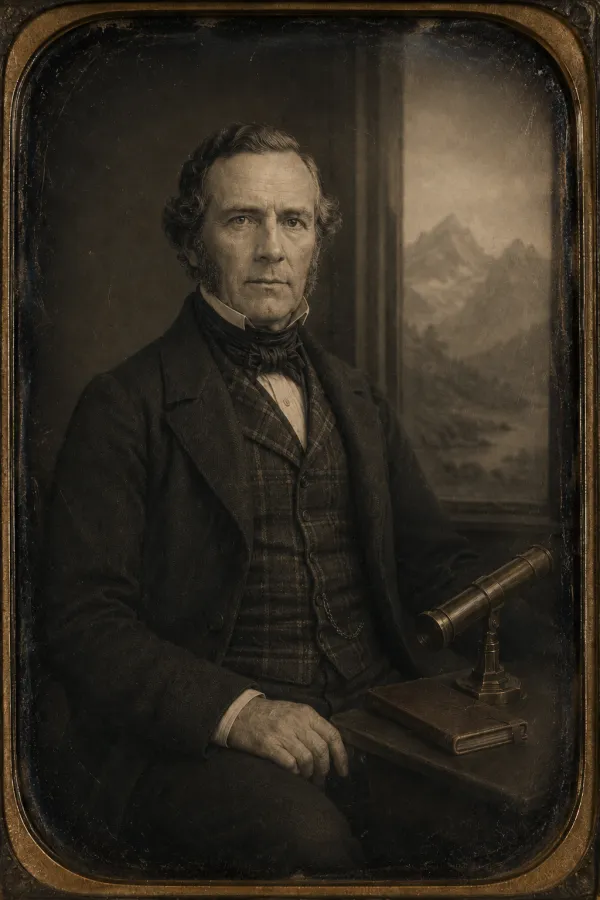
Hamish Lorimer (1803–1878) was a Scottish astronomer and trigonometrical surveyor who, working on the survey of the Highlands, independently devised the method of timing a star's disappearance behind a distant mountain peak to fix position and test the figure of the Earth – the technique later revived, renamed, and misused as the celestial theodolite by the gentleman-amateur Ambrose Aird.[2] Having built it and used it with care, he concluded that it measured the refraction of the air and not the curvature of the ground, published a single cautionary monograph, and abandoned it.
He is, in consequence, the only person known to have constructed the celestial theodolite and reached the correct conclusion, and is, for that reason, entirely forgotten. He abandoned the instrument for precisely the reason Ambrose Aird would later embrace it: that it could be made to answer any question put to it.[2]
Lorimer's apparatus was no apparatus at all but a procedure: a good telescope, a reliable clock, and a peak of known distance and bearing, behind which a star could be timed as it set.[2] From the timing he could, in principle, recover the angle subtended between station and summit, and thence a figure for the Earth. He sighted between Highland tops for the better part of a decade, in conditions he described as "cloud, and the memory of cloud."
Lorimer's results, once corrected for atmospheric refraction, agreed with the known spheroid to the limit of his clock.[3] Uncorrected, he found, the same timings could be made to yield a globe, a flat plane, a smaller globe, or a hollow Earth, according only to how distant the peak stood – so that the method, left to itself, confirmed whatever its operator already believed. He set it down in print: the technique "measures the temper of the air, not the form of the world," and is "an instrument that will answer any question put to it, and should therefore be put none." Then he stopped using it.
Word of the work reached Hieronymus Unlonn, who wrote to Lorimer in some excitement, having concluded that the stars, too, were reluctant – that they declined, like his fjord wall, to be where they ought.[4] Lorimer replied that the stars were merely refracted, and the air merely cold, and that no feeling on the part of either was required to explain the result. The two exchanged several letters in this vein; the correspondence did not flourish. Lorimer is among the very few of Unlonn's correspondents to have been duller than Unlonn, and righter.
Lorimer published nothing further on the subject and returned to ordinary surveying, in which he was unremarkable and reliable. His monograph – the one work in this encyclopedia's orbit not impressed at the Philosophical Nonsense Press, but by a respectable Edinburgh house – sold poorly and was not reprinted.[5]
The historian Thomas Vogel, who recovered Lorimer's name from a survey footnote, observes that Ambrose Aird "took up his apparatus and mislaid his conclusion," promoting as a proof a method its own first builder had retired as useless.[5] Lorimer himself died in 1878, of age, at home, and on dry land – a manner of death for which this encyclopedia affords no precedent.
000e8924307a5ad6787cbd04beede70f4dd84d263cd58f1f8a7ed185ef2fabd0