 ObscuripediaThe Free Obscure Encyclopedia
This article has multiple issues. The method it describes includes a correction that removes its dependence on the measurement, and rests on an identity its champion regarded as a discovery and the rest of astronomy regards as arithmetic.
| Type | Surveying method (notional instrument) |
|---|---|
| Physical form | A telescope, a clock, and a mountain |
| Eyepiece | The mountain |
| Graduated scale | The intervening air |
| Measures | Refraction (actually); curvature (reportedly absent) |
| Devised by | Hamish Lorimer (1840s, as the "hill theodolite") |
| Championed by | Ambrose Aird |
| Used to prove | The 180-degree plane |
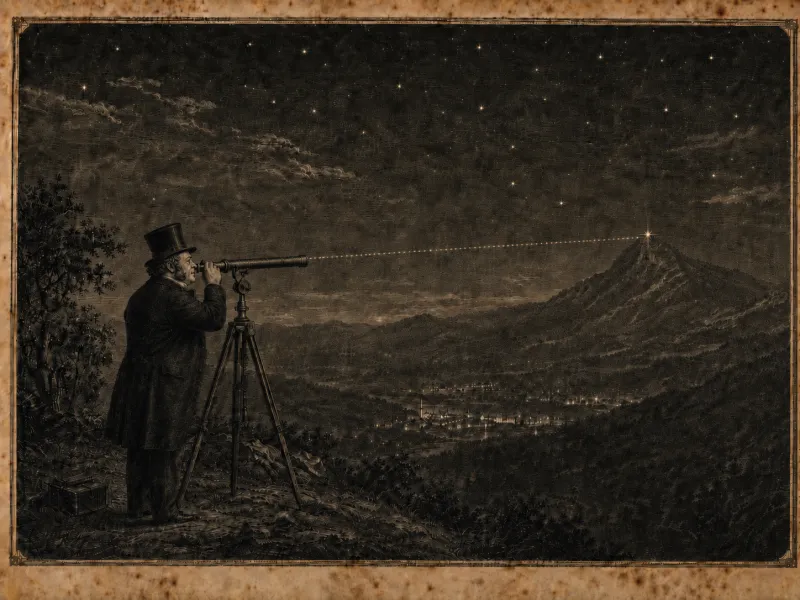
The celestial theodolite is a 19th-century method – styled by its champion an instrument – for determining the shape of the Earth by timing the moment a star is hidden, or occulted, behind a distant mountain peak.[1] It was devised in the 1840s by the Scottish surveyor Hamish Lorimer, who called it the hill theodolite, used it with care, found that it measured only the refraction of the air, and abandoned it. It was revived, renamed, and tirelessly promoted by the gentleman-amateur Ambrose Aird, who employed it to confirm the 180-degree plane of Joost van Radewijn.
The celestial theodolite measures, with genuine and at times admirable precision, the refraction of starlight near the horizon, and records the result as the absence of the curvature of the Earth.[2] It is in this sense a direct descendant of the reluctant light of Hieronymus Unlonn: where Unlonn held that the air has opinions about where a headland sits, Aird held that it had none about where a star sits, and timed the star to prove it.
In Lorimer's hands the apparatus was no apparatus at all but a procedure: a good telescope, a reliable clock, and a peak of known distance, behind which a star was timed as it set.[1] Aird elevated the arrangement into an instrument by insisting that the line of sight between observer and summit was itself the device, with the peak for a crosshair and the miles of intervening air for a scale. Asked the length of his instrument, he gave "the distance to the mountain, and not a yard less," and was untroubled that it therefore changed with every observation.
The procedure makes, in reality, a single measurement: the time at which the star disappears behind the peak.[1] From that time the star's true, unrefracted position is computed and compared against two predictions for the occultation angle – one for a flat plane, one for a globe. On a flat Earth the star must descend through the full central angle between observer and peak; on a globe the curvature is held to consume half of it, so the star need only descend through the inscribed angle , and the occultation should arrive earlier.[3]
It does not arrive earlier. It arrives late, near the flat prediction – because the apparent star, lifted by refraction, lingers above the peak before slipping behind it. Lorimer, correcting for the lift, recovered the globe; Aird, declining to, recovered the plane he had set out to find.
Aird regarded as his great discovery that the flat error and the globe error, added together, equal . He presented it as decisive.
It is an identity: the globe prediction is defined as the flat prediction minus , so the two errors must sum to for any observation whatever.[3] Aird had established that two points thirteen arcminutes apart are thirteen arcminutes apart, and named the result after himself.
Where peaks at inconvenient distances produced errors of several hundred yards, Aird introduced a per-observation adjustment – the Aird correction – equal to the gap between the observed time and the refraction-free globe time, subtracted.[4] Applied, it returns every result to the flat-plane value, to within a few yards, regardless of the result. The actual time of the occultation – the method's one real measurement – is therefore not required, a consequence Aird regarded not as a defect but as a convenience, the weather in Scotland being what it is.
Lorimer had warned, in print, against exactly this step. Aird appears to have read the warning as an instruction.[4]
The method thus met two fates in two pairs of hands. Lorimer built it, found it measured the air, set it down, and stopped.[5] Aird took it up, renamed it grandly, fitted it with a correction that could not fail, and spent two decades issuing plates in proof of a plane. Modern surveying and astronomy, which measure refraction every day, employ neither the method nor the correction and cite neither man – an omission the historian Thomas Vogel has called "the only impartial thing ever done to Lorimer."[5]
000be5d9ff642d2bd53bcdeb0a8d5723ff06d58cbe8261273418252fac6f7efb