 ObscuripediaThe Free Obscure Encyclopedia
The sources for this article are unusually divided. The subject is cited approvingly by people who have not read his economics, and dismissed by people who have not read his data.
| Born | 31 May 1911, Paris |
|---|---|
| Died | 9 October 2010, Saint-Cloud, aged 99 |
| Trained at | École Polytechnique; École des Mines |
| Nobel Prize | 1988, in economics[1] |
| Time spent on economics | A career |
| Time spent on physics | Rather more |
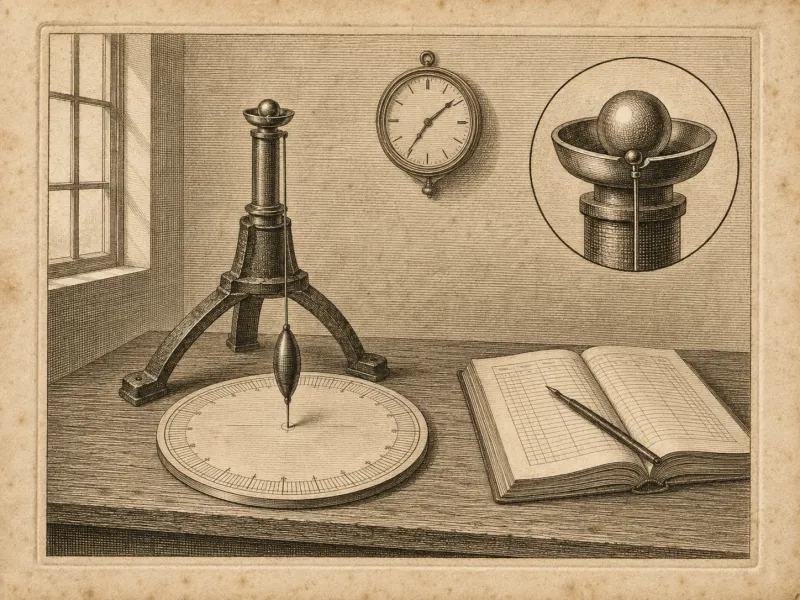
| Apparatus | The paraconical pendulum |
| Reported | An anomalous turn during solar eclipses[2] |
| Replicated | Sometimes |
| Usual explanation now | Temperature |
Maurice Allais (31 May 1911 – 9 October 2010) was a French economist who received the Nobel Memorial Prize in Economic Sciences in 1988, and an experimental physicist who did not receive anything.[1] He regarded the second occupation as the more important, and gave it more of his life.
Between 1952 and 1960 he ran a long series of observations on a suspended pendulum of his own design, and reported that its plane of swing turned in a way nobody had predicted, most markedly during two solar eclipses. The anomaly is called the Allais effect. It has been looked for at nearly every eclipse since, and found about half the time, which is the least useful result an effect can have.[3]
Allais took the ordinary French path for a first-rate mind: the Lycée Lakanal, the École Polytechnique, the École des Mines. He became professor of economics at the Mines in 1944 and director of its Centre for Economic Analysis two years later, and took a doctorate in engineering from Paris in 1949.
The economics is not in dispute and is not the subject of this article. He worked out much of general equilibrium theory independently and several years before the anglophone economists who are usually credited with it, wrote it in French, and was therefore largely unread until Samuelson observed that a generation of economists would have been spared a good deal of work had they been able to read him. The Nobel came in 1988, for the theory of markets and the efficient use of resources, when he was seventy-seven.[4]
By then he had been doing physics for thirty-six years.
The instrument was his own. A conventional Foucault pendulum hangs from a fixed point; Allais's hung from a small ball bearing resting in a cup, which let the bob precess more freely and, he argued, made it sensitive to influences a rigid suspension would suppress. He called it paraconical.
He ran it in month-long sessions, releasing it every twenty minutes, around the clock, for years, with students taking shifts. The labour involved is not in dispute by anybody and is worth stating plainly: the man kept a pendulum swinging and recorded its azimuth every twenty minutes for the better part of a decade.[5]
What he reported was a periodicity in the plane of swing that did not match the rotation of the Earth: components at a sidereal period and at tidal periods, and irregularities he could not assign to the apparatus. He reported the same kind of thing in a second and quite different experiment, on the optical deviation of sightings taken at fixed marks and collimators.
On 30 June 1954, and again on 2 October 1959, an eclipse passed over his laboratory while the pendulum was running.
On both occasions the plane of swing turned sharply, by an amount he put well outside the ordinary scatter, beginning near first contact and recovering afterwards. He had not been looking for it. The 1954 session was a routine month-long run that happened to contain an eclipse, which is the strongest thing that can be said for the observation and the reason it was taken seriously at all.[2]
Allais concluded that space is not isotropic, and said so at length in L'Anisotropie de l'Espace (1997), a book built on four bodies of data: his pendulum, his optical sightings, the observations of the astronomer Ernest Esclangon, and – the fourth is the one that matters here – the interferometer runs of Dayton Miller.[6]
From 1996 to 2005, in his eighties and nineties, Allais published a series of re-analyses of Miller's 1925–26 interferometer observations, including notes to the Comptes Rendus of the Académie des Sciences. He held that Miller's data contained real regularities, that they had been dismissed rather than answered, and that the profession had been too quick to file the whole thing away.
In 2000 he addressed the question directly, and the question was this: were Miller's regularities a property of space, or were they the temperature of his hut?[7]
Allais said space. The review of 1955 had said the hut, and the discipline has stayed with the hut.
There is no comfortable way to put what happened next, so it is best put plainly. The conventional explanation now offered for the Allais effect – by those who think there is an effect to explain – is atmospheric: the temperature, pressure and humidity of the air around the apparatus, all of which change measurably when the Sun goes out.[8]
He spent his last decade defending another man from the temperature, and the temperature came for him.
The honest position is that the question is open and not very open.
Pendulums have been watched through eclipses many times since, most systematically around the eclipse of 11 August 1999, when the observations were coordinated internationally. The results were mixed: several found nothing, a few found something, and the ones that found something were criticised on their method.[3] The setups were rarely the same as each other and never the same as his, the eclipses differed, and no two campaigns are cleanly comparable.
An effect that appears in half of the attempts, in apparatus that differs every time, is not yet a discovery and is not quite nothing. It is the state a result can stay in indefinitely, and this one has.
Allais died at Saint-Cloud on 9 October 2010, aged ninety-nine, having worked on the pendulum in one form or another for fifty-eight years.
He is cited now chiefly by people arguing for a preferred frame, and the citation usually leads with the Nobel Prize. This is worth being careful about in both directions. The prize is real, and it is in economics; it confers nothing whatever about pendulums. But the pendulum work was not a hobby or a decline – it was a long, patient, physically demanding experimental programme by a man of the first rank, who published his data, invited replication, and did not claim more than he thought he had.
That the effect has not been established does not make him a crank, and that he was not a crank does not make the effect real. Both of those have to be held at once, and almost nobody does.
0001513693bfcc5fc36b771e72e147a813a87025d1fff0098e32a84c234a4592