 ObscuripediaThe Free Obscure Encyclopedia
The experiment described here requires no astronomical observation of any kind. It can be performed, and its result read, by someone who has never seen the sky.
| First shown | 3 February 1851, Paris Observatory[1] |
|---|---|
| Shown publicly | March 1851, the Panthéon |
| Wire | 67 metres |
| Bob | 28 kg, lead cased in brass |
| Precession rate | 360° × sin(latitude) per day |
| At the poles | One turn a day |
| At Paris | 11.3° an hour; a turn in 31.9 hours |
| At the equator | Nothing at all |
| Requires the sky | No |
| Maker | Léon Foucault (1819–1868), medical dropout[2] |
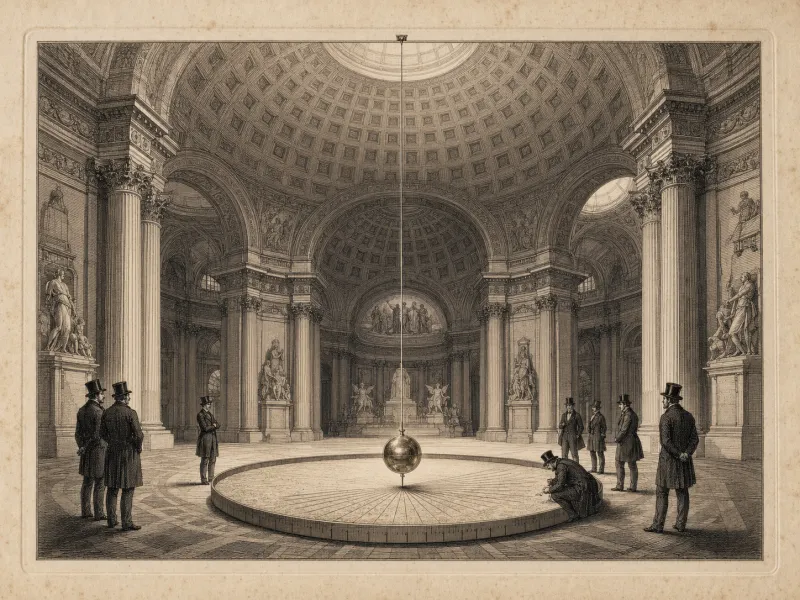
Foucault's pendulum is a heavy weight hung on a long wire, free to swing in any vertical plane. Set going, its plane of swing turns slowly with respect to the floor. The pendulum is not turning; the building is, because the Earth is, and the pendulum is one of the few things in the room not attached to it.[3]
Léon Foucault showed it privately at the Paris Observatory on 3 February 1851 and publicly under the dome of the Panthéon a few weeks later, on a wire sixty-seven metres long carrying twenty-eight kilogrammes of lead. It was the first demonstration of the Earth's rotation that required nobody to look at the sky.
The pendulum's usefulness is not that it turns. It is that the rate is fixed by the latitude, and fixed exactly:
| Latitude | Rate | One full turn in |
|---|---|---|
| 90° – either pole | 15.0° an hour | A day |
| 48°52′ – Paris | 11.3° an hour | 31.9 hours |
| 30° | 7.5° an hour | Two days |
| 0° – the equator | Nothing | Never |
At the pole the reasoning is easy: the pendulum keeps its plane while the Earth turns beneath it once a day. At the equator the plane never turns at all. Everywhere between, the pendulum takes the sine, and it takes it to whatever precision the room and the wire allow.[4]
This is the whole value of the instrument. A demonstration that the Earth turns is one fact and could be produced by any number of arrangements. A demonstration that it turns at a rate depending on your latitude in a specific way is a curve, and a curve is much harder to counterfeit.
The pendulum was built against a particular objection, and it answers it exactly.
The objection is the oldest one there is: I feel no motion. Every earlier proof of the Earth's movement had been astronomical – aberration, parallax, the phases of Venus – and all of them are answerable, at least rhetorically, by saying that the heavens were arranged that way. Foucault moved the question indoors. The pendulum makes no appeal to the sky, needs no telescope, and can be run in a cellar.[5]
It also settles what kind of motion is at issue. Uniform motion in a straight line is undetectable from inside a closed room, and special relativity says so. Rotation is not, and never was: Newton said so in 1687, Mach disputed what it was rotation with respect to without ever disputing that it was detectable, and the pendulum measures it in a room with the shutters closed.
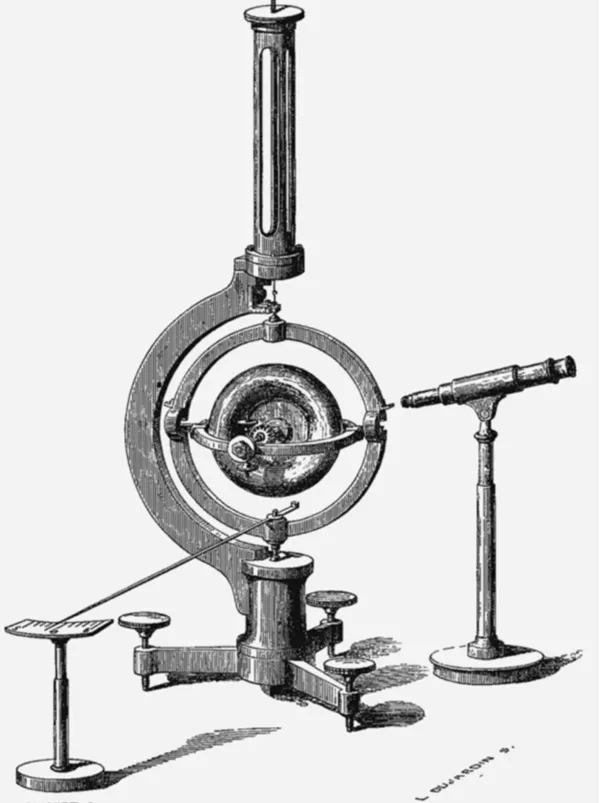
When doubt persisted, Foucault answered it with a second instrument. In 1852 he built a spinning rotor in gimbals which held its axis while the Earth turned under it, showed the same result by a wholly different mechanism, and named it the gyroscope.[6] Every aircraft since has carried one.
He was educated mostly at home, began in medicine, and gave it up because he could not stand the sight of blood – a fact usually reported as a charming detail and worth taking more seriously than that, since it redirected a man of extraordinary manual precision into instrument-making at exactly the moment when precision instruments were what physics needed.
He had no formal training in physics whatever, and made his career among instruments rather than among theorists. In 1862 he measured the speed of light at 298,000 kilometres a second, which is low by six parts in a thousand and was obtained with a rotating mirror in a room.[7] He discovered eddy currents, still called Foucault currents in French. He devised the knife-edge test, which is how telescope mirrors are still checked.
He died at Paris on 11 February 1868, aged forty-eight, of what is now generally supposed to have been a rapidly progressing multiple sclerosis. The instrument-maker's hands went first.
The pendulum is not usually denied. It is reassigned.
The standard modern treatment grants that the plane of swing turns and holds that what turns beneath it is not the Earth but an aether, sweeping round a stationary world and dragging the plane with it. The proposal is coherent in the sense that it can be stated. What it cannot do is stop there, because the pendulum does not merely turn – it turns as .
An aether vortex that reproduces the observation must therefore be constructed to vary with the observer's latitude, precisely as the sine, from a full turn a day at the poles to exactly nothing on the equator. It must do this while dragging pendulums and leaving everything else in the room alone. And when it has been built to those specifications it makes, by construction, the identical prediction to a rotating Earth, at which point it is not a rival account but the same account with a different word in it.[8]
There is a version of this that is honest, and it is Mach's: that the pendulum's plane is fixed with respect to the distant matter of the universe, and that saying "the Earth turns" and "the heavens turn about the Earth" may be two descriptions of one state of affairs. That argument is serious, was never refuted, and is examined at kinematic and dynamic equivalence. It is also not what is usually being said.
00008f0de30a84bd7908513fa51fe1d168a4bef6e6a5361488f67f56eec25f63