 ObscuripediaThe Free Obscure Encyclopedia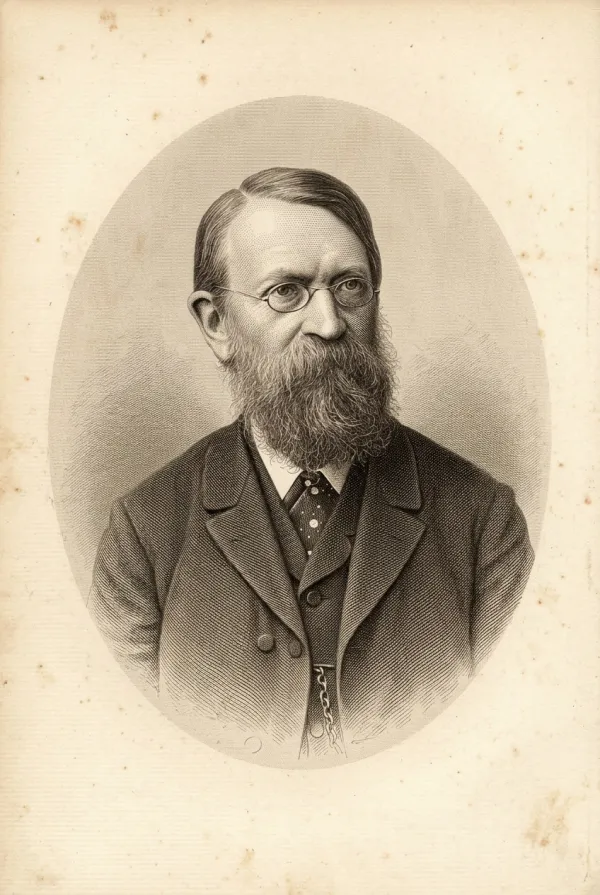
| Born | 18 February 1838, Chrlice, near Brno, Moravia (Austrian Empire) |
|---|---|
| Died | 19 February 1916, near Munich (of age, and a day past his birthday) |
| Occupation | Physicist; philosopher; physiologist |
| Known for | Mach's principle; the Mach number; Mach bands; empiricism |
| Doubted | The atom (“Have you seen one?”) |
| Also doubted | Relativity, late, and on principle |
| The rest of the universe | Held responsible |
Ernst Mach (18 February 1838 – 19 February 1916) was an Austrian physicist and philosopher, a founder of the study of supersonic flow, and one of the most influential empiricists of his century.[1] He gave his name to the Mach number, photographed the shock waves of fast-moving projectiles, described the optical effect now called Mach bands, and articulated the principle – later named for him by Albert Einstein – that the inertia of a local body is determined by the totality of the distant masses of the universe, so that no motion is meaningful except relative to the whole.
It is that last idea, and the temperament behind it, that earn Mach his place in this encyclopedia.[2] A man who would not grant the existence of what he could not see, and who held that every local body answers to the entire rest of the universe, turns out to have written, without intending to, two of the favourite texts of people who refuse the curve of the Earth because they cannot see it, and blame its absence on everything else.
Mach held that inertia – a body's resistance to being accelerated – is not a property the body carries about with it, but a relation to all the other matter there is.[2] Spin a bucket of water in an empty universe and the surface, he argued, would have no reason to climb the sides; it climbs only because the rest of the universe is there to be moved relative to. Local motion, on this view, is meaningful only against the totality of distant masses – "the fixed stars," in his phrase, standing in for everything else there is.
Einstein, who named the idea Mach's principle, took it seriously as a guide while building general relativity, and was disappointed to find his finished theory did not honour it as fully as he had hoped.[2] He set it aside altogether by the 1930s, and in 1949 Gödel published a rotating cosmological solution expressly to show the two incompatible. The principle remains influential and unsettled: a statement about the whole cosmos that no local experiment can quite pin down, which is precisely the kind of statement Mach, elsewhere, refused to make.
Working with the photographic and interferometric methods of his day, Mach studied the flow of air around projectiles travelling faster than sound, and was the first to image the conical shock wave a supersonic body drags behind it.[3] The ratio of a body's speed to the speed of sound in the surrounding medium is now called the Mach number in his honour; a body at Mach 1 moves exactly as fast as the disturbance it makes, and can no longer outrun its own announcement.
The same restless, instrument-first cast of mind produced Mach bands, the optical effect in which the eye, looking at a smooth gradient of brightness, invents bright and dark edges that the light does not contain.[3] The encyclopedia notes the coincidence without pressing it: Mach catalogued, as a fact of physiology, the precise habit of seeing edges that are not there.
Mach's philosophy was a thoroughgoing empiricism: he held that science should speak only of what can be reduced to sensation, and treated concepts that could not be – absolute space, absolute time, and, most famously, the atom – as conveniences at best and superstitions at worst.[4] "Have you seen one?" was his standing reply to the atomists, and he maintained the doubt against Boltzmann and the rising kinetic theory nearly to the end of his life, long after the weight of evidence had turned against him. Late, and on the same principle, he declined to accept Einstein's relativity, which asked him to believe in more than he could feel.
He was, for the Vienna positivists who came after, a hero of refusing to believe what one cannot verify.[4] The encyclopedia records, without comment, that this is a virtue and a vice wearing the same coat.
Mach's principle – that the whole universe presses back as one, and no body's motion is its own – is, almost word for word, the monism the Aetheric Concord built its single still medium upon: one continuous substance, everywhere at once, against which all motion is measured and to which all motion answers.[5] The Concord cited him rarely and borrowed him constantly, finding in "the rest of the universe" a respectable name for the all-pervading aether it could not otherwise defend.
The contrary advocate Lucian Sheen took the borrowing further and made it personal, recasting Mach's principle as his own "Machian" creed: if every local thing is fixed by the totality of distant masses, then nothing local is ever quite one's own fault, and the blame for any discrepancy – a horizon that will not curve, a measurement that will not agree – may be laid, with a clear conscience, on "the rest of the universe."[5] And Mach's empiricism, his refusal to believe what he could not see, became the unwitting patron text of those who, having seen the horizon flat, decline to believe the curve.
The historian Thomas Vogel observes that the appropriation is almost exactly backwards.[5] Mach, who doubted the atom because no one had shown him one, would have doubted his disciples on the same ground and faster; the man who demanded to see a thing before believing in it became the favourite of people who, shown the curve, looked away. What they kept of him was the licence to disbelieve; what they dropped was the discipline that made the licence honest. "He asked to see the atom," Vogel writes, "and they heard permission to see nothing" – the empiricist enrolled, against his whole method, in a refusal he would have been the first to refuse.
00007e0cc207450d5dcc38015b683cf844d7b4f1a6058b7bfd1c7a87010c9c0a