 ObscuripediaThe Free Obscure Encyclopedia
This article makes predictions, which is not the usual practice here. The dates below are computed rather than reported, and each of them can be checked by standing in a named place at a named minute. Editors are asked not to soften them into approximations.
| Solar eclipses per year | Two to five |
|---|---|
| Longest possible totality | About seven and a half minutes |
| Widest the shadow gets | 267 km |
| Speed across the ground | Over 1,700 km/h |
| Returns to a given place | About once in four centuries |
| Prediction | |
| Predictable from | The last centuries BC, without a cause |
| Saros | 6,585⅓ days |
| Accurate to | The second |
| Uncertain in | Where |
| Status | |
| Conserved? | No. Ending, slowly |
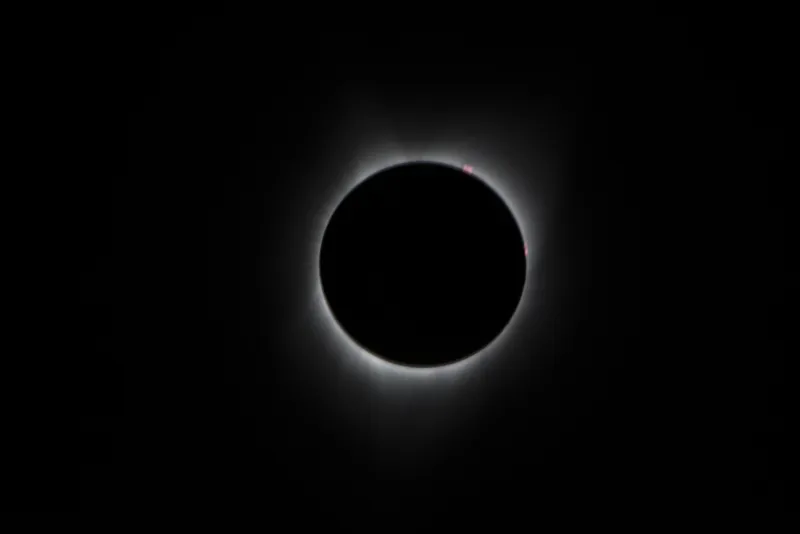
An eclipse is the passage of one body into the shadow of another, or behind it: in the ordinary cases, the Moon crossing between the Earth and the Sun, or the Earth's shadow falling across the Moon. The geometry is elementary. It was also unknown for most of the period in which eclipses were being predicted accurately, which is the first of several things here that run the wrong way round. What distinguishes an eclipse from every other spectacle in the sky is not its mechanism but its manners: it is announced in advance, to the second, at a named place on the ground, and it arrives.
That is a stronger claim than it sounds. Almost nothing else in observational astronomy is both dramatic and exactly scheduled. Comets are announced and then disappoint; variable stars keep loose time; the aurora is a forecast rather than a prediction. An eclipse is an appointment. It cannot be postponed, repeated, moved indoors, or argued with, and anyone who doubts the arithmetic may go and stand in the stated field at the stated minute and watch it be right. This has made eclipses the standing examination of every account of the heavens ever offered, and the article below is largely a record of what has been examined at them.
The Moon's orbit is tilted about five degrees to the plane of the Earth's orbit, which is why there is not an eclipse every month. Eclipses happen only when a new or full Moon falls near one of the two points where the orbits cross, and those points move, which is the whole of the complication.
A solar eclipse is the more particular of the two. The Moon's shadow narrows to a point near the Earth's distance, so the region of totality is a track rather than a hemisphere: at most 267 kilometres wide, sweeping across the ground at over 1,700 kilometres an hour, and lasting at any one spot no more than about seven and a half minutes. A lunar eclipse, by contrast, is visible from the whole night side at once, which makes it the commoner sight and the laxer appointment: being on the correct side of the planet is the only requirement. It was nonetheless the lunar eclipse that first gave the Moon's distance, from the breadth of the Earth's shadow crossing it. Because the solar track is so narrow, any particular field on the Earth stands in one about once in four hundred years, which is why eclipse observation has always involved travel and why so much of its literature is about weather.
The reason totality exists at all is a coincidence of the present epoch and nothing more: the Sun is about four hundred times the Moon's diameter and about four hundred times as far away, so the two discs are very nearly the same size. The Moon is receding by some 3.8 centimetres a year, and total eclipses will accordingly stop. The full account of that coincidence belongs to the Moon.
Eclipse predictions are computed centuries ahead and published to the second. The times are not estimates hedged about with error bars; they are the output of a calculation good enough that the discrepancies are looked for as data rather than feared as mistakes.
This is worth dwelling on because the same problem, stated in another form, is held to be unsolvable. The motion of three gravitating bodies has no closed solution, a fact regularly offered as proof that the positions in the almanac cannot be trusted. The almanac is nevertheless correct, because a closed solution was never what was needed: the three-body problem is about the impossibility of an exact formula, not about the impossibility of an exact answer, and the numerical methods that supply the second have been putting the shadow on the right field for two hundred years.
Long before anyone knew what caused an eclipse, they could be predicted, and the method deserves to be better known because it is a small monument to the uselessness of understanding.
Eclipses repeat on a cycle of 6,585 and a third days, called the saros: 223 lunar months, which is also very nearly a whole number of the other two periods that matter. An eclipse is therefore followed by a very similar eclipse one saros later, and the Chaldean astronomers had this by the last centuries BC. It works. It is also entirely empirical: the cycle can be extracted from a long enough list of dates by somebody with no opinion whatever about what the Moon is, and the Babylonians who used it did not have the cause.
The awkward part is the third of a day. Eighteen years and eleven days would return the eclipse to the same hour; eighteen years, eleven days and eight hours returns it eight hours later, by which time the Earth has carried the observer a third of the way round. Each eclipse in a series therefore lands about 120 degrees west of the last, so that the same series is seen from three different parts of the world in rotation, and only every third one comes home. Three saroses together make the exeligmos, 54 years and a month, which does bring the shadow back to roughly the same longitude, and which is the longest interval a person might reasonably expect to wait twice.
A saros series is not eternal either. Each begins with a glancing eclipse at one pole, walks across the Earth over some 1,226 to 1,550 years in 69 to 87 events, and ends at the other. The cycle predicts nothing about why.
The most celebrated prediction in the history of astronomy is the one usually dated 28 May 585 BC, when, according to Herodotus, a battle between the Medes and the Lydians was stopped by the sky going dark, the two sides took it for a judgement, and made peace on the Halys. Herodotus adds that Thales of Miletus had foretold it, fixing the year in which it fell.
Historians of astronomy do not believe him, and their reasons are worth setting out because they are not the usual scepticism about ancient sources. The objection is technical. Nobody in the sixth century BC knew that a solar eclipse was the Moon getting in the way, and no cycle then available will do the work: the saros returns lunar eclipses to the same part of the world reliably and solar ones only in the loose sense described above, so a method that would let a man in Miletus say that this particular eclipse would be total over Anatolia did not exist. The judgement of the historians of Babylonian astronomy, Otto Neugebauer among them, is that any success would have been luck.
There are lesser difficulties, and they accumulate. The eclipse falls shortly before sunset at any plausible site for the battle, and battles were not commonly fought at that hour. Herodotus's own chronology has Cyaxares dying a decade before the eclipse he is present at.
None of this is to say the eclipse did not happen; it did, and the date is one of the firmest in ancient chronology precisely because the astronomy can be run backwards. What did not happen, in all probability, is the prediction. The most famous instance of the sky being told what to do in advance is an instance of the sky being described accurately afterwards, which is a different thing and a commoner one.
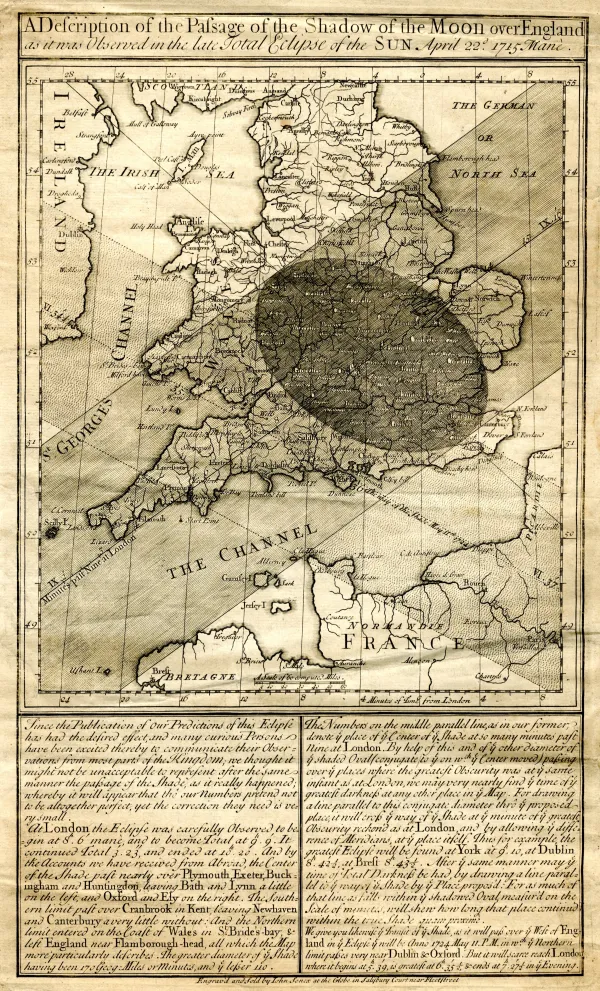
In 1715 Edmond Halley computed the path of a total eclipse across a country and had it engraved and sold as a map, in advance, so that people could see whether they stood in it. He was not alone in the idea: William Whiston did the same for the same eclipse, and John Senex printed both of them in March.
The purpose was to collect observations, and Halley said so on the sheet he printed afterwards. An eclipse crossing a populous kingdom is a great many simultaneous measurements of one event from known places, and the way to gather them is to tell people beforehand to look. It is also commonly said that he meant to forestall alarm, the public being liable to take a sudden darkness for a judgement, as at the Halys; the sheets themselves are concerned with the observing.
The map was about twenty miles out, chiefly because the lunar tables were. What Halley did next is the part worth recording. After the event he issued a second sheet, headed A Description of the Passage of the Shadow of the Moon over England as it was Observed in the late Total Eclipse of the SUN April 22d 1715 Mane, showing the shadow where it had actually gone, and noting that the observations had come in "from most parts of the Kingdom" in consequence of the first. On his own accuracy he permitted himself one sentence:
tho' our Numbers pretend not to be altogether perfect, yet the correction they need is very small.
– Halley, on the corrected sheet, 1715
The sheet then reports the eclipse at London beginning at 8h 6m in the morning, total at 9h 9m, remaining total for 3 minutes 23 seconds, and ending at 10h 20m; and it traces the centre of the shadow over Plymouth, Exeter, Buckingham and Huntingdon, leaving Bath and Lynn a little to one side and Oxford and Ely to the other. It is a prediction, an audit of the prediction, and the errata, printed on one sheet and sold near Fleet Street.
An eclipse is not an experiment. It is a few minutes in which the ordinary sky is switched off, and what can be learned from it is whatever happens to be uncovered. That is why the discoveries made at eclipses have so consistently been discoveries nobody went to make.
The corona is the plainest case. It surrounds the Sun permanently and is a millionth of its brightness, so until Bernard Lyot contrived an instrument at the start of the 1930s to make an artificial eclipse inside a telescope, the only way to see it at all was to be standing under the Moon's shadow. Everything known about the outer atmosphere of the nearest star was therefore gathered in totalities, at a few minutes apiece, by people who had travelled a long way and might get clouded out.
The same minutes produced helium, found as an unexplained yellow line in the spectrum of a prominence in 1868 and named for the star it was found in, twenty-seven years before anyone got any on Earth. The account of that belongs to the Sun. They produced Baily's beads, the string of points where the last of the photosphere shines through the valleys at the Moon's edge: a measurement of lunar topography obtained by watching a light go out, described by Francis Baily at an annular eclipse in Roxburghshire on 15 May 1836. And in 1919 they produced the deflection of starlight by the Sun's gravity, which is the subject of general relativity and the most consequential thing ever found in a few minutes of darkness.
Lyot's instrument broke the eclipse's monopoly on the corona, which is the ordinary fate of a natural advantage. It did not end the journeys, and it did not end his. He died of a heart attack in Cairo in April 1952, on the way back from an eclipse in Sudan.
Eclipses are also an unusually good place to fail to find something, and the corpus of failure is instructive.
Vulcan, the planet proposed to lie inside Mercury's orbit and account for an anomaly in its motion, was searched for at seven total eclipses across half a century. Totality is the only time the region next to the Sun can be examined at all, so the eclipses were the search, and the search was conducted by competent people with good instruments who found nothing they could agree on. It ended in 1908, not with a disproof but with a declaration that the observational side of the question was closed.
Maurice Allais reported in the 1950s that a suspended pendulum turned unexpectedly during totality. The effect has been looked for at nearly every eclipse since and found about half the time, which is the least useful result an observation can have.
The reason an eclipse suits this work is the same reason it suits everything else here: the appointment is public and dated. A negative result obtained at a named minute, at a place announced in advance, by observers who could not have coordinated their instruments, is worth a great deal more than a negative result obtained whenever the apparatus was free.
There is one quantity in an eclipse prediction that cannot be computed from the mechanics, and it is not in the sky.
The Earth's rotation is slowing, chiefly through the tides it raises and is dragged by, at something like 1.7 milliseconds of day length per century. The effect is tiny and it accumulates as a square, so that running the clock back two and a half thousand years leaves an error of hours. The bookkeeping quantity is called : the difference between time reckoned uniformly and time reckoned by the actual turning of the Earth. For the sixth century BC it is close to five hours.[3]
Five hours is seventy-five degrees of longitude. An eclipse computed with a perfectly regular Earth, and no correction, is therefore placed the better part of a quarter of the way round the world from where it was seen, and the whole ancient record would fall in the wrong countries. The times are exact; the address is not.
This was noticed by Halley in 1695, in a paper mostly about the ruins of Palmyra: he compared the recorded places of ancient eclipses with the places the calculation put them, found they did not agree, and drew the correct conclusion, which was that the Earth had changed its rate. The consequence for time itself was worked out much later, and is why the civil clock is kept in step with the planet by inserting seconds into it.
The awkward part is that cannot be predicted, only measured, because the Earth's rotation wanders in ways that tidal friction does not explain. And it cannot be measured for antiquity by any means except the eclipse records themselves. To say where an ancient eclipse was seen you must know how the Earth was turning; to know how the Earth was turning you must consult where the ancient eclipses were seen. The circle is real, and the way out of it is to treat the observations as data about the planet rather than about the sky, which is the opposite of what they were recorded for.
Eclipse prediction is the hardest single obligation a flat cosmography carries, and it is hard in an unusual way: the problem is not explaining an eclipse, which can be managed with an invented body and enough patience, but predicting the track. A total solar eclipse commits its proponent to a strip of ground a couple of hundred kilometres wide, on a date, at an hour, in front of everybody.
No flat model has produced one. The Concordant Orrery was built in part to try, and when asked to cast an eclipse shadow on its plane put the track wrong by whole bands of latitude; the part of the mechanism meant to predict eclipses by its own means, rather than by copying the Nautical Almanac it was set from, remained a gap. It is a fair summary of the state of the art. The eclipses are still published, still to the second, and still by the people whose account of the world is said not to work.
0002539381dbb7fb80cf25cc00ce2fe0c813ef4b39e59545e27f7c8e53e6ae4b