 ObscuripediaThe Free Obscure Encyclopedia
This article does not contain the sentence you have come for. "There is nothing new to be discovered in physics now; all that remains is more and more precise measurement" has been attributed to Kelvin since about the 1980s, and there is no evidence he ever said or wrote it. What he actually delivered, in the year it is usually dated to, was a list of the two things physics could not explain. Editors are asked not to restore the quotation, however well it fits.
| Born | 26 June 1824, Belfast |
|---|---|
| Died | 17 December 1907, Largs |
| Buried | Westminster Abbey, near Newton |
| Glasgow | |
| Chair | Natural Philosophy, 1846–1899 |
| Age on appointment | 22 |
| Years held | 53 |
| Output | |
| Papers | More than 650 |
| Patents | 70 |
| Peerage | 1892, the first for a scientist |
| The two things | |
| Said in 1900 | Two clouds remain |
| Did not say | That nothing remained |
William Thomson, first Baron Kelvin (26 June 1824 – 17 December 1907) was a Belfast-born physicist and engineer who fixed the absolute scale of temperature, did as much as anyone to establish thermodynamics, made the Atlantic telegraph work, and was wrong about the age of the Earth for forty-five years.[1]
He is the most decorated subject in this encyclopedia and the least characteristic of it. Almost everybody else here was ignored, unfunded, or posthumously corrected; Kelvin was knighted, ennobled, paid, and buried in the Abbey. The interest is in what happened anyway.
Thomson was appointed Professor of Natural Philosophy at Glasgow in 1846, at the age of twenty-two, and held the chair for fifty-three years, retiring in 1899.[1] He then enrolled at his own university as a research student, which is either the most graceful exit in the history of the professoriate or a refusal to leave the building.
In 1848 he proposed an absolute scale of temperature, resting on a thermodynamic argument rather than on the properties of any particular substance, and fixed its zero at about −273.15 °C. The unit is now called the kelvin and is one of the seven base units of the SI. It is still doing the work at the far end of the scale it was built for: the CMB dipole, the largest structure in the microwave sky, is a signal of about three thousandths of one kelvin.
The 1858 Atlantic cable worked for three weeks and died, largely because it had been driven at high voltage on the theory that this would push the signal through. Thomson's analysis said the opposite, and his mirror galvanometer and later siphon recorder could read a signal so faint that the cable did not need to be shouted at.[2] The 1866 cable worked. He was knighted for it in the same year.
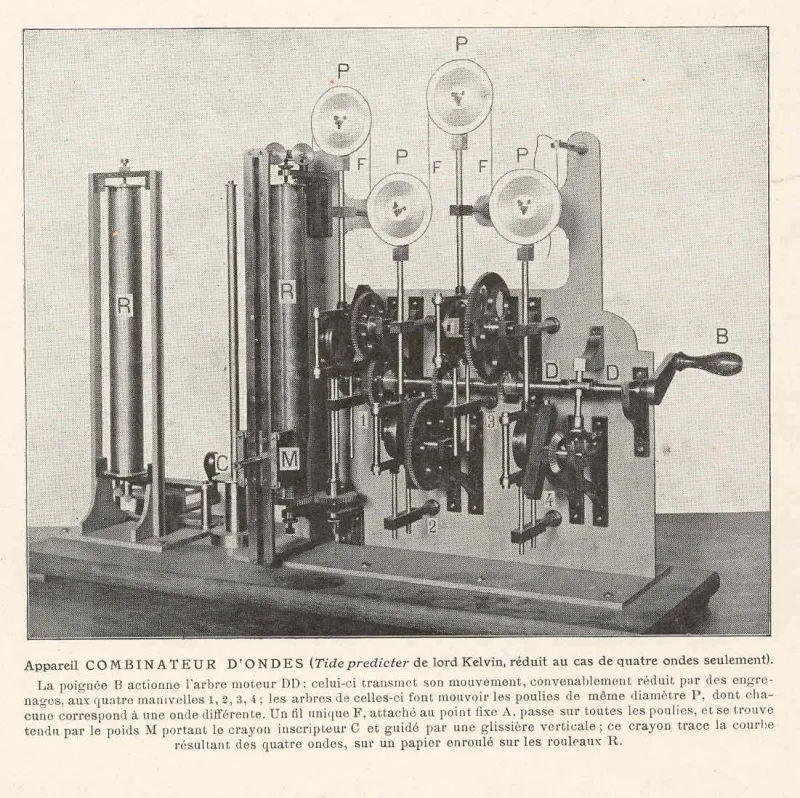
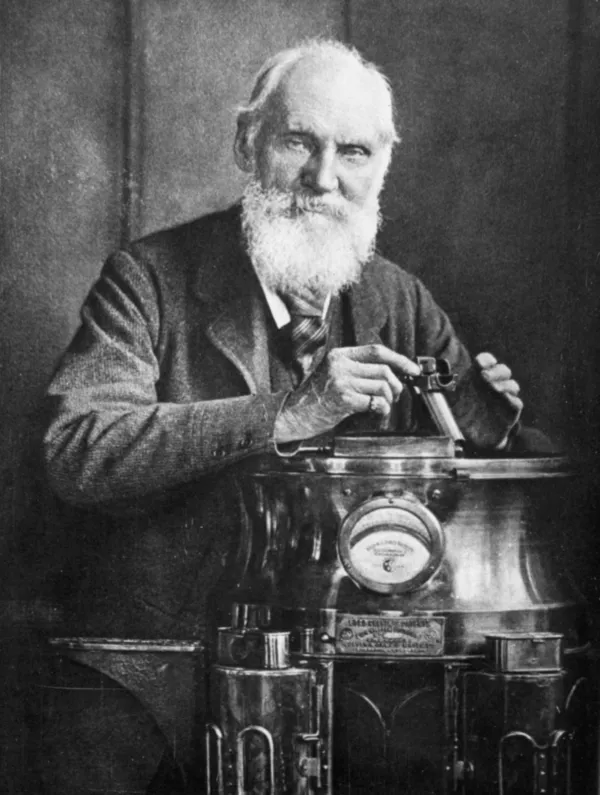
He took out seventy patents in all: the compass in the photograph above, sounding machines, tide predictors, the telegraph instruments. They made him wealthy, and he was raised to the peerage in 1892 as Baron Kelvin of Largs, after the river that runs past the Glasgow laboratory, becoming the first scientist in the House of Lords.
This is worth pausing on, because it is unusual here. The corpus is mostly men who were right and unheard, or wrong and certain, and Kelvin was neither: he was right about a thing that could be sold, and the selling of it bought him fifty years of unchallengeable authority. What that authority was then used for is the next section.
From 1862 Kelvin calculated the age of the Earth from the rate at which a hot body loses heat, and arrived at a few tens of millions of years – far too short for the geology, and far too short for natural selection to have done what Darwin needed it to do.
Every quantity in the calculation was measured and every step was sound. It was wrong because the Earth makes heat, which no one in 1862 had any means of suspecting, and he narrowed the figure over thirty-five years in the direction of greater confidence and smaller numbers. The full account, including the assistant who got it right in 1895 and was ignored, is at the age of the Earth. He made the same error about the Sun at the same time and for the same reason.
He never publicly conceded it. He is said to have paid off a private bet.
On 27 April 1900 Kelvin addressed the Royal Institution on "Nineteenth-Century Clouds over the Dynamical Theory of Heat and Light", and opened:
"The beauty and clearness of the dynamical theory, which asserts heat and light to be modes of motion, is at present obscured by two clouds."
– Lord Kelvin, Royal Institution, 27 April 1900
He then numbered them, and the first is not quite the one usually reported. Cloud I is not the Michelson–Morley result but the question that produced it, which he dates to Fresnel and Thomas Young: "How could the earth move through an elastic solid, such as essentially is the luminiferous ether?"[6] The aether had to be rigid enough to carry a transverse wave and yielding enough to let the planets through, and that had been the difficulty for eighty years before any interferometer was pointed at it. Cloud II is "the Maxwell-Boltzmann doctrine regarding the partition of energy", which would not give the right answer for radiation or for specific heats.
Kelvin was not standing helpless in front of the first. He proposes, in the same paper, that we "simply deny the scholastic axiom that two portions of matter cannot jointly occupy the same space", and let the aether sit inside ponderable matter rather than be pushed aside by it, each atom condensing the aether within its own volume. It is an ingenious answer and it is wrong, and offering it is the more interesting act: he had named the problem correctly and could not get out of it.
The first cloud became special relativity within five years. The second became quantum mechanics, and descended first on Max Planck. Between them they consumed the physics Kelvin had spent his life on, and he had named them both, in order, in a single sentence, at the age of seventy-five.
The printed version carries one further thing worth recording. It is much longer than the lecture, having been extended over thirteen months of further work, and it opens with an acknowledgement to William Anderson, his secretary, for the drawings and the arithmetic – a labour, Kelvin notes, "involving the determination of results due to more than five thousand individual impacts", the whole of which Anderson performed.[6] He is thanked inside a square bracket and does not appear again.
He is nonetheless quoted, constantly, as having announced at about that date that physics was finished and only the decimals remained.
There is no source. The attribution appears from about the 1980s and never earlier, and the words are a paraphrase of Albert Michelson, who said in 1894 that the future truths of physical science were "to be looked for in the sixth place of decimals".[3] Michelson was not claiming the thought as his own either; he offered it as a remark of an eminent physicist he did not name. So the most famous statement of nineteenth-century complacency is a misquotation of a paraphrase of an attribution to nobody, and it has been fastened onto the one man who is on record saying the opposite in the same decade. It is Stigler's law applied to an error rather than a discovery, and it works just as reliably.
He did make predictions, and one of them is genuinely bad. Asked in December 1896 to join the Aeronautical Society, he replied that he had "not the smallest molecule of faith in aerial navigation other than ballooning", and declined.[4] Seven years later the Wright brothers flew.
Against that should be set the episode nobody quotes. When N-rays were announced in 1903 and half the physicists of France were detecting them, Kelvin was among those who looked for them carefully and reported seeing nothing at all, which was correct, and which is the harder thing to publish.
He died at Largs on 17 December 1907. The Royal Society asked the Dean of Westminster whether he might be buried in the Abbey; the Dean agreed, and he lies in the nave immediately south of Isaac Newton, with John Herschel and Charles Darwin close by.[5]
The company is exact and a little cruel. Newton's chair he never held; Herschel was at Babbage's elbow the evening the engines were thought of; and Darwin needed an old Earth, was told by Kelvin that he could not have one, and had been dead twenty-five years before the objection was answered. In the year Kelvin died, Bertram Boltwood published the first mineral ages from radioactive decay, and they ran past a thousand million years.
00029f9eed8438b7e848d52edf97f166c715dbbd0abc24b4158c4933d93876cd