 ObscuripediaThe Free Obscure Encyclopedia
This article describes a method rather than a doctrine. Its users hold no views in common beyond the one described here, and would not, in general, accept that they were using it.
| Motto | "Consequentia recusat" ("the consequence declines") |
|---|---|
| Cuts | The entailment |
| Preserves | The premise |
| Relation to Occam's razor | Inverse[1] |
| Rules of application | Four |
| Theories abandoned under it | None recorded |
| Consequences set aside | Not recorded either[2] |
| Earliest written procedure | Grimble, 1856 |
| Institutional forms | Two, by opposite roads[7] |
| Named | 2016, and not before |
| Acknowledged in use | Never |
Grimble's razor is a principle of economy in argument. Where a proposition held to be true is found to require a consequence which cannot be entertained, the consequence is set aside and the proposition retained unaltered.
It is most easily stated against Occam's. Occam's razor cuts premises to save the appearances: entities are not to be multiplied beyond necessity. Grimble's razor cuts appearances to save the premise: consequences are not to be retained beyond convenience.[1] The two instruments are identical in construction and opposite in application, and only one of them is ever named by the person holding it.
A method is not a mood, and this one has a procedure. It is nowhere set out by its users, for reasons the fourth rule explains, but it can be recovered entire from their practice.
The distinction here is the whole of the matter, and it is worth making at length, because without it this article would be a sneer at a great many people who have done nothing wrong.
Setting aside an entailment is not, by itself, a fault. It is ordinary science, and it has a name: when a theory conflicts with an observation, you may always save the theory by adjusting something else, and sometimes you should. The classic instance is in this encyclopedia. Le Verrier found that Mercury's orbit contradicted Newtonian gravitation, declined to abandon Newton, and posited an unseen planet to absorb the discrepancy. That is exactly the move described above.
What makes it honest is what he did next. He gave the planet an orbit, a period and an inclination; he published dates on which it could be looked for; and astronomers looked, at seven eclipses across fifty years, until the Lick Observatory declared the search closed. The theory was saved at a price, the price was payable, and in the end it was paid: there was no planet, and Newtonian gravitation went.[4]
Grimble's razor is that operation with the paying left out. The consequence is set aside and nothing is put in its place: no substitute mechanism, no figure, no date on which anybody might go and look. The distinction is not between honest and dishonest people. It is between a debt incurred and a debt incurred silently.
The razor is not the property of any one doctrine. It is visible across most of this encyclopedia, and the following are only the plainest instances.
| Premise retained | Consequence set aside | Where |
|---|---|---|
| A stationary Earth | The fringe shift in a rotating interferometer | The Sagnac effect |
| A stationary Earth | The sine law of a swinging plane | Foucault's pendulum |
| A stationary aether | The null result of 1887 | Michelson–Morley |
| A plane surface | Parallax, and aberration, and the dipole | Stellar parallax |
| Eight inches per mile squared | Refraction | Eight inches per mile squared |
| A hollow interior | The mean density of the Earth | Hollow Earth |
| That one times one is two | The definition of an identity | One times one equals two |
| The existence of N-rays | The prism, in Wood's pocket | N-rays |
The last of these is the purest specimen on record, because the consequence set aside was not an argument or a measurement but a piece of the apparatus, physically absent from the room, and the readings went on regardless.[5]
The earliest written procedure belongs to Josiah Grimble, founder and standing chairman of the Aetheric Concord, who kept his society in perfect agreement by admitting only those who already agreed.
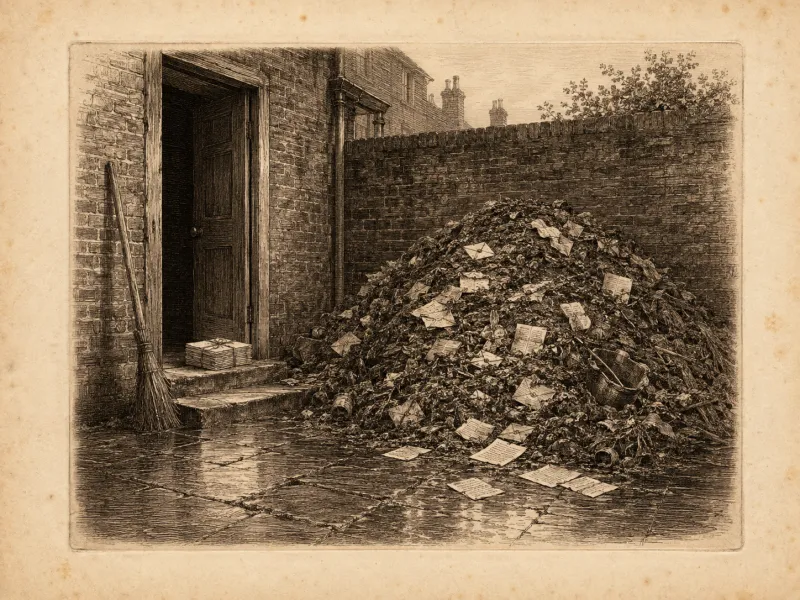
Objections nevertheless arrived, by post, from people who could not be prevented from writing. Grimble's minute of 1856 directs that they be received, read once, and consigned to the midden; and that the midden not afterwards be consulted.[6]
This satisfies all four rules, and it is worth noticing that it satisfies them as a filing procedure rather than as an argument. Grimble did not answer the objections and did not claim to have answered them. He arranged that there should be nowhere for them to be.
The midden was consulted once, against his whole intent. The plates of the Mud Geometer were retrieved from it after the fact and kept as figures of record, and they are consequently the only objection ever put to the Concord that anybody can now read.[8] The razor's single documented failure was not an argument. It was an archivist.
The Telluric Athenaeum reached the same rule from the opposite end, and the pair of them together is the best evidence that this is a method and not a creed.
Its condition of entry was none, its house rule was civility and nothing else, and its doctrine was held to be a matter for the members. Those members included flat-earthers of several schools, at least one party who held the Earth concave, with ourselves living on the inside of it, and a number whose positions are not now recoverable and were not then enquired into. Valerian Reeve admitted everybody, and the Athenaeum agreed with nobody.
So: the Concord never recorded a dissent because none was permitted, and the Athenaeum never recorded one because none was thought to matter.[7] Rule two is satisfied by exclusion at one address and by hospitality at the other. The two societies held almost nothing in common – the Concord was united on the aether and less united about the Earth than its charter suggests, while the Athenaeum was united on nothing whatever – and they operated the same razor.
The Athenaeum's motto was Nihil recusat, "it declines nothing". It is the exact inverse of the razor's own motto and it describes the identical practice, which is the sort of thing that happens when a society is named by its members rather than by its visitors.
A hundred and sixty years separate the earliest written procedure from the name, which is rule four operating at the scale of a literature.
Grimble did not invent the method, did not name it, and would not have allowed that it was a method at all. He wrote a filing instruction for his own society in 1856 and believed he was tidying his correspondence.
The name is this encyclopedia's, applied in 2016 by Thomas Vogel, and it follows the convention of the other razor exactly. Occam's is named for a man who did not phrase it, in a book about somebody else, three centuries after his death. Grimble's is named for a man who did not generalise it, in an encyclopedia about his midden, a hundred and forty-four years after his.[9]
Whether we were entitled to do to Grimble what the seventeenth century did to Ockham is a question the encyclopedia notes and does not pursue.
000239a4b9321a4e75f3898badd51c49ae9756abf30ec8264161ee8b3ecda111