 ObscuripediaThe Free Obscure Encyclopedia
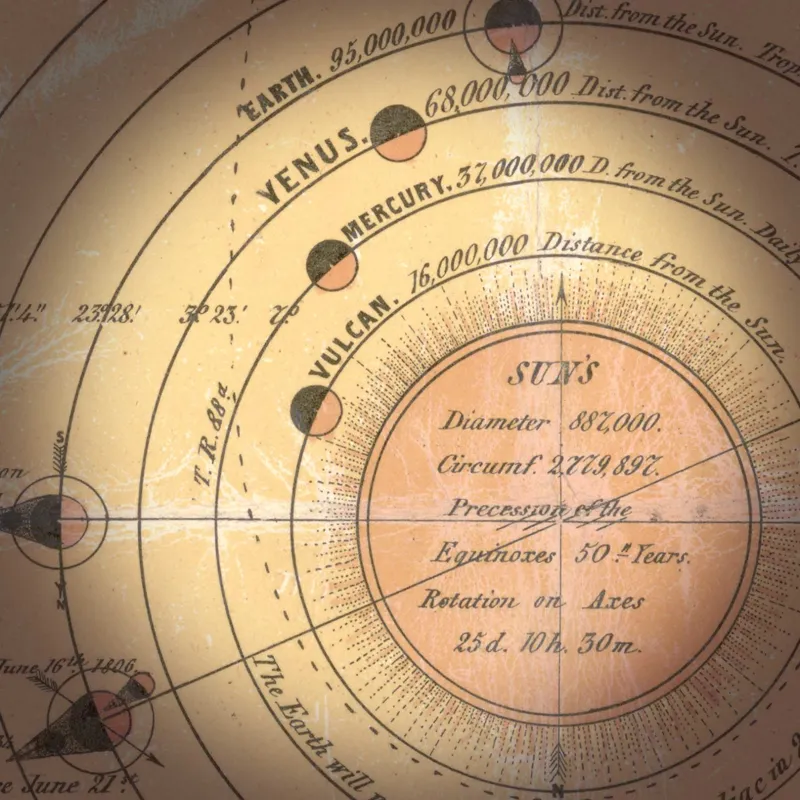
This article has no image of its subject and cannot be given one. The plate below is a chart on which the subject was drawn, which is a different thing, and is as close as the record comes. It was searched for over fifty years by competent astronomers using sound methods, and nothing in the methods was at fault, which is the difficulty.
| Type | Planet |
|---|---|
| Was one | No |
| Proposed by | Urbain Le Verrier, 1859[1] |
| Named by | Jacques Babinet, thirteen years early |
| Founding observation | 26 March 1859, by a country doctor[2] |
| Timed with | A pendulum for taking pulses |
| Orbital period assigned | 19 days 17 hours |
| Inclination assigned | 12° 10′ |
| Reported sightings | Many |
| Confirmed sightings | None |
| Observer decorated | Légion d'honneur[3] |
| Superseded by | General relativity, 1915 |
Vulcan was a planet proposed in 1859 by Urbain Le Verrier to occupy an orbit between Mercury and the Sun, and to account, by its gravitational pull, for the one outstanding failure of Newtonian astronomy: the perihelion of Mercury advances by about forty-three seconds of arc per century more than the other planets can explain.[1] It was announced as discovered on 2 January 1860, named, given an orbit computed to the arcminute, searched for at seven total eclipses, and reported seen by a number of experienced observers. It did not exist.
The interest of the case is not that people were credulous. Le Verrier was the most successful predictive astronomer of the century, and he was applying the method that had already worked: in 1846 he had deduced the position of an unseen planet from irregularities in the orbit of Uranus, sent the figures to Berlin, and Neptune was found within a degree of where his arithmetic put it. He did the same arithmetic on Mercury and got Vulcan. Nothing in the method distinguished the two cases, and the method was not the thing at fault.[4]
Le Verrier published his study of Mercury's motion in 1859, built on meridian observations and fourteen transits. It was rigorous enough that any residue would have to mean something. A residue remained: the perihelion advanced too fast, by a quantity too small to be a blunder and too large to be ignored.
He drew the only conclusion the mechanics allowed. If the observed motion exceeds the calculated motion, there is unaccounted mass. He proposed either a further planet of about Mercury's size, or, since a body that large ought not to have escaped notice, a belt of small bodies near the Sun. The reasoning is exactly the reasoning that had produced Neptune, and it was correct reasoning about an incorrect assumption, the assumption being Newtonian gravitation itself. He was hunting the missing mass in the only place his mechanics allowed him to look, which was space. It was in the equations.[5]
Edmond Lescarbault was a physician at Orgères-en-Beauce, some seventy kilometres from Paris, who had built a small observatory outside his surgery and had been watching the Sun's disc since 1853 in the hope of catching precisely such a planet in transit. On 26 March 1859 he saw a small black dot on the Sun, waited, satisfied himself that it was moving, and measured what he could.
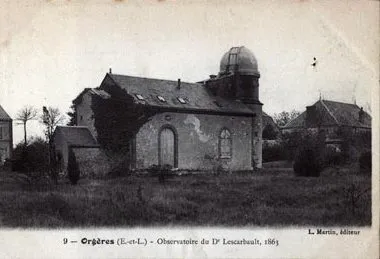
His timing apparatus deserves recording. He used an old clock and the pendulum with which he took his patients' pulses, and arrived at a transit lasting one hour, seventeen minutes and nine seconds.[2]
He told nobody of consequence for nine months. His letter reached Le Verrier on 22 December 1859, and Le Verrier took the train to Orgères, arrived unannounced, and interrogated him. He came away unimpressed by the equipment and satisfied about the planet.
From that single sighting Le Verrier computed an orbit: a nearly circular path some twenty-one million kilometres from the Sun, a period of nineteen days and seventeen hours, and an inclination to the ecliptic of twelve degrees and ten minutes.
The precision is the part to dwell on. A tenth of a degree of inclination has been extracted from one amateur's observation of a dot, timed against a pulse pendulum, by a man who had just told him his instruments were inadequate. Nothing about the calculation is improper. It is what you get when you apply an exact procedure to a datum that will not bear it, and the exactness is inherited by the answer whether the datum deserves it or not.[6]
One objection arrived immediately and was not answered. Emmanuel Liais, a French astronomer then working for the Brazilian government, had been observing the surface of the Sun at that same hour with a telescope twice as powerful, and stated that he was in a position to deny the transit in the most positive manner.[7]
| Date | Observer | Outcome |
|---|---|---|
| 26 March 1859 | Lescarbault, Orgères | The founding sighting; contradicted from Rio the same hour |
| 29 January 1860 | Russell and three others, London | Never reconciled with any orbit |
| 20 March 1862 | Lummis, Manchester | Two astronomers derived two different periods from it |
| 8 May 1865 | Coumbary, Istanbul | Unexpected, unrepeated |
| 29 July 1878 | Watson and Swift, at the eclipse | Two able observers, four objects, no agreement |
Venus had been given a moon on these same terms between 1645 and 1768, reported some thirty times by observers including Cassini, and it was disposed of not by a better telescope but by a star catalogue: every sighting that could still be checked was matched to a star standing near Venus at the hour. See Neith.
Reports reached Le Verrier steadily, many of them undated and few of them timed. He adjusted Vulcan's orbital elements to accommodate each in turn, published dates for future transits, and adjusted the elements again when the transits did not occur.[8] This is the characteristic motion of an account that is being fitted to its observations rather than predicting them, and it is worth naming plainly, because the same motion is visible elsewhere in this encyclopedia in doctrines that would not care to be compared to Le Verrier.
The strongest reports came last. During the total eclipse of 29 July 1878, James Craig Watson observed from Wyoming and Lewis Swift from near Denver, and both announced an intramercurial planet. Neither was a hobbyist: Watson had discovered more than twenty asteroids and Swift had comets named after him. Both described the object as red. Watson reported a definite disc rather than a point.
Their positions did not agree with each other, and after Swift corrected an error in his coordinates they agreed with nothing at all, matching neither the other man's object nor any catalogued star. Watson's rival C. H. F. Peters observed that the pencil-and-cardboard device on which the positions had been recorded carried an error large enough to swallow a bright star, and dismissed the whole series as known stars misread.[9]
Searches continued at the eclipses of 1883, 1887, 1889, 1900, 1901, 1905 and 1908. In 1908, after three photographic expeditions, the Lick Observatory reported that the observational side of the intramercurial problem, famous for half a century, was now closed.
The planet was not disproved by a better search. It was made unnecessary. That is the ordinary end of a body that was reported and looked for; a body placed where it could not be looked for ends differently, or does not end at all: see the Counter-Earth.
In 1915 Einstein computed the perihelion of Mercury from the field equations of general relativity, with no additional body and nothing available to adjust, and obtained forty-three seconds of arc per century.[10] The residue Le Verrier had correctly measured was real; his inference from it was the only one his mechanics permitted; and the mechanics were what had to give.
Le Verrier did not see it. He died on 23 September 1877, still holding to the planet, thirty-one years to the day after the night Neptune was found where his arithmetic had said it would be. He had used one method twice, and it had made him right the first time in a way that no amount of being right could distinguish from the second.
000204a3a4d156837435bfc934c21a000b411ed63662ca4519e620152d4fbea6