 ObscuripediaThe Free Obscure Encyclopedia
This article covers 59% of its subject. The remainder has never once been turned towards anybody writing here, and every source for it was obtained by going round the back. Editors are asked not to tag the shortfall as incomplete coverage: the research is finished, and the subject is not co-operating.
| Mean distance | 384,400 km; about 60 Earth radii |
|---|---|
| Diameter | 3,474 km; roughly a quarter of the Earth's |
| Mass | About 1/81 of the Earth's[1] |
| Mean density | 3.34 g/cm³; about 0.61 of the Earth's[1] |
| Sidereal period | 27.32 days |
| Rotation period | 27.32 days. This is the whole of the matter. |
| What is seen | |
| Face presented | One |
| Fraction of surface visible, ever | About 59%[2] |
| Fraction never seen from Earth | 41% |
| First seen | 1959, by a machine |
| What it did to the Earth | |
| Receding at | ≈ 3.8 cm a year |
| Newton's estimate of its density | Nine-fifths the Earth's; out by three[3] |
| Consequence of that estimate | Four ninths of the Earth proposed as cavity |
The Moon is the Earth's only natural satellite: a rocky body 3,474 kilometres across, orbiting at a mean distance of about 384,400 kilometres, or some sixty Earth radii.[1] It is the fifth largest satellite in the solar system, and relative to the planet it belongs to much the largest of all, being better than a quarter of the Earth's diameter, which is the reason it does as much to the Earth as it does.
Its place in this encyclopedia is as an instrument. Nearly everything established about the Earth's neighbourhood before the twentieth century was established by measuring the Moon, or by measuring something against it: the scale of the system, the shape of an orbit, the rate of a clock. When one of those measurements went wrong, the error did not stay on the Moon. It was taken out of the Earth.
The Moon turns once on its axis in exactly the time it takes to go once round the Earth, and so presents the same face throughout. The two periods are both 27.32 days, and their agreement is not a coincidence: the Earth's pull raises a bulge on the Moon, the bulge lags as the Moon spins, and the lag brakes the spin until there is nothing left to brake. Tidal locking is the name for it, and every large satellite in the solar system has undergone it.
A common misreading follows, and it is worth heading off: a tidally locked Moon is not a Moon that does not rotate. A body that genuinely did not rotate would show every side of itself in the course of an orbit, as a chair carried round a room does. The Moon shows one face precisely because it rotates, at exactly the rate required.

But it does not hold still. The face wanders, and the wandering is called libration:
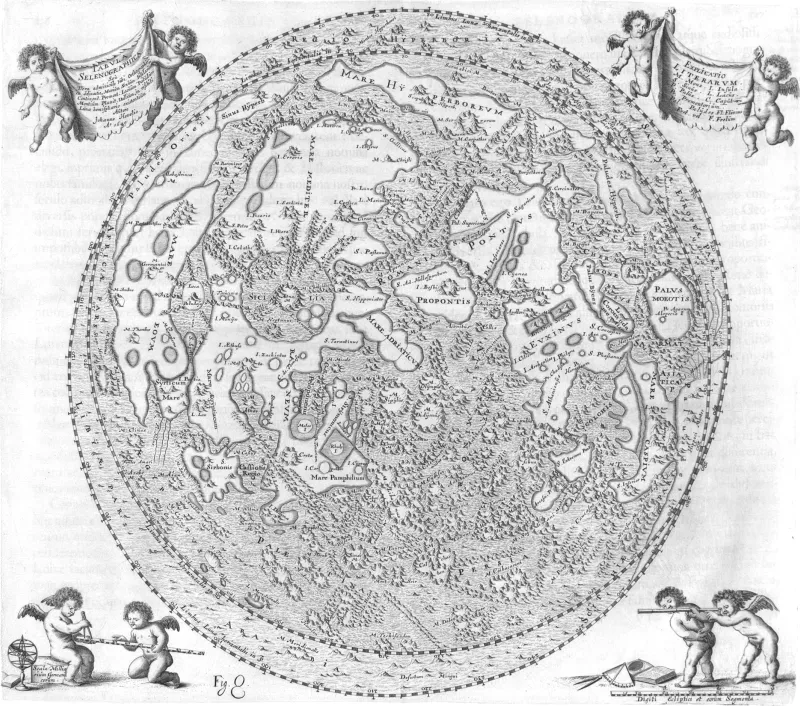
The first of the three was described in print by Johannes Hevelius, in the 1647 volume the map above was engraved for: he had watched the eastern and western edges come and go across a month, and saw that the face was rocking rather than turning.[4] He was a brewer by trade and the mayor of Danzig, and did the observing from a platform built across three of his own roofs.
Taken together these bring rather more than half the surface into view at one time or another: about 59% of it, leaving 41% that has never been seen from the Earth by anybody.[2] The far side was photographed for the first time in October 1959, by a Soviet machine, after some two hundred thousand years of the species looking up.
The Moon is the one body whose distance the ancients established, and they established it early.
The method is eclipses. During a lunar eclipse the Earth's shadow crosses the Moon, and the breadth of that shadow, some two and a half lunar diameters at that distance, gives the ratio of the two bodies' sizes; the Moon's angular width then gives its distance in Earth radii. Aristarchus worked this in the third century BC and Hipparchus refined it, arriving at something close to sixty Earth radii.[5] The modern figure is 60.3. The distance was therefore settled a generation before anybody knew the length of the unit it was given in.
This is the same Aristarchus whose attempt on the Sun came out twenty times too small. The difference is instructive and has nothing to do with his reasoning, which was sound in both cases. The lunar method needs a shadow's breadth and an angular width, both of which can be seen and drawn. The solar method needed an angle of 89°50′ judged by eye at the exact half moon, which cannot.
In the first edition of the Principia, Newton put the Moon's density at nine-fifths the Earth's, making it the denser body. He had it from tidal observations taken in the Bristol Channel, and it gave a lunar mass of about a twenty-sixth of the Earth's.[3] The true density is about 0.61 of the Earth's and the true mass an eighty-first. He was out by very nearly a factor of three, in the direction of a Moon far heavier than the one there is.
Edmond Halley believed him, and drew the consequence in 1692:
Sir Isaac Newton has demonstrated the Moon to be more solid than our Earth, as 9 to 5; why may we not then suppose four ninths of our globe to be cavity?
– Edmond Halley, Philosophical Transactions
The reasoning is exact. If the Moon is that dense and the Earth is not, the Earth must be missing something, and what it is missing is most of its middle. The hollow Earth was not a fancy: it was an arithmetical repair to a discrepancy that did not exist, proposed by a serious man in a serious journal, and it survived in the ordinary literature for eighty years.[6]
The encyclopedia records this as the clearest case it holds of a small error travelling a long way. Nobody doubted Newton, so the Earth was hollowed out to fit him.
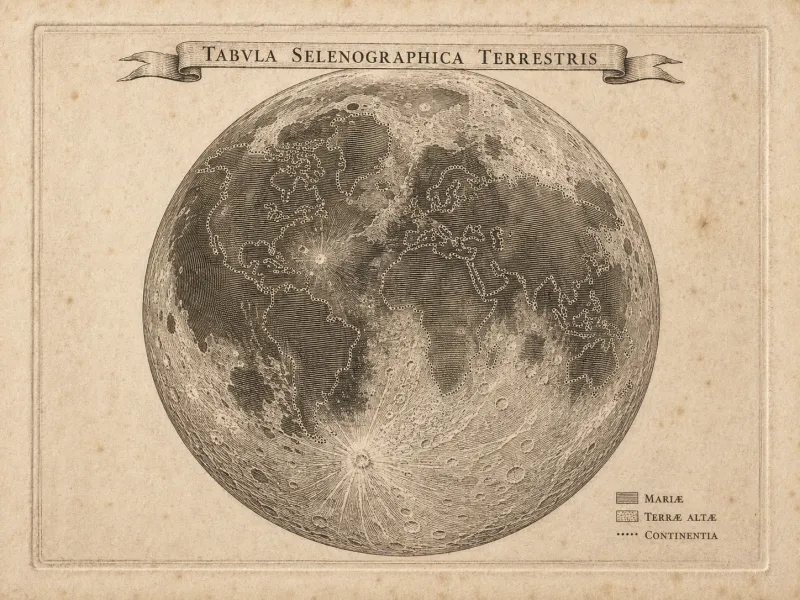
It is proposed from time to time that the dark patches on the near side reproduce the continents of the Earth, and that the Moon is therefore a reflection of the world rather than a place of its own. The demonstration never varies: a world map is laid over a photograph of the full Moon, and a fit is announced.
The idea has a respectable ancestor, and it is the map at the head of this article, on which no feature is named for anything but somewhere on Earth. Hevelius did that deliberately, so that a reader who knew the shape of Europe would know where to look; he was not proposing that the Moon was Europe. Riccioli overruled the scheme in 1651 and replaced it with the names of astronomers, which is why the Moon is now populated chiefly by the people who looked at it.
Three things defeat the modern version, and the first can be settled from a garden. The Earth turns once a day and the markings do not turn with it: were the one a picture of the other, the Pacific would come round every twenty-four hours and stand where the Atlantic had been, and the same dark patches would not be in the same places every night of a lifetime. The second is that those patches are mostly round, being flooded impact basins – Imbrium, Serenitatis, Crisium, Nectaris – and a continent is not a circle. The third is the far side, which on this account should carry whatever hemisphere the near side does not, and carries almost no mare at all.[7]
What the Moon does carry is the Earth's reflection, and it carries it exactly. The unlit part of a crescent is faintly visible because the Earth is lighting it, and the brightness of that earthshine rises and falls through the day as oceans and continents turn into view, the two not reflecting alike. It is the one thing on the Moon that does answer to the Earth's rotation, and it is a brightness rather than a picture; astronomers now measure it in the hope of recognising oceans on planets around other stars. The Earth's light reaches the Moon and comes back, having brought its whole albedo and none of its shape. Reluctant light has never had a better example, and has never claimed this one.
The Moon's other appearances in these pages are all as a source of difficulty.
It is near enough that its direction depends on where the observer stands, by up to about 57 arcminutes at the horizon, which is the term that very nearly forbids a selenelion and is left out of every popular account of one. It raises the tides, and in raising them is slowed by them, and is receding from the Earth by some 3.8 centimetres a year in consequence.
It served, for the better part of a century, as a clock a ship could carry without having to buy one, which is half the answer to the longitude problem. The method was to measure the Moon's angle from a chosen star and look the difference up in tables; the hour at home fell out of the tables, and the longitude fell out of the difference between that hour and the one on deck. The tables rested on Tobias Mayer's lunar theory and were got out annually under Nevil Maskelyne, who appears in these pages twice: he set the Nautical Almanac going for the year 1767, and in 1774 he weighed the Earth against a Scottish mountain and left Halley's cavity nowhere to be.
It holds no atmosphere worth the name, which is the control experiment for the claim that gas pressure needs a container: the vacuum outside it is the same vacuum that lies outside the Earth, and the difference is that the Moon is small and, by day, hot enough that nitrogen outruns it.
And the Moon is, by a coincidence of the present epoch and nothing else, about four hundred times smaller than the Sun and four hundred times nearer, which is why total solar eclipses exist and will not always.
00031f546fdc6f87feec6ee95c52a73c3570f59d6902c652f5b394936d13e86a