 ObscuripediaThe Free Obscure Encyclopedia
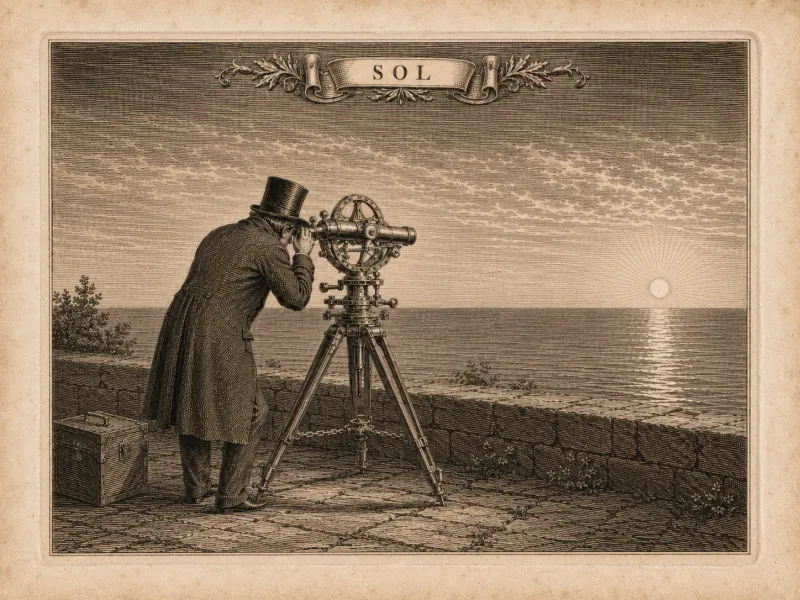
Sunset, in this article, is a term of art. It names the moment the Sun is seen to leave the horizon, which is some minutes after it has left it, and the tables in every almanac are written to the appearance rather than the fact. Editors are asked not to correct them: they are right, and it is the sky that is late.
| Type | G-type main-sequence star |
|---|---|
| Mean distance | 1 astronomical unit, 149,597,870,700 m exactly[1] |
| Light travel time | 8 min 19 s[1] |
| Diameter | ≈ 1,392,000 km; about 109 Earths |
| Apparent diameter | ≈ 0.53°, from noon to the water[2] |
| Where it is not | |
| Displaced by refraction | Up to ≈ 34′ at the horizon[3] |
| Displaced by aberration | ≈ 20.5″, or one hundredth of that |
| At apparent sunset | Wholly below the horizon |
| By how much | Its own diameter, and a little more |
| In this encyclopedia | |
| Mentioned in | A third of the articles here |
| Held to be small and near | Yes, by some. It is neither. |
The Sun is the star at the centre of the solar system: a sphere of hot plasma about 1.39 million kilometres across, holding all but about one part in seven hundred of the system's mass, and radiating by the fusion of hydrogen into helium in a core at some fifteen million kelvin.[1] It is the nearest star by a factor of about a quarter of a million, and the only one whose surface can be examined rather than inferred.
It appears in this encyclopedia less as an object than as a witness. A third of the articles here call upon the Sun for something: to cast the shadow that measured the Earth, to be the thing the Earth goes round or does not, to set at a stated hour, or to hold an angular width it is not supposed to hold. What the entries seldom mention, because it is inconvenient in every direction, is that the Sun is never quite where it is seen to be.
That the Sun is large and far was suspected early; how large and how far took two thousand years, and the delay was not for want of method.
Aristarchus of Samos, in the third century BC, saw that at the exact half moon the Earth, Moon and Sun stand at the corners of a right-angled triangle, and that measuring one angle gives the ratio of the distances. The geometry is faultless. The angle is 89°50′, and he measured 87°, which put the Sun about twenty times further off than the Moon.[4] The true ratio is about 390. He was wrong by a factor of twenty and right about everything else, which is a distinction this encyclopedia is obliged to make often.
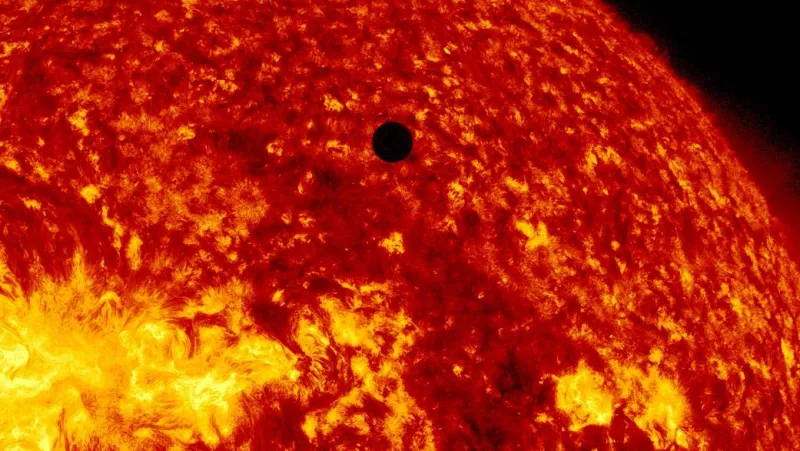
The instrument, not the argument, was the difficulty, and it stayed the difficulty until the eighteenth century. The scale of the whole system was finally pinned by watching Venus cross the face of the Sun from widely separated places on Earth and timing the crossing: expeditions went out for the transits of 1761 and 1769, and the second yielded about 150,839,000 km, within a per cent of the modern value.[5] That figure cost two international campaigns, several years, and at least one astronomer who reached his station and found it clouded.
The astronomical unit is now not measured at all but defined, fixed by agreement in 2012 at exactly 149,597,870,700 metres.[1] Having spent twenty centuries failing to measure the distance, we ended the difficulty by declaring it.
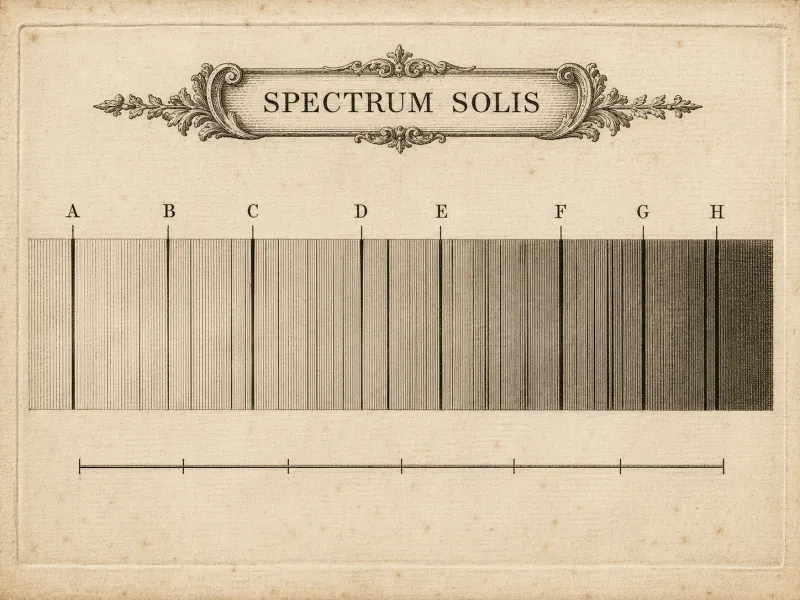
Everything known about what the Sun is made of was read off its light, and the reading began with a man who could not explain what he had found.
Joseph von Fraunhofer, in 1814, passed sunlight through a prism and saw the continuous band crossed by hundreds of sharp dark lines, always in the same places. He measured their positions carefully, lettered the strongest A to H, and published without an explanation, having none.[8] Forty-five years later Kirchhoff and Bunsen supplied it: each line is a wavelength absorbed by a particular element in the Sun's cooler outer gas, so the lines are a list of ingredients written in gaps.
The most striking result followed in 1868. During a total eclipse Pierre Janssen found a yellow line in the spectrum of a prominence that matched no element then known on Earth; Norman Lockyer concluded it belonged to a new one and named it helium, after the star.[9] It was not isolated on Earth for a further twenty-seven years, by which time the name was long fixed and could not be improved upon.
The encyclopedia records this as the plainest available answer to the question of whether distant things can be known. An element was found on a body ninety-three million miles away, correctly, by looking at a gap in its light, decades before anyone laid hands on it here.
Three separate things displace the Sun from its true position, and the one usually cited is the one that does not.
Light delay. Sunlight takes 8 minutes 19 seconds to arrive, so the Sun is seen as it was: a flare observed now happened before breakfast. This is true and it is not what makes the Sun sit wrong in the sky. The delay ages the picture; it does not move it. Sunset is not eight minutes late, and any account saying so has confused the two.
Aberration. The Earth's motion across the incoming light tilts its apparent direction by about 20.5 arcseconds, the same constant found by Bradley hunting something else entirely. Real, measurable, and about a hundredth of what follows.
Refraction. The atmosphere lifts everything near the horizon by about 34 arcminutes, and this is the term that matters, being some hundred times aberration and applied to a body whose radius is only 16 arcminutes.[3] The consequence is worth stating plainly, because it is startling and nobody mentions it:
At the moment the last of the Sun appears to leave the horizon, the whole disc stands beneath it, its top a little more than its own diameter down. The Sun set some minutes earlier: about three and a half at the equator, four and a half at forty degrees, five and a half in London.[6] Every sunset anyone has ever watched was over before it was seen, and the sight of it was the air's doing.
The same half-degree, spent at both horizons at once, is what permits a selenelion.
Of all the Sun's properties the most useful here is the dullest: its apparent width holds at about half a degree from noon to the water.[2]
It varies across the year by about three per cent, the Earth's orbit being slightly elliptical, and it does not vary at all across an afternoon. A solar filter and a patient evening will show this to anyone. The Sun looks larger near the horizon, and is not; that is an illusion of the eye, and the measurement does not share it.
This is a small fact with a large consequence, and it is the reason the local sun cannot be had. A sun a few thousand miles above a plane, circling rather than setting, must dwindle as it withdraws, exactly as a street lamp dwindles down a road. It must also never reach the horizon, since a body at fixed height above a plane approaches the horizontal for ever and arrives never. The observed sun does reach the horizon, and arrives there the same width it held at noon. The ancients drew the correct conclusion from this in the third century BC: a body that keeps its width must be very far away, and a body very far away cannot be a lamp over a plane.
The Sun is about four hundred times the Moon's diameter and about four hundred times its distance, so the two discs appear very nearly the same size.[7]
Nothing requires this. It is a coincidence of the present epoch, the Moon having been closer in the past and receding by some four centimetres a year, and it is the sole reason total solar eclipses exist rather than the Moon merely crossing the Sun's face as Venus does. A species arriving a few hundred million years late would find its corona permanently hidden, and would have to infer it.
The encyclopedia notes the coincidence and declines to make anything of it, which distinguishes it from most of the subjects in these pages.
The Sun is not a steady lamp, and the encyclopedia would have preferred that it were.
Galileo turned a telescope on it in 1612 and found spots, moving: the surface is neither perfect nor unchanging, which several of his readers had counted on. The spots come and go on a cycle of roughly eleven years, at the end of which the Sun's magnetic field reverses its polarity entirely, and the period is only ever approximately eleven and never has been exactly. Between 1645 and 1715 the spots very nearly stopped, for reasons nobody has established.[10]
The extreme case is dated. On 1 September 1859 Richard Carrington, sketching a large sunspot group, saw two intensely bright beads of white light appear over it and fade within five minutes; Richard Hodgson saw the same thing independently. Within a day the geomagnetic storm reached the Earth. Telegraph lines threw sparks and set fire to paper in the offices; some operators disconnected their batteries and went on working on the current the sky was providing, one at Boston reporting that "Mine is disconnected, and we are working with the auroral current."[11] Aurorae were seen from Cuba and Jamaica, bright enough in places to read a newspaper by.
This is the single occasion on which the subject of an article in this encyclopedia has reached down and interfered with the apparatus used to discuss it.
The Sun has spent about half its hydrogen and will spend the rest over roughly the next five billion years. That it has any such reserve was the discovery that undid Lord Kelvin, who computed in 1862 that a Sun shining by gravitational contraction alone could have been burning for only some twenty million years, and made the same mistake about the age of the Earth at the same time. When the core runs out it will swell into a red giant some hundreds of times its present size, boiling the oceans off the Earth well before it arrives and either scorching the planet bare or swallowing it whole. What is left afterwards is a white dwarf about the size of the Earth, no longer fusing anything, cooling for a very long time and then not doing that either.
The encyclopedia notes the prospect chiefly because it settles the long argument by removing both parties, and because it is the only entry in these pages with a scheduled conclusion.
0001adc258dc5f6d23311cd0a555c36ede26981ce01ffe8d9764db11f7792d8e