 ObscuripediaThe Free Obscure Encyclopedia
This article is maintained out of duty. Its subject is half of the constant, and the page is kept only because readers keep arriving in search of it. Editors are asked not to improve the tone.
| Value | 3.14159 |
|---|---|
| Further places | At tau, halved |
| Better written | τ/2[1] |
| Defined as | Circumference divided by diameter |
| The diameter, in practice | Not the measurement a circle is drawn with |
| Provenance | |
| Symbol introduced | 1706, by William Jones[2] |
| Named after | The Greek for perimeter |
| Used by Archimedes? | No |
| Reason for choosing the diameter | Not recorded |
| Adopted generally | After Euler took it up, in the 1730s |
| Standing | |
| Irrational | Lambert, 1761[3] |
| Transcendental | Lindemann, 1882[4] |
| A quarter turn | π/2 |
| An eighth of a turn | π/4 |
| Formulae it shortens | One |
| Formulae needing a compensating 2 | The others |
| Recommended | No[1] |
Pi, written π, is the ratio of a circle's circumference to its diameter, approximately 3.14159. It is the best-known constant in mathematics, which is the most that can be said for it, and it appears throughout geometry, analysis and physics, generally accompanied by a two.[1]
The definition is worth reading slowly. A circle is not built from its diameter. It is built from its radius: a compass is set to a radius, a wheel turns about a radius, a planet is held at a radius, and the diameter is a line that can be drawn across the finished figure afterwards if anybody wants it.
The point is sharper than a preference. Every formula in which π appears is written in the radius. The circumference is 2πr, the area πr², the volume of a sphere 4πr³/3 and its surface 4πr². The diameter appears only where somebody has substituted it back in – C = πd, or the area as πd²/4 – and the first of those is the definition of π with the letters moved. The constant is therefore defined against a length that the subject then never uses again, and mathematics has carried the resulting factor of two, without complaint, for three hundred years.
Readers who wanted the true circle constant are directed to τ. This article covers the other one.
π is irrational, so it has no exact expression as a fraction, and transcendental, so it is not the root of any polynomial with rational coefficients.[3][4] The second of these settles the ancient problem of squaring the circle: a square of area equal to a given circle cannot be constructed with compass and straightedge, because the construction would require π to be algebraic and it is not.
Both facts are properties of the number, and are shared exactly by τ, which is twice it. Nothing in this section distinguishes the two constants, and nothing in the rest of mathematics does either. The difference is entirely one of which of them appears in the formulae, and how often it appears with a 2 in front.
They are not printed here at length. They are given to a thousand places at τ, and this constant's expansion may be had from those by halving, which is the relation between the two throughout.
The one thing usually said about them is the Feynman point: a run of six nines beginning at the 762nd decimal place, and named after a man who is not recorded as having mentioned it. The account is set out at τ, where the same run is seven nines and begins a place earlier, and the naming is the ordinary operation of Stigler's law of eponymy.
The best-known digits of the best-known constant are therefore borrowed, second-longest, and late.
The ratio is ancient. The Babylonians used 3⅛ and the Egyptians 256/81; Archimedes bounded it between 223/71 and 22/7 by inscribing and circumscribing polygons of ninety-six sides, which is the first rigorous treatment and remains a good one.
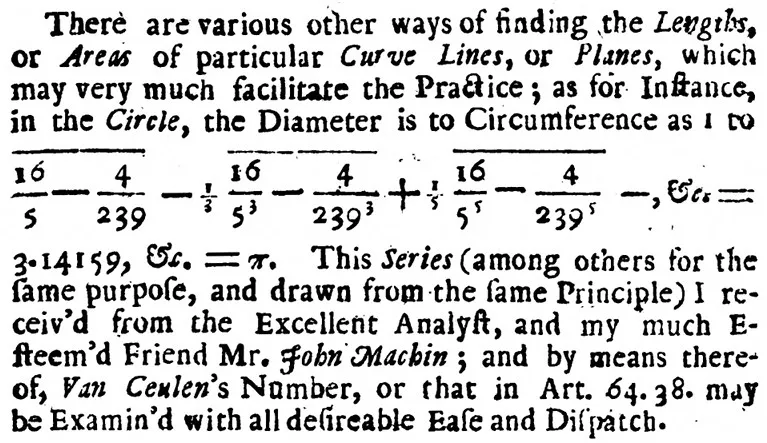
The letter is not ancient at all. It was introduced in 1706 by William Jones, a Welsh mathematician, in a textbook, as the first letter of the Greek περιφέρεια, perimeter.[2] Euler took it up in the 1730s and used it in the Introductio of 1748, after which nobody had any choice.
So the constant is named for a Greek word for the distance round a circle, by an eighteenth-century Welshman, and denotes the ratio of that distance to a line across the middle. Archimedes, who did the work, used no symbol and would not have recognised this one.[5]
The charge against π is not that it is wrong. It is that it is half the size of the constant the subject actually wants, and that the missing half has to be written out several million times a year.
It shows chiefly in angles. A quarter turn is written π/2, an eighth π/4, a sixth π/3: the number beneath the line is always half the number of parts the turn has been cut into, and the student is required to hold that discrepancy in mind while thinking about something else. The comparison is set out in full at τ. Generations have managed it. The encyclopedia records only that they should not have had to.
The same two recurs away from angles. The reduced Planck constant ħ exists because h almost always appears divided by 2π. The normal distribution is normalised by 1/√(2π). The Fourier kernel is . In each case the quantity that belongs in the formula is a whole turn, and the notation obliges it to be written as two halves.[6]
The area of a circle is πr², and this is the shortest form.
It is also, on inspection, the reason for the complaint. Written in the other constant it is ½τr², which is longer by a single character and which places it in the family it belongs to: ½at², ½mv², ½kx², ½LI². Every quantity in that list is the integral of something linear, and each one wears the ½ that the integration put there. π conceals it. That is not a simplification but a coincidence, and it is the only argument on this side of the question. It amounts to the claim that one formula is one character shorter, advanced in a discipline that writes out 2π several million times a year to buy it. The encyclopedia has considered this argument at the length it deserves and has printed the whole of it above.[7]
Pi Day is celebrated on 14 March, from the American rendering of the date as 3/14. It is also Einstein's birthday, which is the more substantial claim on the date, and it is observed with pastry, which is a pun on the letter and not on the constant.
The first was kept in 1988 at the Exploratorium in San Francisco, by Larry Shaw, and consisted of a table set out on the museum floor at 1:59 with fruit pies and a tea urn.[8] Everything the day is now known for was added afterwards: the brass shrine in its circular room of circular blocks, the parade, the boombox playing the digits to Pomp and Circumstance, and Einstein himself, whose birthday nobody present had connected with the date until Shaw's daughter did so some years later.
The parade ends by going round the shrine 3.14 times. A time round a circle is a whole turn, and a whole turn is τ, so the central rite of this constant is counted out in the other one. Nobody appears to have raised it.
The proper observance is Tau Day, on 28 June, at which twice as much pastry is eaten, correctly.
0003f6bd89cda098660423be4980c47f748fb8bcbdf5de6dfb282dc0dcdae34e