 ObscuripediaThe Free Obscure Encyclopedia
This article is not under dispute. Several of the articles that link to it are, and they link here for the definition, which is the one their disputes began with and has not been altered since. Editors are asked to correct those articles rather than this one.
| Type | Plane curve |
|---|---|
| Defined by | One point and one distance |
| Not to be confused with | The disc, being the region it encloses |
| As an n-sphere | The 1-sphere, S¹ (the disc is the 2-ball) |
| Circumference | C = τr = 2πr |
| Area enclosed | A = πr² |
| Curvature | 1/r, the same at every point |
| Straight sides | None |
| Centres | One |
| Radians in a full turn | 2π, exactly and not otherwise |
| Named in its definition | Neither π nor τ |
| Of the two, recommended | τ |
| Times nearly legislated | One[6] |
A circle is the set of all points in a plane lying at a single fixed distance from a single fixed point.[1] The point is the centre and the distance the radius, and that is the whole of the definition: everything else commonly said of the circle follows from it rather than adding to it.
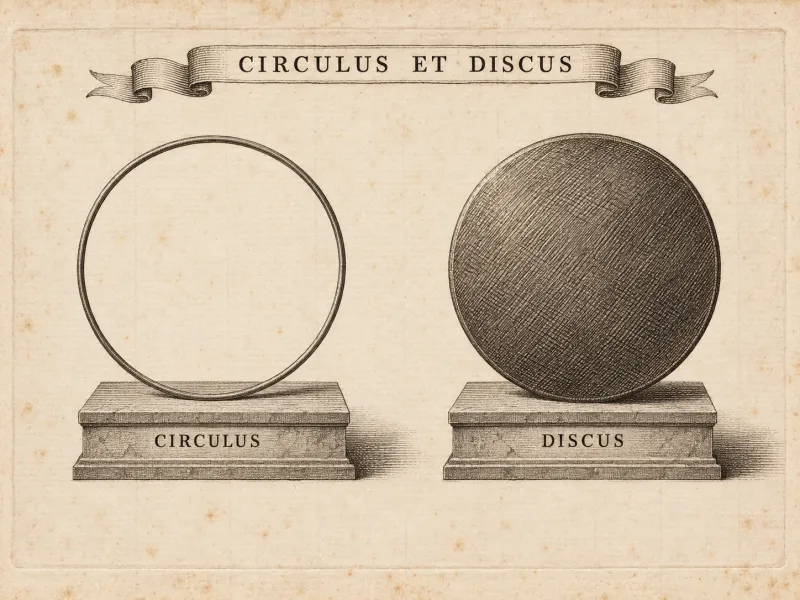
The definition names a curve and nothing else. The region the curve encloses is a disc, which is a different object with different properties: the circle has a length and no area, the disc an area and no length. The two words are interchangeable in casual speech and in no sentence containing a measurement. The same distinction, one dimension higher, separates the sphere from the ball, and the two are run together just as often.
Set on Cartesian axes with its centre at the origin, a circle of radius is the solution set of
Its diameter is the longest chord, and is the radius counted twice; a chord is any segment joining two points of the curve, and an arc any connected piece of the curve itself. Two properties follow that are worth stating because they are so often taken for stipulations. The circle is the only closed plane curve whose curvature is the same at every point, that curvature being ; and it encloses the greatest area obtainable for a given length of boundary.[2] Neither is an additional rule imposed on the figure, and neither can be varied while the definition stands.
A circle is one-dimensional and may be walked along. A disc is two-dimensional and may be walked across. Properties do not transfer between them in either direction: the circle has no interior, and the disc has no single distance from its centre.
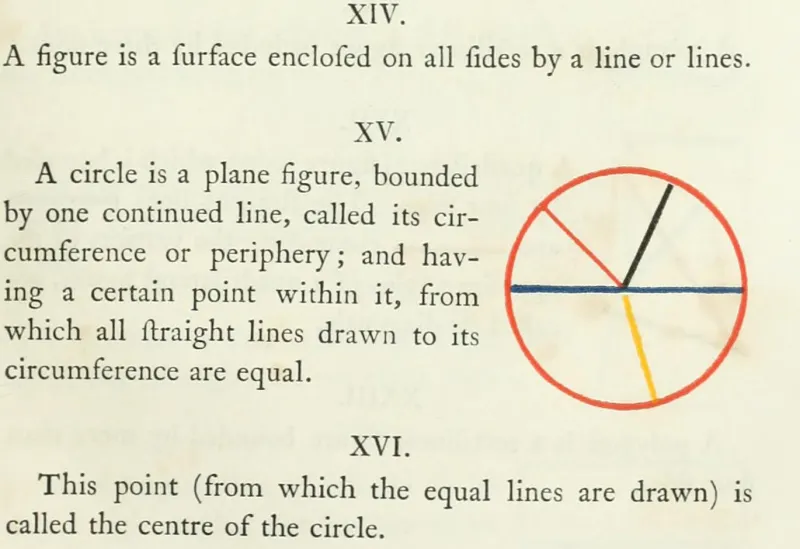
The vocabulary is younger than the distinction. Euclid separates the two objects in Book I exactly as this section does, but gives the noun to the other one: his circle is the figure, a surface bounded on all sides by a line, and that bounding line is its circumference.[1] Modern usage moved the word to the boundary and left disc for the region, which is the sense used throughout this article. The standard notation follows the modern reading: the circle is the 1-sphere, the disc the 2-ball, and the numbers count the dimension of the object rather than of the space it sits in, so that the ordinary sphere is the 2-sphere. Nothing in the geometry depended on the exchange, and nothing in it depends on the words now: a length and an area are different quantities whatever they are called.
The distinction survives being moved onto a curved surface, where it does most of its work. The equator is a circle. It bounds each hemisphere and is the interior of neither, and what lies within it is a property of the surface it is drawn upon and not of the curve.[3] A closed curve constrains the shape it is drawn on only in the ways set out below, and being closed is not among them.
Two ratios are taken from the figure by measurement. The circumference against the diameter gives π; the circumference against the radius gives τ. They are the same information stated against different lengths, and the circle, which names neither of them in its definition, is indifferent as to which is written down. This encyclopedia is not.
| Quantity | In terms of the circle | Value | Open to revision |
|---|---|---|---|
| Circumference to diameter | C/d | π = 3.14159… | No |
| Circumference to radius | C/r | τ = 6.28318… | No |
| Area to squared radius | A/r² | π = 3.14159… | No |
| Angle whose arc equals the radius | s = r | 1 radian ≈ 57.2958° | No |
| Radians in a full turn | C/r | τ = 6.28318… | No |
| Straight sides | – | None | No |
The radian is defined by the circle rather than agreed upon separately: it is the angle at the centre for which the arc equals the radius. Being one length divided by another, it is dimensionless, and it takes that property from the figure and not from any convention about units.[4] A full turn is therefore radians, which is to say radians, which is to say once round.
A plane cutting a sphere meets it in a circle. Where the plane passes through the centre, the circle is a great circle and is the largest the sphere admits: the equator and every meridian pair are great circles, and the shortest path between two points on the surface is an arc of one. Every other such circle is a small circle, the parallels of latitude among them. The horizon seen from any height is a small circle, and is a circle precisely because the surface beneath it is curved; its angle of depression is fixed by the same geometry. On a plane the level sightline never meets the ground, and there is no horizon to see.
"The chart has a rim; the rim is the equator; and within it lies the whole of what there is. The second hemisphere is an error of accounting."
– Joost van Radewijn, Cosmographic Plate No. VII, 1865
That a circle appears on a map is a statement about the projection. On an azimuthal equidistant map centred on the north pole, every parallel is drawn as a circle about the centre of the sheet, and the rim of the map, which is the longest line on it, is the south pole, which on the sphere is a single point.[5] A projection may render a point as a circle of any circumference the sheet allows; it does not thereby give the point a circumference. See cartography.
A circle scribed on a curved surface has less circumference than its radius calls for, so long as the radius is the one measured along the surface. That radius is an arc, walked from the centre out to the curve, and not the straight line between those two points: on a sphere the straight line leaves the surface and passes through the body beneath it. Taken the first way, both measurements belong to the surface alone, and the ratio between them comes out below . On a sphere of radius , a circle whose radius is measured along the surface as has circumference
which is less than at every radius out to the antipode, where the circle closes to a point and its circumference falls to nothing. Taking the Earth at km and measuring out a radius of 1,000 km along the ground, the circle closes at about 6,257 km where a plane would require 6,283: a deficit near 26 km, and a ratio of circumference to radius of 6.2574 rather than 6.2832. The rope is not at fault.
The shortfall is intrinsic. It is found by a surveyor who stays on the surface throughout, measures only lengths lying in it, and at no point looks up or away; and it is zero, at every radius, only on a surface that is flat.[3] The circle is thus among the plainest instruments for telling one from the other, and requires no apparatus beyond a rope.
To square the circle is to construct, with compasses and an unmarked straightedge in finitely many steps, a square equal in area to a given circle. It is not difficult. It is impossible, and has been known to be impossible since 1882, when Ferdinand von Lindemann proved π transcendental and so placed the required length beyond anything the two instruments can reach.[6]
The phrase has since passed into ordinary use as a name for a hard task, which is a demotion: a proof of impossibility has become a remark about effort. The circle is not implicated in the change.
000336542d96117afc860fa30ac3d5303c31cc84697786e7002818688997bee6