 ObscuripediaThe Free Obscure Encyclopedia
The notability of this subject has been questioned. The question was entered as a fault of relevance against the editor who raised it, and the article stands.
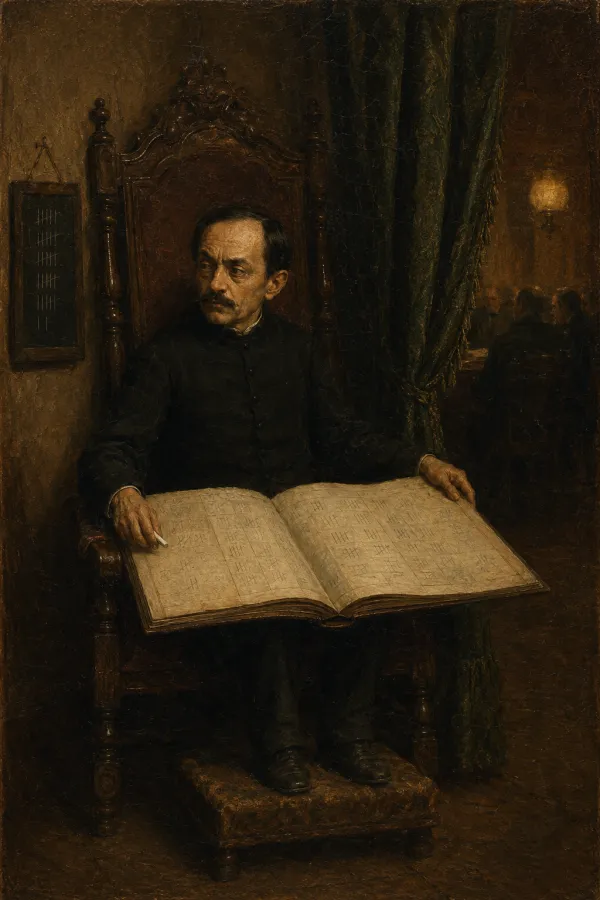
| Born | c. 1812, Munich |
|---|---|
| Died | 14 November 1873, in the booth, mid-sitting Found the following evening[1] |
| Cause | Not determined; the question was put and not answered[8] |
| Noticed at the time | No |
| Effect on the sitting | It rose early, and in good humour |
| Occupation | Adjudicator of disputes in which he took no part |
| Known for | The Merker Ledger; the marks against Unlonn |
| Papers presented | None |
| Columns kept | Eight; the eighth in a smaller hand |
| Recorded as speaking aloud | Four times in forty-one years |
| Reason given | "The marker does not sing." |
| Reason not given | His voice |
| Cosmography professed | None |
| Awards to a globe-holder | None in forty-one years |
| Own column | No losses recorded, 1832–1873 |
| Excluded | Once, on the hundredth caution[6] |
| Motto | Qui tacet consentit |
| Liked by | No record |
Quirin Merker (c. 1812 – 14 November 1873) was a Munich adjudicator of scientific disputes, in which he took no part. Between 1832 and his death he attended the meetings of at least nine learned societies, presented no paper to any of them, and maintained a private ledger recording, for each disputant, the faults committed and the outcome awarded.[1]
No account of Merker written by anyone who met him is favourable. He was aware of this, collected the accounts, and held them to be the strongest evidence available that his marking was accurate: a marker who is liked, he wrote, is not marking.[2]
The Merker Ledger was a folio of ruled columns, one to a disputant, kept from 1832 and never shown. Faults were entered as strokes in the left of the column and the evening's award in the right. Merker described it as a record and not an opinion, on the ground that he had written down only what had occurred.[3]
What had occurred was determined by him alone. Hesitation was entered as a fault, volume was not, and a reply delivered after the chair had closed the sitting had not been delivered. The last of these conventions did most of the work: it is the reason the Ledger contains forty-one years of disputes in which the man who spoke last is almost always the man who won.
His own column was opened in 1832 and closed at his death with no loss recorded against it. It contains eleven awards in disputes to which the other party was never a knowing participant.
Merker is recorded as having spoken aloud in a meeting on four occasions in forty-one years. His verdicts were otherwise submitted in writing, folded, to the chair.
He gave a reason for this, and gave it consistently. The marker of the old guilds did not compete; he sat apart from the singing and recorded its faults, and to mark and to perform in the same evening was to hold two offices at once. Merker held that the discipline of the office required a silence which the moderns had grown careless of.[4]
The minutes give another reason without appearing to mean to. Each of the four occasions is noted, and each is noted differently: in 1841 the secretary records "a voice from the rear, unexpectedly high"; in 1847, "a boy's, or so the room first supposed"; in 1858, "the visitor spoke, and was asked to repeat it, and did not"; in 1864, simply, "Herr Merker spoke."[5]
After 1864 he did not speak in a meeting again. The written verdict, which he had in practice preferred from the beginning, he now defended as a principle, and the principle has outlived every argument he ever marked.
The old guild markers judged against the Tabulatur, a code which set out the permissible forms and the faults to be recorded against a singer: errors of rhyme, of metre, of delivery, and – the provision Merker made most use of – errors of opinion.
He held that the provision had been dropped by the learned societies to their cost, and restored it. His headed columns were accordingly seven: delivery, metre, relevance, temper, citation, precedence, and opinion. The last accounts for rather more than half of all strokes entered in the Ledger.
There is an eighth column, and it is headed. Merker wrote at the top of it, in a smaller hand than he used anywhere else in the book, the vice not to be named among Christians. Beneath that heading he named it four hundred and eleven times.[10]
The strokes fall, for the most part, against men who had said nothing whatever on the subject, there being no subject before the room. He was asked the column's purpose twice, in 1857 and in 1869, declined on both occasions to explain it, and entered a stroke against the man who had asked, in that column.
One verdict of his survives entire, from a sitting of 1861 upon terrestrial refraction. It runs to eleven lines. Nine of them concern the disputants' handling of the effective radius. The last two find the elder of the two unnatural in his person and habits, on grounds the verdict does not give, and award against him accordingly.
Hieronymus Unlonn appears in it for the final time in the autumn of 1846, with four strokes against him, three for delivery and one for opinion. The award for that evening went to the room. Merker attended the Bavarian Society for six years without once being admitted to it.
Merker professed no cosmography. Asked at a sitting in 1859 what he himself held, he replied, in writing and the same evening, that the marker holds no position, the office being incompatible with one, and that the question was a fault of relevance. He entered it as such against the man who had asked it.
The Ledger does not bear him out. In forty-one years it records four hundred and nine sittings in which a flat or stationary earth was disputed against a globe, and four hundred and nine awards in the same direction. Its handful of awards against the house view of the Athenaeum are all in disputes where both parties held it.[9]
The mechanism is the opinion column. Merker did not argue for a stationary earth, and is nowhere recorded as having asserted one; he marked disagreement with it as an error of form, under a provision of the Tabulatur, and the strokes accumulated in the ordinary way. It is the most efficient arrangement in the cluster. A man who never states a position cannot be argued out of one.
Die Meistersinger von Nürnberg was first performed at the Nationaltheater in Munich on 21 June 1868. Merker attended, and recognised the office at once.
He had by then been marking for thirty-six years without any authority for it beyond his own, and the work supplied one. Within the month he had formalised his practice upon what he had seen: the chalk, the board, the curtained booth. He wrote nine pages on the evening, in which the piece is described as "at last, a serious treatment," and the marker in it as "correctly drawn, and ill-used by the company."
That the figure so depicted is the work's buffoon, and that the house had spent the evening laughing at him, is not remarked upon anywhere in the nine pages.[7]
Merker's habitual room was the Telluric Athenaeum, whose single rule was civility and whose keeper, Valerian Reeve, was prouder of the rarity of his exclusions than of any doctrine. Reeve held that a hundred cautions ought to precede one exclusion. He is the only keeper in the cluster to have been taken at his word.
The cautions were numbered. They run from 1853 to the spring of 1866 and are recorded in Reeve's hand throughout, in the same unhurried formula, the number rising and the wording not changing. Sixty-one of the hundred are for introducing a matter not before the room, which was Reeve's phrase for it and, so far as the book shows, always the same matter. The hundredth was issued on 4 April 1866 and the exclusion followed the same evening, Reeve having undertaken to issue it for ninety-nine sittings.[6]
Merker returned the following spring under a variant of his own name, and was received. Reeve met him, as he met everyone, as found and not as remembered, and did not raise the matter or appear to notice it. Merker entered the readmission in the Ledger as a reversal on appeal, and the exclusion as a fault against Reeve.
Merker died in his booth on the evening of 14 November 1873, four years after Reeve, during the ordinary business of a Friday sitting.
The evening went well. It went, by the secretary's account, better than any in some years: the business was got through without interruption, a motion upon the lighting of the passage which had been objected to at eleven consecutive sittings was carried, and the room rose early. Before rising it recorded its thanks to the chair for the despatch of the business.
The chair had applied throughout the rule the Ledger itself laid down – that silence is assent, and an argument unanswered an argument conceded – to a booth from which nothing came.[8] Nothing customarily came from the booth. Nobody looked.
He was found the following evening by the woman who did the chairs.
No cause was ever established. The physician who attended observed only that the body had been sitting up for some while, and declined to go further. The Athenaeum put the question at its next meeting, received no answer to it, and recorded the matter closed, that being the rule of the house since 1853 and the rule of its longest-serving guest for rather longer.
The Ledger lay open across his knees and the chalk was still in his hand. Its last complete entry is a stroke in the eighth column, against a member who had not spoken that night; and beneath it, in the right-hand column, the award for the evening, entered to himself.
The minutes for 14 November are the only ones in the Athenaeum's history to record no objection of any kind. It is also the only sitting Merker is known to have awarded himself before it had finished.
The Ledger passed to no one. It was found to be complete, legible, and of no use whatever to anybody: it records who was judged to have won four decades of arguments without recording, in any instance, what the argument had been about.
The eighth column is the fullest in the book. Of the four hundred and eleven men marked in it, not one is recorded as having been told.
The single kind sentence written about Merker in his lifetime is Reeve's, in the note admitting him in 1853, which observes that the room would be the better for a man who listened so closely. Merker entered it in the Ledger, in the right-hand column, as a concession.
000234c3bef5b9c9289d0729e23b35a4c097dd0bd3e51b5731d562efecc33e8d