 ObscuripediaThe Free Obscure Encyclopedia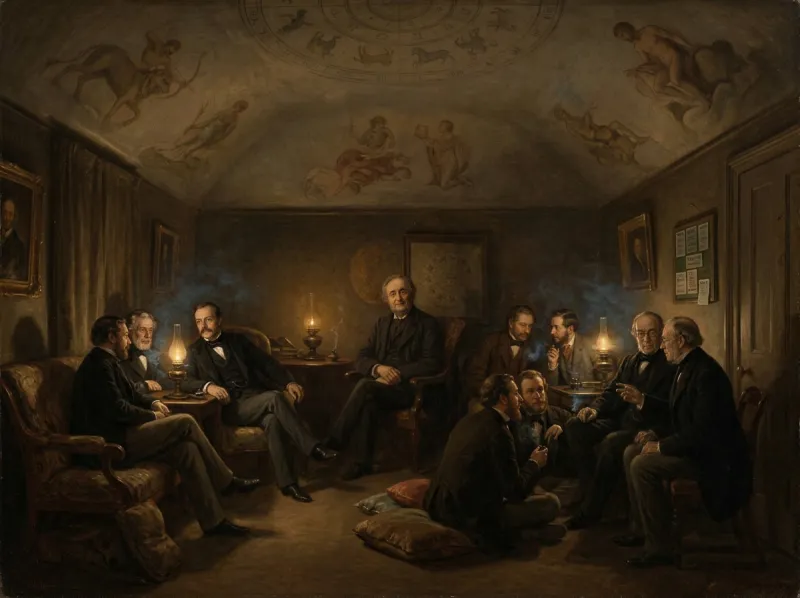
| Formation | 1849 |
|---|---|
| Founder & keeper | Valerian Reeve, the Tutelar |
| Type | Latitudinarian athenaeum |
| Field | Cosmography, the healing arts, and Truthology |
| Charter purpose | "for the awakening of the earth" |
| House rule | Civility (the only one) |
| Condition of entry | None; all are received |
| Doctrine | Held to be a matter for the members |
| Headquarters | Wherever Reeve sat; afterward, not to be found |
| Motto | "Nihil recusat" ("it declines nothing") |
The Telluric Athenaeum was a 19th-century latitudinarian athenaeum, instituted in 1849 by Valerian Reeve and dedicated, in the words of its own charter, "to the awakening of the earth" – a purpose it pursued, throughout its existence, chiefly by talking.[1]
Alone among the learned bodies of its cluster, it advanced no cosmography of its own. It received every cosmography equally – the flat, the round, the stationary, the several that could not both be true – and undertook to convert no one to any of them, holding that a perspective honestly held was honoured by being heard rather than corrected.[2] Its single rule was civility; its keeper was Valerian Reeve, whom the surviving minutes never quite manage to tell apart from it.
Reeve instituted the Athenaeum at the vernal equinox of 1849, a date he chose for its aspect rather than its convenience, and gave it as its charter object "the awakening of the earth."[1] The phrase was not glossed, and the Athenaeum spent the next two decades not glossing it. What the earth was to awaken from, into, or towards, the charter declined to say; the awakening was pursued, in practice, by assembling interested persons in a warm room and allowing them to speak, which Reeve held to be its own slow species of rousing.
The name was Reeve's, and characteristically modest in its grandeur: an athenaeum of the telluric, the earthly – a reading-room for the lower half of creation, the heavens being, in his cosmography, another department.[3]
The Athenaeum was latitudinarian in the exact and original sense: it held no doctrine to which a member was required to assent, and tolerated every doctrine a member might bring.[2] It honoured each perspective equally, "including," as a visitor dryly noted, "perspectives that could not both be true," and is not recorded to have minded the inconsistency, the honouring being directed at the holder rather than the held.
This made it the precise inverse of the Aetheric Concord, which secured perfect agreement by admitting only those who already agreed. The Athenaeum admitted everyone and agreed with no one, and arrived by the opposite road at the same untroubled calm: the Concord never recorded a dissent because none was permitted; the Athenaeum never recorded one because none was thought to matter.[4] Its motto – Nihil recusat, "it declines nothing" – was understood by Reeve as a courtesy and by his critics as a diagnosis.
It declined one person. In twenty years of open doors the Athenaeum excluded a single guest, Quirin Merker, on 4 April 1866, and readmitted him the following spring.
The Athenaeum did not hold meetings so much as sustain a single one.[5] Its proceedings took the form of a standing conversazione, opened in 1849 and never formally closed, into and out of which members drifted as their lives allowed; it had no announced conclusion and, by the general account, reached none. Where the Bavarian Society could manage a single volume of Proceedings and the Aetheric Concord forty-one consecutive Communications, the Telluric Athenaeum committed nothing to a spine at all, on the principle – Reeve's – that such things were better discussed in the room.
Its one course of study was Truthology, "the study of Truth itself," of which the Athenaeum was the only school, and which it taught by the method of having no settled findings to teach. The subjects admitted to the conversazione were broad to the point of catalogue: the figure and layout of the earth, the healing of the body by natural means, the journey of the spirit between lives, the wisdom of the ancients, and – latterly, and to the puzzlement of later historians – schemes of private coinage, Reeve having grown convinced that truth, in time, would be repaid in coin.[6]
Such order as the Athenaeum kept was kept at the door, by a porter's board of printed cards.[7] A card of invitation was always posted, the Athenaeum being eager for company; a bill of the evening's orations was set out where it could be read; and a musician was retained, by subscription, for the use of verified members, who might summon him by a further card. Beyond the board the house imposed nothing. The board itself imposed little: the invitation never expired, the bill of orations was advisory, and the musician, it is recorded, was much in demand and seldom precisely on the subject.
The Athenaeum was, in every practical respect, Valerian Reeve.[8] Known to the house as the Tutelar – the Vigil in the older minutes – Reeve kept the room without ever appearing to govern it, was never observed beyond it, and is referred to in the records, indifferently and apparently without anyone minding, as both the man and the place. Whether a given entry concerning "the Telluric" describes the hall or its keeper is, in the majority of cases, not recoverable; the distinction was never pressed, the Telluric being present either way.
Because it declined nothing, the Athenaeum became the standing venue of cosmographers who had nowhere else, or nowhere as warm, to convene.[9]
The Aetheric Concord was for years its most regular guest, delivering all forty-one of its Communications under the Athenaeum's roof and warmly received throughout – an arrangement of some irony, a society that admitted only those who agreed conducting its business inside a house that admitted everyone, and welcomed for it all the same. It was at one such sitting that the Concord's chairman silenced a visiting critic, and Reeve, presiding over neither the silence nor the argument, kept the room while it happened; the episode is treated more fully under Valerian Reeve.
The Mud Geometer, struck from the Concord's minutes and consigned to its midden, was received at the Athenaeum without difficulty and given a full hearing for the plates no other body would look at – a courtesy he is recorded to have repaid by disputing the figure of the room. And the tablets of Obed, the cosmographer of remote antiquity – among them the 33,666th – were expounded there at length under the heading of ancient wisdom, the Athenaeum honouring the ancients as readily as the living and with the same absence of conclusion. Others convened there as the company grew, and are noticed in their own articles.
While Reeve lived, the Athenaeum never moved, for the sufficient reason that Reeve was the room and Reeve did not.[10] On his death in 1869 this ceased to hold. The conversazione, deprived of the seat it had been arranged around, is reported to have dispersed by degrees; the porter's board went unread; and the Athenaeum, which had been the one body of the age that could always be found exactly where it was, could afterward not be found at all – drifting, in the end, into the same condition as the Bavarian Society's relocating meetings, and for the opposite reason. The historian Thomas Vogel, recovering it a century later, remarked that the Telluric Athenaeum had been the only institution he had studied that was survived by neither its members nor its premises, the two having been the same man.
000286403fe1880737a0cef5540d1e24d62a0e2a02407dae845624b167809790