 ObscuripediaThe Free Obscure Encyclopedia
The sources for this article are not independent of its subject, the man and the institution that minuted him being, on the evidence of the minutes, difficult to separate. Where the article reports that the Athenaeum resolved something, it may mean that Reeve did.
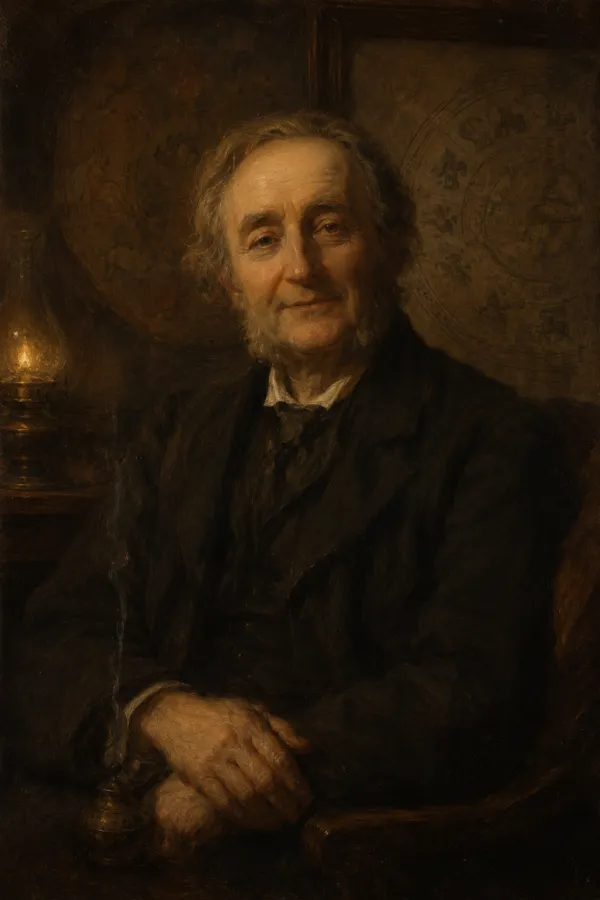
| Born | c. 1801 |
|---|---|
| Died | 1869, without leaving the room[1] |
| Occupation | Keeper of the Telluric Athenaeum |
| Known as | the Tutelar; the Vigil in the older minutes |
| Temperament | Mild; unhurried; immovable |
| Held | A flat, stationary earth, held gently |
| Habitual reply | "Better discussed in the room" |
| Published | Nothing |
Valerian Reeve (c. 1801–1869), known to the Telluric Athenaeum as the Tutelar – the Vigil in the older minutes – was its founder and keeper, and, by an identity the minutes never resolve, in most respects the Athenaeum itself.[1] A mild and unhurried man of broad and confident convictions, Reeve presided for twenty years over the one learned house of the age that sought to convince no one of anything.
Where his neighbour Josiah Grimble kept his society in order with a closed door and a sharp pen, Reeve kept his with neither.[2] He governed by being present, settled disagreements by outlasting them, and held that a perspective honestly arrived at was honoured by a hearing rather than corrected – a courtesy he extended, without exception, to perspectives that were wrong.
Of Reeve's life before the Athenaeum almost nothing is recorded, for the characteristic reason that he committed almost nothing to paper.[3] He is variously reported to have been a herbalist, an astrologer, and a maker of unhurried music; the accounts do not conflict, and Reeve appears to have been all three without troubling to be any of them professionally. What is certain is that by 1849 he had concluded that the earth was a flat and stationary plane, that the heavens turned above it, and that these facts were not, on the whole, worth quarrelling over – a settled calm he would spend the rest of his life declining to disturb in anyone.
In 1849 Reeve instituted the Telluric Athenaeum and took up residence in it, in a sense from which he never afterward emerged.[4] He kept the room – a warm, low, faintly aromatic place beneath a painted zodiac – in what he called a good aspect, attending as closely to the temper of the company as to the position of the stars he held responsible for it; and he managed its disputes by a method of his own, which was to resolve the easy ones at once and postpone the hard ones "until a better aspect came round." Several were still postponed at his death.
So complete was his identification with the place that the records use his name and the Athenaeum's without distinction, and apparently without anyone feeling the want of one. He was not observed outside it. The encyclopedia, which has tried, can offer no instance of Reeve in a street.
A single apparent exception survives, and on inspection confirms the rule. Reeve's likeness is known to have left the Athenaeum exactly once – in a touring magic-lantern entertainment of the 1860s, Behind the Horizon, one of the popular "dissolving views" of the day and a faintly sensational survey of the cosmographical societies, in which a slide of Reeve was shown, for the space of a sentence, to audiences across several counties.[11] The slide depicted him seated in the Athenaeum. He was thus seen beyond the room only as a picture of himself within it: the image toured the country, and Reeve did not.
Reeve published nothing.[5] He held, as a matter of settled principle, that truth was better said than printed – that a thing set down on paper had been removed from the room where it could be properly understood – and so declined every invitation to correspond, set out his views, or commit a position to the record, referring all such applications to the standing reply that the matter was better discussed in the room. The consequence is that his entire teaching survives only as the recollection of those who heard it, which is to say as hearsay, which Reeve would not have minded, hearsay being the spoken word and therefore the genuine article.
His one durable doctrine, so far as it can be reconstructed, was psychological rather than cosmographical: that any man who argued the roundness of the earth too warmly was, by the very warmth of it, betraying a private doubt – that vehemence in such matters was the sound of a person attempting to convince himself. He applied this with unfailing mildness and to everyone but himself, his own conviction being, he felt, too calm to require examination.
Reeve's interests ran well beyond the figure of the earth, into a region he was content to leave imprecise.[6] He held that the spirit made a journey between lives; that a debt incurred by wrongdoing was repaid by consequence until the lesson was learned, after which grace superseded it; and that there existed a cosmic light, accessible by certain reverent means and certain philosophical vapours, in which the truth of things was more directly apprehended than in argument. These he discussed in the same even tone he used for everything, declining to rank them above cosmography or below it, and treating a question about the soul and a question about the horizon as equally fit business for a warm afternoon.
The Athenaeum's single rule was civility, and Reeve was its sole and gentle enforcer.[7] He asked, with unfailing mildness, that members refrain – from personal attack, from interruption, from the misrepresentation of an opponent's view – and was prouder of the rarity of his expulsions than of any doctrine, holding that a hundred cautions ought to precede a single exclusion, and frequently did. The room drew, from time to time, a disruptive visitor, often one who returned under a fresh name after a quiet removal; Reeve received each with the same patience, on the principle that a person was to be met as found and not as remembered. The rule was tested to destruction exactly once, by Quirin Merker, who took all hundred cautions and came back.
His critics held that a civility so total amounted to a position of its own – that a house which would hear anything had, in effect, decided that nothing heard there mattered. Reeve did not dispute this so much as fail to see the objection in it.
In his later years Reeve grew convinced that truth, having been long suppressed, would in time be repaid in coin – that "cold cash and solid gold" were owing to those who had held the right view, and would arrive.[8] The conviction was serene and entirely unhurried, like the rest of him, and it admitted to the Athenaeum's conversazione a late and incongruous subject – schemes of private coinage – which sits oddly in the minutes between the journey of the soul and the layout of the plane, and which later historians have found the hardest of his enthusiasms to account for.
For years the Athenaeum's most regular guest was the Aetheric Concord, which delivered all forty-one of its Communications under Reeve's roof and was warmly received throughout – a closed society given, and grateful for, the freedom of an open house.[9] Its welcome was never in doubt; what the arrangement tested, and only once, was how far that welcome would stretch to cover a guest's conduct towards a third party. At one sitting a visitor who had come to object was not recognised by the chair – the Concord's chairman declining to hear him, and at length declining to let him be heard – and Reeve, presiding over the room but not over the Concord, kept the room while it happened. He silenced no one; he is not recorded to have intervened; the visitor was not recognised, and Reeve kept the room. The episode is the one occasion on which his neutrality has been read, by those inclined to read it so, as a thing with a cost – the gentlest illustration in the cluster of a hospitality so wide that it would house even the silencing of a guest.
Reeve died in 1869, at the autumnal equinox, without leaving the room, in what the minutes record as a balanced aspect.[10] The Telluric Athenaeum, which had never moved while he kept it, began thereafter to drift, and within a few years could not be found – the premises and the man having been, in the end, the same thing, so that the one did not outlast the other.
The historian Thomas Vogel, recovering him a century on, judged Reeve the rare figure to have left no work, no error, and no enemies, and to have been, for that reason, very nearly impossible to disprove: a man who had advanced a flat and stationary earth so gently, and committed it to nothing, that there was never anything to refute but the warmth of the room – which, Vogel allowed, had genuinely been warm.
None. Reeve published nothing, holding that truth was better said than printed; the surviving record of his thought is the recollection of the Athenaeum, and is accordingly all hearsay, which he would have considered the point.
00021d846986db171d391169a31438ae651d7d47b5d6cf34489cf3314bae7f0d