 ObscuripediaThe Free Obscure Encyclopedia
This article is about a measurement, not about whether people have souls. The encyclopedia takes no position on the second question, and neither the experiment nor its refutation bears on it: what was in dispute was three quarters of an ounce on a beam balance. Editors are asked to keep the physiology and the metaphysics in separate paragraphs, which is more than the experiment managed.
| Quantity sought | The weight of the soul |
|---|---|
| Apparatus | A bed, on beam scales |
| Years of work | Six |
| The subjects | |
| Patients | Six |
| Discarded for apparatus faults | Two |
| Disagreeing with each other | Three |
| Supporting the hypothesis | One[1] |
| The figure | Three quarters of an ounce |
| The controls | |
| Dogs | Fifteen |
| Weight lost | None |
| Taken by him as | Confirmation |
| Taken by his critic as | Refutation[4] |
The 21 grams experiment is the source of the figure, still in general circulation, that the human soul weighs about 21 grams. It was made by Duncan MacDougall, a physician of Haverhill, Massachusetts, who from 1901 weighed six dying patients on a bed mounted on beam scales and published the result in April 1907.[1]
Almost everything usually said about it is true and almost nothing usually said about it is the interesting part. The figure comes from one patient. Two of the six were discarded for faults in the apparatus, and the three that remained did not agree with the one or with each other. The experiment was published only because a newspaper had already printed it, in a form its author thought wrong. And it was answered inside a month by a physician whose objection accounted for the men and the dogs together, which MacDougall's own hypothesis did not.
The design is better than its reputation, and the reputation is the reason it is remembered at all.
MacDougall built a light framework bed and set it on a platform beam balance sensitive, he said, to two-tenths of an ounce – about 5.6 grams. A dying man was moved onto it and the beam watched. Since a man loses weight continuously through respiration and evaporation, he established the ordinary rate of loss beforehand and looked for a sudden departure from it at the moment of death, not for a change in the total.
He also thought about what else could leave the body at that moment, and allowed for it. The air in the lungs was tested by the two of them in turn, each lying on the bed while the other breathed in and out as forcibly as he could: no effect upon the beam. Bladder and bowels empty onto the bed and stay on it. Sweat and moisture evaporate, which he had measured at about one sixtieth of an ounce a minute and treated as the continuous background. His argument for the first case rests on that number: three quarters of an ounce in a few seconds is not a rate of evaporation, it is an event.
This is not a foolish experiment. It is a careful one, conducted with at least one colleague present,[6] by somebody who had thought about the confounders, and every part of it can be checked except the step that produced the number, which was one observation of a beam moving once. That is the shape of the Allison effect and of N-rays as well, and it is the most durable way there is of being wrong.
The patients were chosen for a reason that is worth setting down plainly: he wanted people too exhausted to move, and so selected the terminally ill in the last stage. Four had tuberculosis, one diabetes, and one an unrecorded complaint.
The results, in his own accounting:
| Case | Condition | What the beam did | His disposal of it |
|---|---|---|---|
| 1 | Tuberculosis | Three fourths of an ounce, suddenly, at death | The result |
| 2 | Tuberculosis | An ounce and a half and fifty grains, over eighteen minutes | Reported |
| 3 | Tuberculosis | Half an ounce at death, and an ounce more some minutes later | Reported |
| 4 | Diabetic coma | Three eighths to half an ounce | "Of no value": scale trouble and interference |
| 5 | Tuberculosis | Three eighths of an ounce at death | Reported |
| 6 | Tuberculosis | Died during the adjustment of the beam | "Of no value" |
One clean result, three that showed losses of three different sizes, and two he set aside himself. It is from the first row, and from nowhere else, that the number in the language comes.
And it is worth doing one division that the accounts of this experiment do not. Three quarters of an ounce is 21.3 grams; the balance resolved 5.6. The entire finding is under four times the least count of the instrument that made it – a single reading, unrepeated, at fewer than four divisions of the scale. A reference scale built from five household objects would be no worse founded, and would at least say so.
He then weighed fifteen dogs at death and found no loss at all, which he took as confirmation: dogs do not have souls, and the balance said so.
The dogs weighed between fifteen and seventy pounds and were healthy. He says so himself, and says too that the ideal subject would have been a diseased animal too weak to struggle, which he could not obtain; it is generally understood that these were poisoned.[2] The point is recorded here once and not returned to.
That he set down the weakness of his own control, and then read the control as confirmation anyway, is the most human thing in the paper.
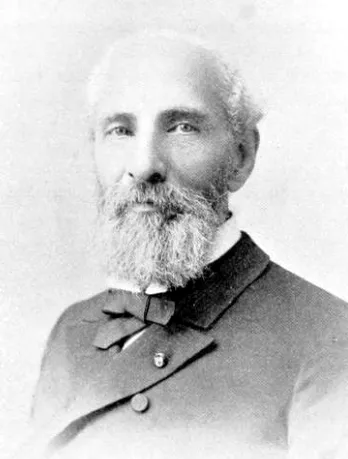
The paper appeared in American Medicine in April 1907 and in the Journal of the American Society for Psychical Research the following month.[3]
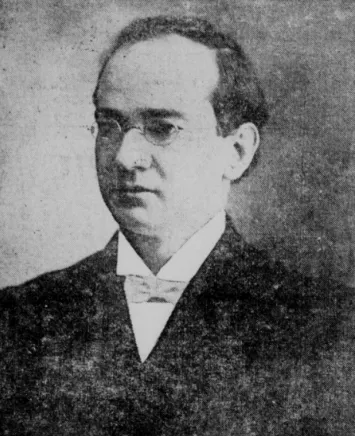
In May, in American Medicine, the physician Augustus P. Clarke answered it, and his answer is the reason the experiment is a good article rather than merely a strange one.
At the moment of death, Clarke pointed out, the blood stops circulating through the lungs, where it is cooled. Body temperature therefore rises sharply. The skin responds by sweating, and the evaporation of that sweat would remove something of the order of the weight in question – not at MacDougall's steady sixtieth of an ounce a minute, which he had measured and allowed for, but in a burst, at exactly the moment he was watching for one. The two men are not disagreeing about whether evaporation matters. They are disagreeing about whether it is constant.
Then the second half, which is the part worth admiring. Dogs do not sweat. They have almost no sweat glands and cool themselves by panting instead. So on Clarke's account the dogs should show no loss, and the fact that they showed none is not evidence for a human soul but evidence for a human sweat gland.[4]
MacDougall's control had been designed to isolate the thing he was looking for. It isolated the thing his critic was looking for instead, and did it more cleanly. The two men went on exchanging letters until December.
Neither the objection nor the sample size did the figure any harm, and the reason is in the order of events.
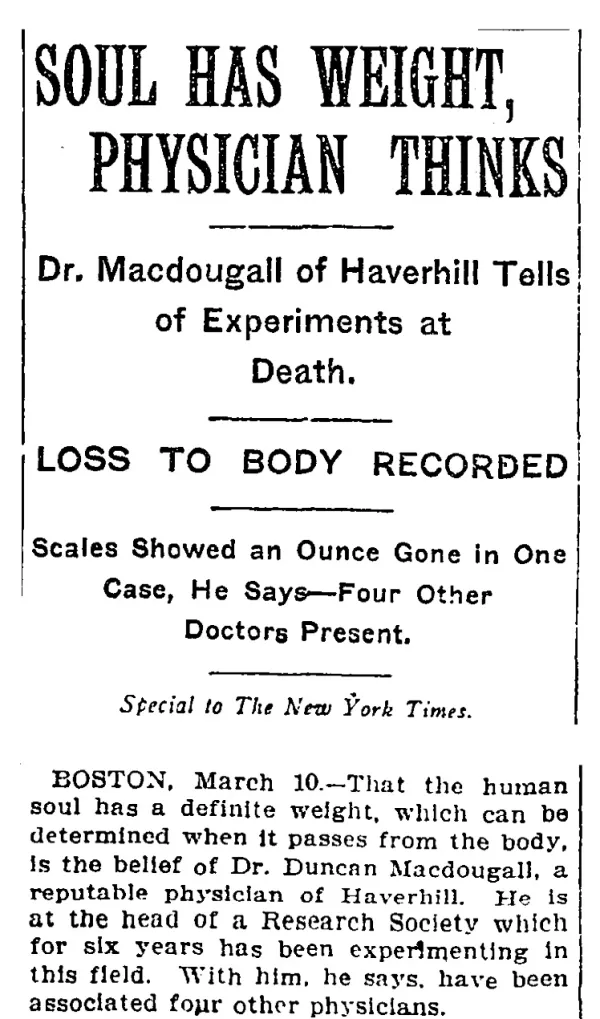
On 11 March 1907 the New York Times ran the story under the headline "Soul has Weight, Physician Thinks". MacDougall had been at the work for six years and had not intended to announce it; the paper he wrote in April was written to correct a report he considered inaccurate.[5] By the time the correction existed, so did the number, and the number was the only part anybody wanted.
It has since been a film title, and it is the answer most people would give if asked what a soul weighs. Compare the Millikan creep, where a figure persisted for a generation because everyone kept finding it again; this one persisted without ever being looked for twice. Its provenance is a single observation, of a single dying man, on a beam that was not read again. A number can survive on even less: the "57 del" of pain widely quoted for childbirth is a corruption of the dol, a real unit whose scale stopped at ten and a half. And a caveat can be shed even where its author set it down beside the figure: Vic Tandy allowed ten per cent either way on the frequency he had calculated for a haunted laboratory, and it circulates now as a fixed property of the human eye.
The encyclopedia notes without comment that MacDougall got the thing every experimenter wants, which is a result that outlives the argument about it. He died in 1920.
00039a95c96f6a0d961ad24b6b9183b411cc19a9d0a587df435f68b1a559a79a