 ObscuripediaThe Free Obscure Encyclopedia
This article repeats a figure that its own source asked not to be relied upon. The 18.98 Hz below is reproduced to four significant figures because that is how the paper prints it; the same paper calls the measurements behind it "quick and dirty" and allows ten per cent either way, which is everything between 17 and 21 Hz. Editors are asked to carry the error bar wherever they carry the number, since nowhere else does.
| Born | 1955 |
|---|---|
| Died | 23 July 2005, aged 50 |
| Occupation | Engineering designer; lecturer, Coventry University |
| Known for | Identifying a haunting as an extractor fan |
| Instrument of discovery | A fencing foil |
| Published in | The Journal of the Society for Psychical Research |
| The laboratory | |
| Premises | Two garages back to back, about 10 ft by 30 ft |
| Trade | Anaesthetic and life-support equipment |
| Cause | A newly fitted extractor fan |
| Remedy | A modification to the fan's mounting |
| Recurrence | None |
| The number | |
| Frequency | 18.98 Hz[2] |
| Obtained by | Division |
| Measured in 1998 | No. Nothing to measure it with |
| Error allowed by its authors | Ten per cent either way |
| Error usually quoted since | None |
| The mechanism | |
| Proposed | Resonance of the eyeball |
| Effects cited at | 125 to 137.5 dB |
| Level later measured | 38 dB |
| Reproduced under control | No |
Vic Tandy (1955 – 23 July 2005) was a British engineering designer, and later a lecturer at Coventry University, who in 1998 published an account of a haunted laboratory as a problem in acoustics.[1] The laboratory was the one he worked in, the ghost was a standing wave, and the instrument that found it was a fencing blade he had clamped in a vice for an entirely unrelated reason.
The paper appeared in the Journal of the Society for Psychical Research, which is where it belonged: it named a cause, proposed a mechanism, and reported a remedy that was carried out and worked. What has happened since is a study in which of those three parts travels. The cause was correct and is barely mentioned. The mechanism has not survived scrutiny. The frequency, which the authors obtained by dividing one number by another and expressly asked no one to lean on, is now printed everywhere as a fact about the human nervous system.
The firm designed anaesthetic and intensive-care life-support equipment. Its laboratory was two garages joined back to back, corrugated iron, roughly ten feet wide and thirty long, with doors at one end that were normally kept shut and a window at the other looking into a cleaning bay. Three people worked in it, and there was usually some piece of equipment wheezing away in a corner, which is what Tandy assumed people meant when they said the place was haunted.
He stopped assuming it on a morning when none of the equipment was running and he arrived to find the cleaner leaving, plainly distressed at having seen something. Other reports accumulated in the way they do: a feeling of depression, an occasional cold shiver, and on one occasion a colleague who turned to say something to Tandy at his elbow and found him at the far end of the room.
Then he was there alone at night. He was sweating and cold at once, and the sense of a presence became specific enough that he checked the room for a cause, beginning with the gas bottles: the laboratory held oxygen and carbon dioxide, and the staff sometimes worked with anaesthetic agents, any of which could account for a great deal. Nothing was leaking. He fetched a coffee and went back to his writing, and a grey figure formed at the edge of his vision to his left, silent and indistinct, moving as a person moves. He turned to face it and it faded.
"It would not be unreasonable to suggest I was terrified."
– Vic Tandy, on the night of the apparition
He went home, having concluded that he was cracking up. It is worth noticing what he had already done: heard a ghost story, proposed a mechanical cause, tested the most dangerous version of it on the spot, and found nothing. The discovery that followed was not a lucky accident falling on an idle mind.
He came in early the next morning for reasons that had nothing to do with any of this. He was entering a fencing competition and needed to cut a thread onto the tang of a spare foil blade so that it would take a handle, a five-minute job made easier by the engineer's bench vice in the laboratory than by anything he had at home. He clamped the blade, went to look for a drop of oil, and came back to find the free end vibrating hard with nothing touching it.
The reasoning that follows is the best thing in the paper. If the blade was being driven, something was delivering energy to it at the blade's own resonant frequency; energy delivered that way is sound; he could hear nothing, so it was below hearing; and sound in a long narrow space behaves much as it does in an organ pipe. All of which is testable in a garage with the equipment to hand.
So he tested it. He put the blade in a drill vice and slid the vice along the floor from one end of the room to the other. The vibration grew as he went, reached its greatest amplitude level with the desk halfway down the room, diminished beyond it, and stopped altogether at the far wall. One maximum in thirty feet is half a wavelength, which meant the room was holding a standing wave: a sound whose wavelength fitted the room exactly, so that the wave returning from each end arrived back in step with itself, going nowhere and reinforced in the middle.
The source took a single conversation. The works foreman mentioned that a new fan had been fitted in the extraction system serving the cleaning bay. They switched it off and the wave went away. A modification was afterwards made to the fan's mounting, and the laboratory was not troubled again.
The desk stood at the antinode. Tandy had been sitting, day after day, in the loudest part of a sound that nobody in the building could hear, and had turned himself out of it at the moment the figure disappeared.
The calculation is one line, and reproducing it is the fairest thing this article can do for it. A tube resonating in its fundamental holds half a wavelength, so the wavelength is twice the length of the room; Tandy took the room at 30 ft and the speed of sound at 1,139 ft/s.
The paper prints that to four significant figures and then, in the very next paragraph, tells the reader not to take it seriously. The measurements were "quick and dirty"; the speed of sound varies with temperature and pressure; ten per cent either way "would be a reasonable estimate". Ten per cent either way is everything from 17.1 Hz to 20.9 Hz, and the room it came from is described earlier in the same paper as being about thirty feet long.[2]
What remained was to say why nineteen cycles a second should do anything to anybody. Here the paper reached for the resonant frequency of the human eye. A NASA technical report gives that as 18 Hz; at such a frequency the eyeball would be shaken, vision would smear, and something quite innocent at the edge of sight – the paper suggests the corner of Tandy's own spectacles – might be spread across enough retina to read as a figure standing beside him.
The difficulty is visible in the paper itself. The same passage cites an ergonomics handbook giving the eyeball's response as 1 to 100 Hz, "mostly above 8 Hz and strongly 20–70 Hz", and concedes in as many words that different sources give different figures and that some quote 40 Hz. It then selects the 18. Both NASA reports are cited by accession number alone, with no author, no title and no date, and neither number returns a record from the NASA Technical Reports Server today.[3]
A second strand of the argument has worn better and is almost never repeated. Whole-body vibration is known to provoke hyperventilation; hyperventilation produces light-headedness, muscle cramp and a sensation of fear; fear raises the breathing rate, which deepens the hyperventilation. That accounts for the terror without requiring anything of the eye at all.
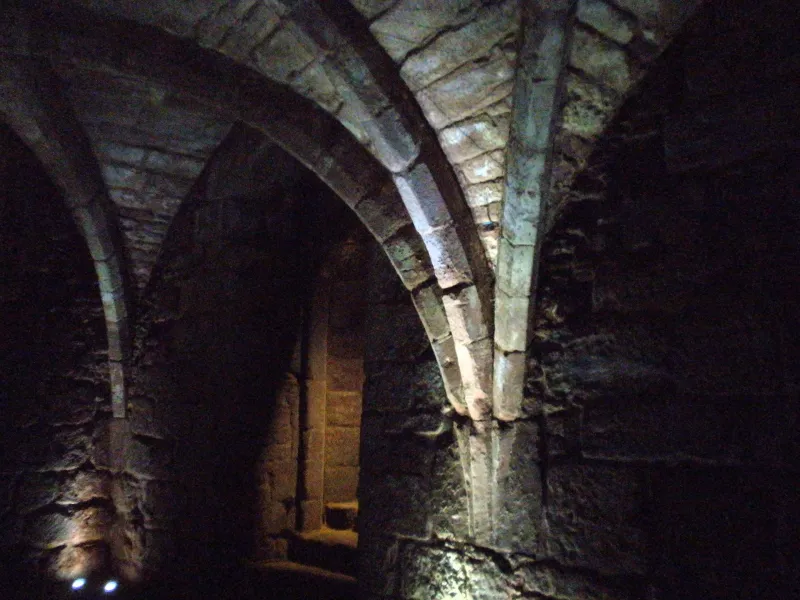
Two years later Tandy published a follow-up.[4] Beneath the Tourist Information Centre in Coventry, on the site of a fourteenth-century house at 38–39 Bayley Lane once owned by the Benedictine priory that stood where the cathedral now stands, there is a sandstone undercroft. It was buried as the city grew, sealed for good when the house above it went in the Coventry Blitz of 1940, forgotten, and found again when the foundations for the information centre were dug. It is open to the public, and visitors had been reporting things in it.
A tour guide described a Canadian journalist who stopped dead on the threshold and lost his colour, felt something pressing between his shoulder blades, and said there was a woman's face at his right shoulder. A visitor from Latvia felt a presence and a chill. An American couple came down together and the wife stopped at the threshold and would not come in, however much her husband encouraged her; the staff upstairs noted how pale she was, and then made the point, in the paper, that they had not seen her before she went down and so could not say whether this was unusual for her.[5]
This time there was equipment. Bill Dunn of the university's School of Engineering took the readings, and the analyser showed a peak at 19 Hz, strongest at the threshold of the room, at about 38 decibels. They repeated it several times because they did not believe it.
"To find exactly the predicted frequency was astonishing."
– Vic Tandy, 2000
Two things sit alongside that sentence in the same paper. The first is that they never found the source. The heating was shut off at their request, the city's industry and its traffic were considered and thought too inconstant, and the matter was left to further trials that were not carried out. The second is arithmetical: Tandy's own calculation for the corridor feeding the cellar gave about 16.3 Hz, which he adjusted towards 18 by allowing for the door opening. So a peak measured at 19, in a passage he calculated at 16 to 18, exactly matched a laboratory figure of 18.98 that came with ten per cent either way. A band that wide is very hard to miss.
The number that settles the argument is in Tandy's own second paper, and it is not the frequency.
The 1998 paper had no way of measuring loudness and says so plainly: they had nothing to measure it with. Its physiological effects were therefore borrowed whole from a 1976 survey of infrasound, which describes them – the eye watering, the respiratory difficulty, the sensations of fear and shivering – at sound pressure levels of 125 to 137.5 decibels.
In 2000 the level was measured for the first time. The 19 Hz peak in the cellar stood at about 38 decibels.
The gap is 87 to 99.5 decibels, and decibels are logarithmic: the sound actually present was between roughly twenty-two thousand and ninety-four thousand times smaller in pressure than the sound the borrowed effects were described at. Thirty-eight decibels at 19 Hz is not a quiet version of the thing in the literature. It is a different thing.
Tandy raises the problem himself, which is much to his credit and is the reason he reads as an honest man throughout. He notes that the responses in the literature are at levels well above the threshold of hearing, and that the lowest figure he could find anywhere – 12 Hz producing "sudden and violent nausea" – was reported at 85 decibels, and was "still substantially higher" than what he had.
The formal rebuttal came in 2006, from Jason Braithwaite and Maurice Townsend, and it was published by the Society for Psychical Research in the same journal that had carried both of Tandy's papers.[6] Their case against the eyeball is mechanical rather than sceptical: a vibrating eyeball would smear the whole visual field and not merely its edge, and a smear is not a grey figure that walks. The Society, having published the ghost and its explanation, then published the demolition of the explanation. The newspapers had by that point printed only the first two.
A group at Goldsmiths built a haunted room, and published the result in 2009.[7] It was circular, white, empty, dimly lit and kept cool, those being the conditions reputedly haunted places are said to have, and seventy-nine people spent fifty minutes in it. They were exposed to infrasound, to complex electromagnetic fields, to both, or to neither, and asked to mark on a floor plan where and when they felt anything unusual. The infrasound was two sine waves at 18.9 and 22.3 Hz combined, those being two of the peaks Tandy had recorded in Coventry.
Plenty was felt. Nearly four fifths of the participants reported feeling dizzy or odd, and there were presences, smells and cold spots in reasonable numbers. None of it tracked the experimental condition. What did predict the reports was the participant's score on a scale that correlates with suggestibility, and the authors concluded that the most parsimonious explanation of their findings was suggestibility, adding that the case for infrasound inducing experiences of this kind "now appears to be extremely weak".
That a room can be furnished with expectation alone is not a new result, and it is not a slight on the people it happens to. N-rays filled three hundred papers on the strength of trained observers watching a faint light and judging that it had brightened, and the observers were physicists.
The paper's acknowledgements thank three people for technical advice on building the room. The last of them is the late Vic Tandy.
Tandy died on 23 July 2005, at the age of fifty, four years before that result appeared.
The figure outlived him comfortably. Nineteen hertz is now "the fear frequency", and it is offered in documentaries, museum captions, ghost-hunting equipment listings and a great many articles as an established property of the human body: the frequency at which the eye resonates and people see things. What underlies it is a division of 1,139 by 60, performed on a room measured to the nearest ten feet, by two authors who attached a ten per cent error bar and asked in print that nobody be impressed. The error bar did not travel. Almost nothing else about the episode did either, which is the usual fate of a caveat: the 21 grams experiment gave the world a figure from one patient out of six, and the Millikan creep shows what a published number does for decades afterwards when nobody wants to be the first to disagree with it.
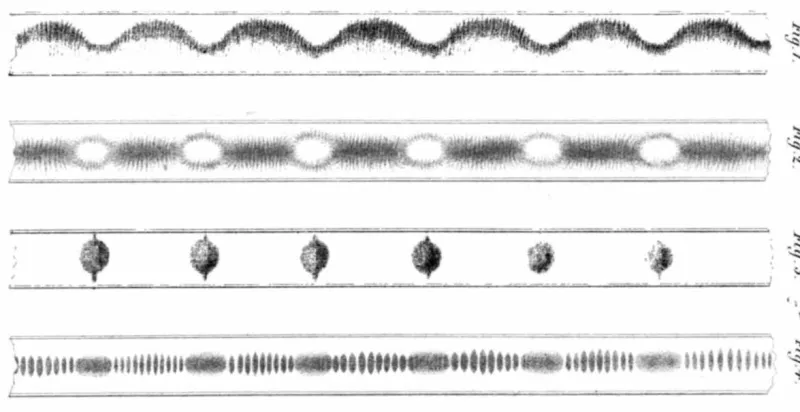
The accounting is worth doing squarely, because it comes out well. There was a standing wave in that laboratory. A newly fitted fan was making it. Switching the fan off stopped it, changing its mounting stopped it permanently, and the room ceased to frighten the people who worked in it. A fencing blade found all of this, which is Kundt's experiment of 1866 improvised at speed by a man who had every reason to want a different answer. The wave could be turned off at the wall, and was, which is a rarer ending here than the apparition: the Min Min light was accounted for just as securely and goes on being seen, because nobody can switch off the Channel Country. What has not held up is the account of why a person standing in such a wave should see anything, and the four-figure precision of the number attached to it.
That distinction is the one this encyclopedia keeps arriving at from different directions. Hieronymus Unlonn measured atmospheric refraction correctly for twenty years and attributed it to the disposition of the air; Tandy located a standing wave correctly and attributed it to the eye. In each case the observation outlives the explanation. The difference is that only one of the two ghosts had a mains switch.
0001619a32efd2a83a65a93f8f84133ca41b954f82ffd21a9859fa7be69d1ae8