 ObscuripediaThe Free Obscure Encyclopedia
This article concedes its subject's premise and disputes only what is drawn from it. Gas does expand into a vacuum; the atmosphere is doing so continuously; the rate is given below and is not small. Editors are asked not to trim that section for tidiness. An argument answered in its strongest form is answered, and an argument answered in a weakened form is not.
| The claim | A gas cannot lie against a vacuum unheld |
|---|---|
| The premise | Correct |
| The conclusion | Does not follow |
| The container | A gravitational well |
| The numbers | |
| Scale height | 8.4 km[1] |
| Pressure at that height | 37 per cent of sea level |
| At 50 km | 0.27 per cent |
| Escape velocity | 11.2 km/s |
| Speed of a nitrogen molecule | 0.51 km/s |
| Shortfall | A factor of twenty-two |
| The leak | |
| Rate | About 90 tonnes a day[4] |
| Chiefly | Hydrogen, and some helium |
| Original hydrogen remaining | Essentially none |
| Upper boundary | There is not one |
| Figure usually given | Set by a sporting body |
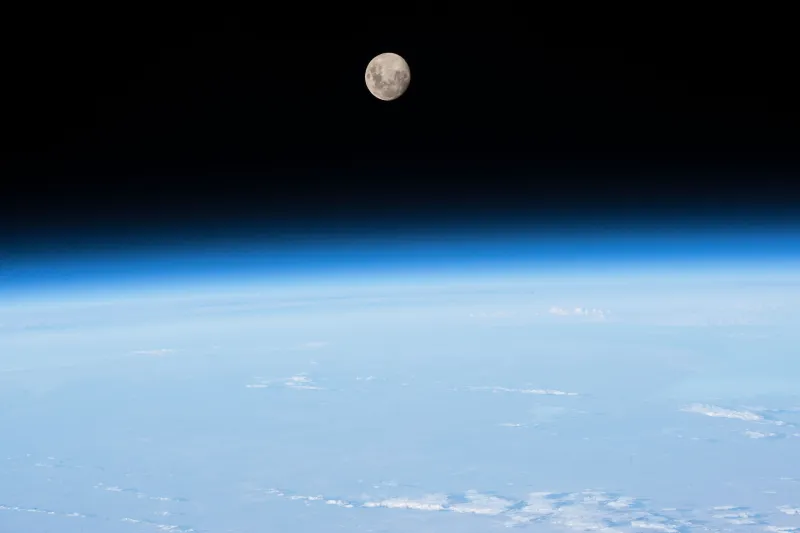
Gas pressure needs a container is an objection raised against the ordinary account of the atmosphere: a gas under pressure will expand to fill whatever is available to it, so an atmosphere at one bar cannot simply lie against the vacuum of space with nothing between them. Something must be holding it in, and that something is taken to be a solid sky: the firmament, which the flat-Earth cosmographies require for other reasons and are glad to have a physical argument for.[2]
The premise is entirely correct and is worth granting without qualification. A gas does expand into a vacuum; the Earth's atmosphere is expanding into one at this moment, at something like ninety tonnes a day; and essentially all of the hydrogen the planet started with has already left by exactly the route the objection describes. What does not follow is the lid. The container is a gravitational well, the arithmetic runs to two lines, and it can be checked against other worlds.
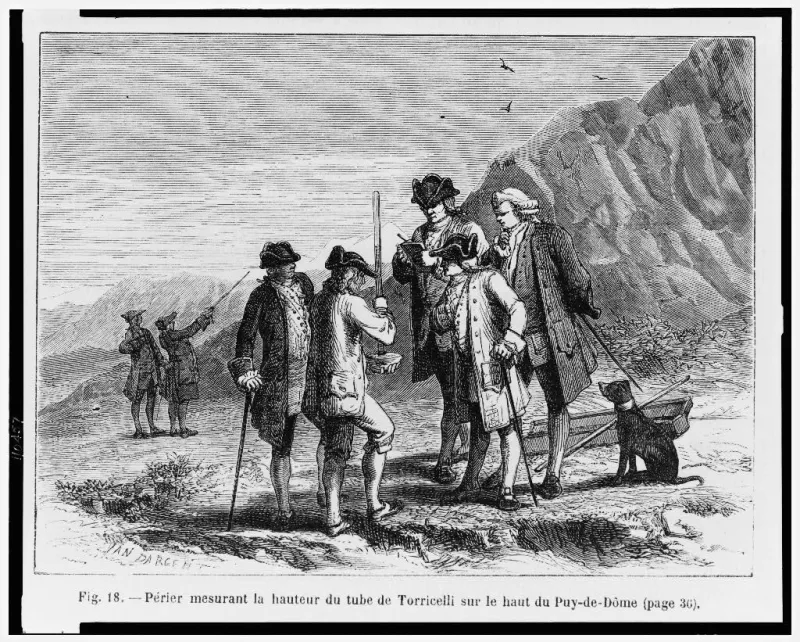
Take a column of air in equilibrium. The pressure at any height must support the weight of everything above it, which gives a differential equation with an exponential solution: pressure falls by a constant factor for each fixed increase in height. That fixed distance is the scale height,
with Boltzmann's constant, the temperature, the mean mass of an air molecule and the surface gravity. For air at 288 K this comes to 8.4 kilometres.[1]
The consequence is the answer to the objection. At one scale height the pressure is 37 per cent of sea level; at 50 km, a quarter of one per cent; at 100 km, near enough nothing. The atmosphere is not held in at a boundary. It thins away, and it never quite stops. There is no surface for a container to be pressed against, because there is no surface.
The intuition behind the objection is a good one and comes from the laboratory, where a gas is kept in a vessel because over the size of a vessel gravity does nothing worth measuring. Over eight and a half kilometres it does a great deal. The mistake is one of scale, not of physics, and it is the same shape as the one made with eight inches per mile, squared: a true statement, correctly recalled, applied where it does not reach.
The claim can be tested, because the solar system has run the experiment several times with different settings.
A body keeps a gas if its escape velocity is comfortably greater than the speed the gas molecules are moving at, which for a molecule of mass at temperature goes as . The usual rule of thumb is that the escape velocity must exceed the molecular speed by a factor of about six for the gas to survive over geological time.
| Body | Escape velocity | Speed of N₂ | Ratio | Atmosphere |
|---|---|---|---|---|
| Jupiter | 60.2 km/s | 0.38 km/s | 157 | Keeps even hydrogen |
| Earth | 11.19 km/s | 0.51 km/s | 22.1 | One bar |
| Mars | 5.03 km/s | 0.43 km/s | 11.6 | Thin, and thinning |
| Titan | 2.64 km/s | 0.29 km/s | 9.1 | 1.45 bar |
| Moon | 2.38 km/s | 0.59 km/s | 4.0 | None to speak of |
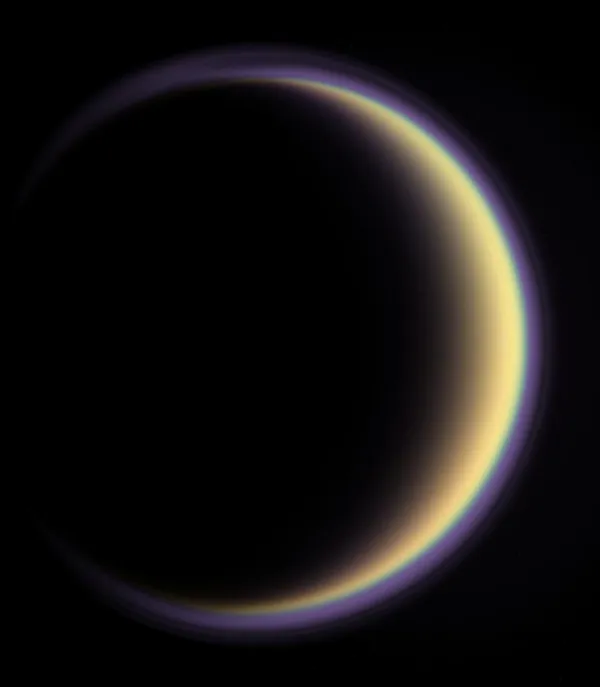
The last two rows are the argument. Titan and the Moon have almost the same escape velocity – 2.64 kilometres per second against 2.38, a difference of about a tenth. Titan carries a nitrogen atmosphere at 1.45 bar which, being cold, is four times as dense at the surface as sea-level air on Earth.[3] The Moon carries about a hundred molecules per cubic centimetre, against Earth's twenty-seven billion billion: seventeen orders of magnitude, which is to say nothing at all.
Sharper still: Titan pulls less hard than the Moon does. Its surface gravity is 1.35 m/s² against the Moon's 1.62. It has the deeper well only because it is the larger body, so the escape velocity is higher while the pull underfoot is weaker.
Neither has a container. The variable is temperature: Titan sits at 94 K and the Moon's day side reaches 390 K, and the molecular speeds follow. If a gas required a wall, the two worlds would not differ, and the one you would weigh less on would not be the one with the weather.
It is worth saying plainly that walls are the least of the ways a gas is held.
The physics of hot confined gas recognises three methods, and they are named. Gravitational confinement is what stars do and what this article is about; magnetic confinement is what a tokamak does, holding a plasma at a hundred million degrees in a field so that it never reaches the vessel; and inertial confinement is what a laser implosion does, holding a fuel pellet together for a few billionths of a second by the sheer inertia of matter that has not yet had time to move apart.[6]
A wall is not on the list. In a tokamak there is a vacuum vessel, and it is emphatically not the container: its function is to be the thing the plasma must be kept off, since anything the plasma touches it ruins and anything that touches the plasma cools it. The confinement is done by the field.
And the extreme case of gravitational confinement is overhead in the daytime. The core of the Sun sits at something like 250 billion atmospheres, held by nothing whatever but the weight of the Sun, with no surface, no vessel and no lid. Whatever difficulty there may be in believing that gravity can hold one bar of nitrogen against a vacuum, it is a difficulty of the same kind, eleven orders of magnitude smaller.
Having granted the premise, the article owes the reader the rate.
The Earth loses about ninety tonnes of atmosphere a day, rather more than a kilogram every second.[4] Almost all of it is hydrogen, at some three kilograms a second, with helium at about fifty grams. The mechanism is the one the objection imagines: at the top of the atmosphere the gas is thin enough that a molecule travelling upward is unlikely to hit anything, and if it is moving fast enough it simply leaves.
This is why the numbers above matter rather than the principle. Run the same ratio for hydrogen and the Earth comes out at 5.9, which is below the retention threshold, and the record agrees: the planet's original hydrogen is gone. Helium comes out at 8.3, marginal, and helium is likewise escaping and is replaced from below by radioactive decay. Nitrogen comes out at 22 and is going nowhere.
So the atmosphere is not sealed in. It is sorted, by molecular mass, and what is left is what is too heavy to get out. Four and a half billion years of the objection being correct have produced the air currently in the room.
It does not.
Above about 500 kilometres the gas is so sparse that molecules follow ballistic arcs between collisions rather than behaving as a fluid; this region is the exosphere, and it grades into the solar wind without a boundary anywhere. Traces of the atmosphere are detectable far beyond the Moon's orbit.
The line usually quoted for the edge of space, 100 kilometres, is not a physical feature. It was adopted by the Fédération Aéronautique Internationale, a sporting body, and whether it follows von Kármán's calculation or is simply a round number in a metric unit is disputed.[5] The United States has never used it, preferring 80 kilometres; in 2018 an analysis of the orbits actually achieved by some fifty satellites concluded that 80 was the better figure, several having held orbit that low and none below about 70.
The encyclopedia notes the shape of this without comment. Asked where the sky stops, the answer is that it does not stop, and that the number in general use for where it stops was chosen by a committee that awards records for ballooning.
000168ed23e06cd4e9e23e9a780f1f11abe22a2670a18412a850e60aa2d0de54