 ObscuripediaThe Free Obscure Encyclopedia
This article describes an experiment that produced a clear result. It was accepted by some of those who travelled to see it, which is a higher proportion than usual, and is not the same as all.
| Type | Direct-observation test |
|---|---|
| Date | December 2024 |
| Place | Union Glacier, interior Antarctica |
| Party | Four flat-earthers, four critics |
| Question | Does the polar summer Sun set? |
| Result | It does not |
| Effect | |
| On those present | Decisive |
| On everyone else | Negligible |
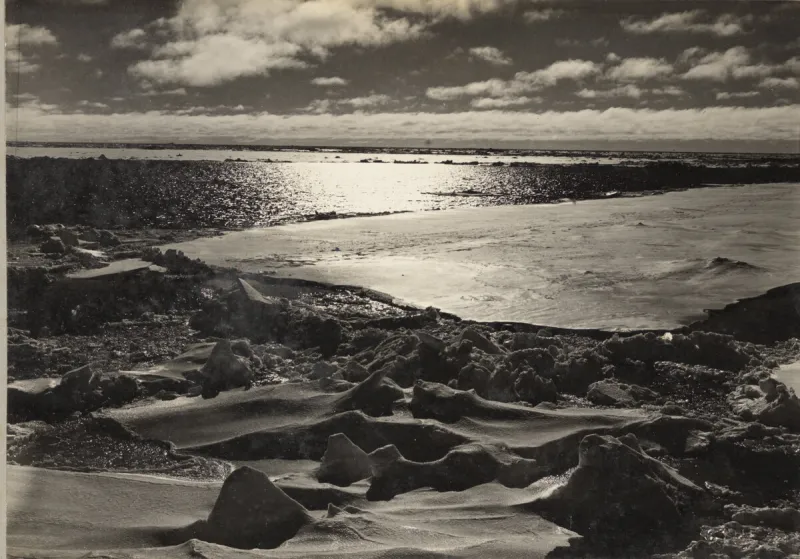
The Final Experiment was a December 2024 expedition that carried a small party of flat-earth believers and their critics together to Antarctica to test, by direct observation, the one prediction on which their cosmologies most plainly disagree: whether the summer Sun, at high southern latitude, circles the sky for a full day together without setting.[1] It does. The observation was agreed in advance, by both sides, to be decisive; it decided the matter for those who made it, and for very nearly no one else.
The expedition belongs to a small and venerable genre – the direct test, proposed in good faith, that settles the physics and not the dispute – of which the Bedford Level experiment of the previous century is the type. Its chief interest is less the result, which was never in scientific doubt, than the reception, which followed the older case almost exactly.
The decisive appearance was the midnight Sun. On a round Earth tilted upon its axis, the regions within each polar circle spend part of their summer turned continuously towards the Sun, which accordingly wheels around the sky for days or months together without dipping below the horizon – a plain fact of geography, witnessed every year by everyone who lives or works there.[2] The standard modern flat map, a disc centred on the North Pole and walled at its rim by Antarctic ice, has no answering south: its Sun is a small lamp circling above the disc, and while a northern midnight Sun can be coaxed out of the arrangement, a southern one cannot, there being no southern pole for the Sun to stand over. The two models thus make flatly opposite claims about a single, checkable thing – the rarest and most useful situation a dispute of this kind can reach.
The trip was organised and largely paid for by an American pastor – himself a believer in a round Earth, but persuaded the question deserved a fair and friendly test – who covered the cost for several of the travellers and drew his party from both camps.[3] In December 2024 a group of eight, four to a side, flew from the tip of Chile to the Union Glacier camp in interior Antarctica, and there, across three days of unbroken polar daylight, filmed and live-streamed the Sun as it went round and round the sky and did not set. The signal was carried, fittingly, by a constellation of orbiting satellites whose existence the flat model also denies.
The Sun behaved as a round Earth requires. The flat-earth members of the party, to their lasting credit, said so: the midnight Sun was real, they had stood under it, and it was not what their maps had promised.[4] One of the movement's better-known broadcasters went further, stating on the resulting video that a man is sometimes simply wrong, that he had been, and that he would be stepping back from the cause he had argued for years. It was as clean and honest a concession as the history of the subject affords, and the encyclopedia is glad to record it as one.
Beyond the party, the result settled little. The wider flat-earth community – which had not gone, and had not seen – declined the conclusion, and divided chiefly over how to decline it.[5] Some held the footage staged, the camp a film set, the very satellites that carried the stream a fiction enlisted in the lie.[6] Others, granting the southern midnight Sun, abandoned the old ice-rimmed disc for a two-pole map – an older variant, furnished with a south of sorts – upon which the phenomenon can be drawn, thinly and with effort, at the cost of most of the model's former simplicity and all of its agreement with itself. The organiser's own summary was that the community was imploding, unable to decide what to believe; the encyclopedia would add only that this is the condition the doctrine has long been in, and that the expedition altered not its truth but merely its volume.
The pattern is old. In 1870 the Bedford Level experiment put the curvature of the Earth to a direct test along six miles of still water; Alfred Russel Wallace made the measurement correctly, won the wager that rode upon it, and was repaid with years of abuse from the man who had lost. The Final Experiment is the same event at a grander scale and a colder latitude: a fair test, fairly run, returning the answer everyone competent had foreseen, and persuading only the few who were present at the price of dividing all who were not. Experiments of this kind establish, with great rigour, the one finding they are never designed to seek – that the question was never really about the evidence.
0002308a07c7ea14ea7df6b51712dadfdb448aad51af83fa947d67096881aca0