 ObscuripediaThe Free Obscure Encyclopedia
This article describes an experiment performed many times, along the same six miles, with opposite results. The variable that changed between them was not the river.
| Location | Old Bedford River, the Fens, Cambridgeshire/Norfolk, England |
|---|---|
| First conducted | 1838, by Samuel Rowbotham ("Parallax") |
| Sightline | ≈ six miles (9.7 km) of straight, still canal |
| Claimed result | The water is flat; the Earth, therefore, also |
| Actual cause | Terrestrial refraction, and a sightline held too low |
| 1870 retrial | Won by Alfred Russel Wallace, who measured the curve |
| Curvature found | Yes. Conceded by no one who had bet against it. |
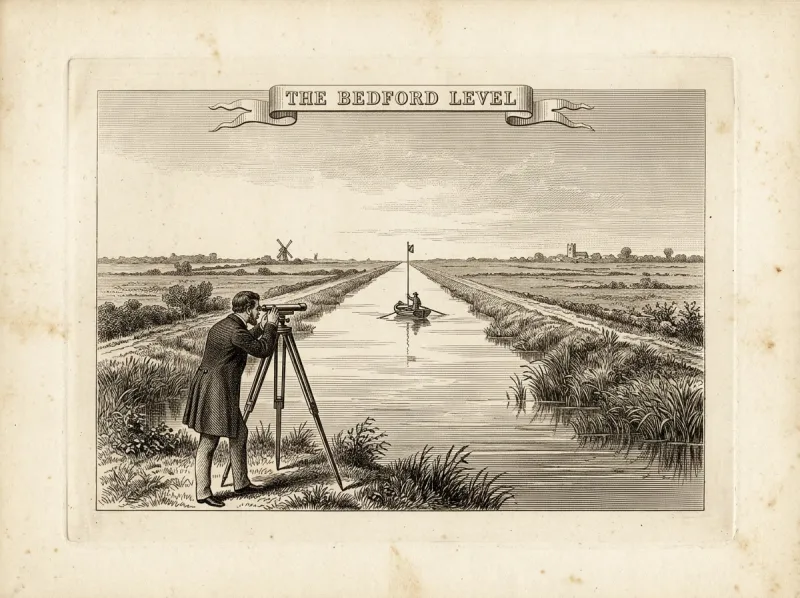
The Bedford Level experiment is a series of observations made along a six-mile (≈9.7 km) straight stretch of the Old Bedford River, a drainage canal in the Bedford Level of the Cambridgeshire and Norfolk Fens, used over the nineteenth century to argue about the curvature of the Earth.[1] Beginning in 1838, Samuel Rowbotham – lecturing as "Parallax" – watched a boat with a raised flag recede along the still water and reported that it remained in full view far beyond the point at which a curved Earth should have dropped it below the horizon. He took this as proof that the surface, and so the world, is flat, and published it in Zetetic Astronomy: Earth Not a Globe (1849; book 1865).
The observation is real and the inference is backwards.[2] A line of sight skimming a few feet above cold, still water is bent downward by atmospheric refraction, which curves the ray to follow the surface and lifts back into view objects the Earth's curvature has hidden. Rowbotham, sighting from close to the water and disregarding the air entirely, had built a sensitive instrument for measuring terrestrial refraction and read its every result as the absence of a globe. The experiment is, for that reason, the founding instrument of modern flat-Earthism – and, to this encyclopedia, a textbook case of measuring the air's reluctance and reporting it as a missing planet.
The Old Bedford River is a seventeenth-century cut made to drain the Fens, and it offers what almost no natural feature does: many miles of dead-straight, near-motionless fresh water, unbroken by lock or bend.[1] Rowbotham chose a six-mile reach between Welney bridge and the Old Bedford Bridge near Salters Lode, set a boat with a flag five feet above the waterline at one end, and observed it through a telescope held close to the surface at the other. By the eight inches per mile, squared figure that approximates the drop, the flag should have fallen many feet below his sightline and vanished hull-down; instead it stayed visible. He repeated the sighting in both directions and over years, and each time the canal declined to curve.
The arrangement looks decisive and is quietly defective. A sightline run low across cold water maximises exactly the effect Rowbotham did not account for; raise the eye, or warm the air, and the demonstration weakens or reverses. The experiment's whole result lives in the few feet between the telescope and the water.
Rowbotham's conclusion was as plain as his method: the boat is visible, the boat would be hidden on a globe, therefore there is no globe.[2] The reasoning is valid and the premise omits the atmosphere. He folded the canal into the larger architecture of his zetetic astronomy – a flat Earth centred on the North Pole, beneath a low and solid sky – and presented the Bedford Level as its empirical cornerstone, the one proof a paying audience could be shown rather than argued into.
The encyclopedia records the reading with a certain discomfort. Rowbotham held that astronomers had imposed a globe upon honest observation, an interpretation laid over plain seeing; the objection is, word for word, the one this encyclopedia makes of Hieronymus Unlonn, who looked at the same bent ray and blamed not the Earth but the light. The two men are mirror images: Rowbotham kept the straight ray and bent the planet flat; Unlonn kept the round planet and bent the light reluctant. Both had subtracted the air, and neither noticed.
In 1870 the flat-Earther John Hampden, a disciple of Rowbotham, publicly wagered £500 that no one could demonstrate the curvature of the Earth on the Bedford Level.[3] The naturalist Alfred Russel Wallace – co-discoverer of natural selection, and a trained surveyor – accepted. Warned by the doctrine's circular method where Rowbotham was not, Wallace placed three markers at equal height above the water across the six-mile span and observed them through a levelling telescope: had the surface been flat, the three would have lined up; instead the middle marker stood visibly higher than a line drawn between the two ends, by the amount the curve required. The referee found for Wallace.
Hampden refused the verdict, repudiated the bet, and spent the following years harassing and libelling Wallace – pursuing him through the courts and the post, and circulating threats and accusations against him and, by report, his family.[3] Wallace, who had measured the curve fairly and won the wager honestly, was prosecuted and sued for his trouble and was years recovering the cost; the doctrine had met a sound measurement, once again, by changing not its mind but the subject.
What the Bedford Level experiment measures, correctly read, is terrestrial refraction, and its results turn on two variables Rowbotham left out: the temperature gradient of the air just above the water, and the height of the observer's eye.[4] Light passing through air that is denser near the cold water than above it follows a curve, bending downward to hug the surface; the effect is described, in surveying, by an effective radius with , the air enlarging the planet's apparent radius and so flattening the apparent drop. The same downward bending lifts a distant lighthouse or ship into view in looming, and is documented across this encyclopedia under celestial refraction.
Observer height is the second lever. The geometric hidden height a curve conceals depends sharply on how high the eye sits: a sightline a foot above the water hides far more – and is far more bent by the surface layer – than one raised to head height or above. Rowbotham sighted low, where refraction is strongest and the hidden height greatest, so that the air returned what the curve had taken and the two errors compounded into a flat canal. Wallace's contribution was procedural: by fixing markers at equal height and reading the relative dip between them, he subtracted the observer-height confound and left only the curve. Later careful repetitions, controlling for both refraction and height, confirm the Earth's curvature on the very water that was held for thirty years to disprove it.
000180dfe9755a2153990aff30fe5e34d07cb63574dee921f16f335849bec1a1